How to Read a Syllabus So You Never Miss a Deadline
Drop your syllabus here
Every assignment, exam, and reading on your calendar in about 30 seconds. Free, no account.
PDF, Word, or a photo of a paper one. No syllabus handy? See a sample
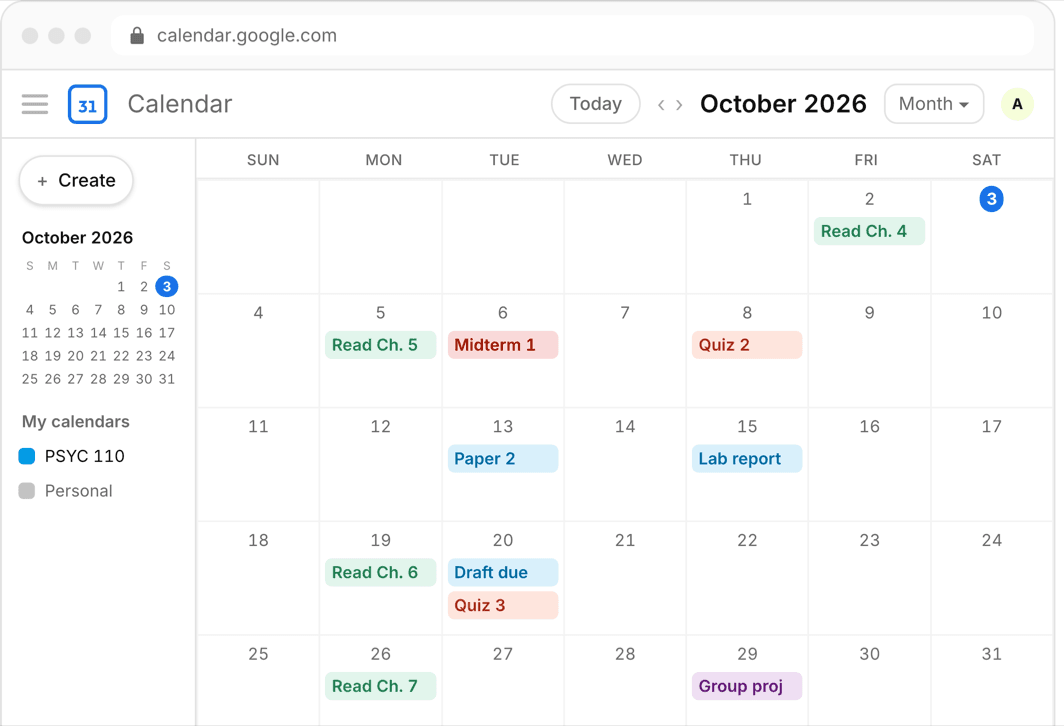
You get four to six syllabi the first week of the semester, skim each one for about thirty seconds, and never open them again. That is the single most expensive habit in college — because half of your grade and every deadline that matters is buried in those documents.
This guide walks through how to actually read a syllabus: which sections move your grade, what to extract, and how to turn a wall of PDF text into a calendar you can trust.
Or skip all of it
Upload the syllabus. Get the calendar.
Every assignment and exam on Google, Apple, or Outlook in about 30 seconds. One syllabus free, no account, no card.
Start with the grading breakdown, not the schedule
Before you look at a single due date, find the grading table. It usually lives on page one or two and tells you exactly how your final grade is calculated — for example: 40% exams, 30% papers, 20% problem sets, 10% participation.
This is the most important section because it tells you where to spend your effort. A 30% paper deserves far more attention than a stack of 2% reading quizzes, even though the quizzes feel more urgent week to week.
Extract every graded item and its weight
Go through the syllabus and list every graded item: each exam, paper, project, problem set, quiz, and participation component. Next to each one, write its weight and its due date.
- Exams and midterms — usually the largest single chunk of your grade
- Papers and projects — high weight, long lead time, easy to underestimate
- Problem sets and homework — frequent, lower individual weight, adds up fast
- Quizzes — often tied to assigned readings
- Participation and attendance — silent grade-killers if you ignore them
Find the policies that can sink you
Most syllabi contain a few policies that can cost you a letter grade if you miss them. Read these carefully: the late-work policy, the attendance/absence policy, the academic integrity rules, and how the professor wants to be contacted.
Pay special attention to anything phrased as "no exceptions" — a no-late-work policy or a hard cap on absences. These are the rules professors enforce most strictly.
Map the reading schedule to real dates
The reading schedule is where students lose the most ground. "Read Chapter 4 by Tuesday" rarely makes it onto a calendar, so it gets skipped — and then the quiz on Chapter 4 is a surprise.
Convert every "by [day]" into an actual calendar date for the current semester, and treat reading deadlines as real deadlines, not suggestions.
Turn it into a calendar in one pass
Once you have every graded item, weight, and date, put all of it into one calendar so you can see the whole semester at once. The goal is to never be surprised — to know on week one that there is a 25% paper due in week nine.
This is exactly what Classmaite automates: you drop in the PDF and it extracts the assignments, exam dates, grading breakdown, and reading schedule, then pushes them to Google Calendar, Apple Calendar, or an .ics file in about thirty seconds.
Frequently asked questions
What is the most important part of a syllabus?
The grading breakdown. It tells you exactly how your final grade is calculated, so you know where to focus your effort before you ever look at a due date.
How long should it take to read a syllabus properly?
Reading it carefully and extracting every graded item, weight, and policy takes about 15–20 minutes per course by hand. A syllabus parser like Classmaite does it in about 30 seconds.
Should I put my syllabus on a calendar?
Yes. Putting every assignment, exam, and reading deadline on one calendar is the single best thing you can do to avoid week-12 panic and surprise deadlines.