How to Add Your Syllabus to Google Calendar
Quick answer
Google Calendar cannot read a PDF syllabus, so you have three options: type each deadline in by hand (15–30 minutes per class), put the dates in a spreadsheet and import it as a CSV under Settings → Import & export, or upload the PDF to a syllabus parser like Classmaite, which pulls out every assignment and exam and adds them to Google Calendar in about 30 seconds.
Drop your syllabus here
Every assignment, exam, and reading on your calendar in about 30 seconds. Free, no account.
PDF, Word, or a photo of a paper one. No syllabus handy? See a sample
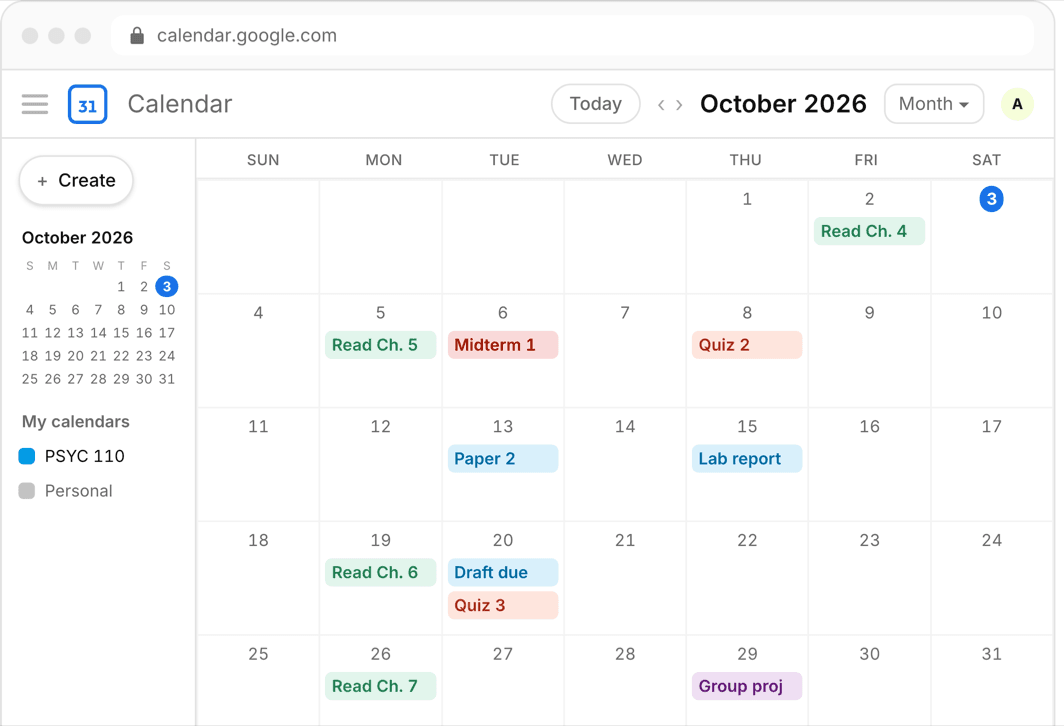
Your syllabus lists every deadline of the semester. Google Calendar is where you actually live. The problem is getting one into the other without spending an hour typing dates.
Here are the three realistic ways to add a syllabus to Google Calendar, from slowest to fastest, with the exact steps for each — plus the one setup step that makes all three easier to live with.
Or skip all of it
Upload the syllabus. Get the calendar.
Every assignment and exam on Google, Apple, or Outlook in about 30 seconds. One syllabus free, no account, no card.
Before you start: make one calendar per class
Whichever method you use, put each course on its own calendar instead of dumping everything into your main one. In Google Calendar on a computer, click the + next to "Other calendars", choose "Create new calendar", and name it after the class (for example "BIO 1010").
This gives every class its own color, lets you hide a class with one click, and — most importantly — means that if an import goes wrong you can delete that one calendar and start over, instead of hunting down forty stray events.
- Open the new calendar’s settings and set its default notifications before adding anything, so every deadline gets a reminder
- Use all-day events for due dates and timed events for exams, so exams show up with their real start time
Option 1: Add each deadline by hand
Open Google Calendar, click the due date, and create an event for every assignment, exam, and reading deadline. Give it a clear title ("BIO 1010 — Lab report 3"), pick the class calendar you just made, and add a reminder a few days before.
It works, but it is slow — expect 15–30 minutes per course — and it is the most error-prone, because you are copying dates from a PDF one at a time. A syllabus that says "Week 9, Thursday" also means doing the date math yourself.
Option 2: Build a CSV and import it
Google Calendar can import a CSV file, which is faster when you have several classes. Make a spreadsheet in Google Sheets or Excel where the first row is exactly these headers, then add one row per deadline:
- Subject — the event title, e.g. "PSYC 2000 — Midterm 1" (required)
- Start Date — in MM/DD/YYYY format, e.g. 10/14/2026 (required)
- Start Time — e.g. 2:00 PM (leave blank for an all-day deadline)
- All Day Event — True for due dates, False for timed exams
- Description — optional notes like the weight ("20% of grade") or the chapters covered
How to import the CSV into Google Calendar
Download the spreadsheet as a .csv file (in Google Sheets: File → Download → Comma-separated values). Then, on a computer — the Google Calendar phone app cannot import files — go to Settings (the gear icon) → Import & export → Import, choose your CSV, pick the class calendar as the destination, and click Import.
If the import fails or events land on the wrong days, the cause is almost always the date format or a misspelled header. Fix the spreadsheet, delete the class calendar, recreate it, and import again. The same Import screen also accepts .ics files, which is what most syllabus tools and LMS exports produce.
Option 3: Auto-parse the syllabus (about 30 seconds)
The fastest option is to let a syllabus parser read the PDF and create the calendar for you. You upload the syllabus, the tool extracts assignments, exams, and reading deadlines, and sends them to Google Calendar — or hands you an .ics file that works with Apple Calendar and Outlook too.
Classmaite does this in about thirty seconds and lets you review and edit anything before it syncs, so you are never trusting a black box with your grade. Its events go on their own calendar inside your Google account, so they never tangle with your personal events.
Add your class meeting times, too
A syllabus usually lists deadlines, not when the class meets. For the meeting times, create one event for the first class, set it to repeat with "Custom" → weekly on the right days (for example Monday, Wednesday, Friday), and set it to end on the last day of classes. Do this once per course and your week view shows both where you need to be and what is due.
Which method should you use?
If you have one simple syllabus and time to kill, hand-entry is fine. If you have four to six courses — which is most students — the manual and CSV routes turn into an hour of tedious typing in the first week of the semester, exactly when you have the least time.
Automating it is the difference between "I’ll do it later" (and never doing it) and having your whole semester on your calendar before your first class. Whichever route you pick, check the calendar against the syllabus once, then again whenever your professor announces a change.
Frequently asked questions
Can Google Calendar import a syllabus directly?
Not on its own — Google Calendar can import a CSV or .ics file, but it cannot read a PDF syllabus. You either build the CSV by hand or use a syllabus parser like Classmaite that generates the calendar for you.
What file format does Google Calendar accept for import?
Google Calendar imports CSV and iCal (.ics) files, from Settings → Import & export on a computer. Classmaite can export an .ics file or add events to Google Calendar directly.
Can I import into Google Calendar from my phone?
No. The Google Calendar app for iPhone and Android cannot import files, so do the import from a computer. Once the events are in, they sync to your phone automatically.
How do I undo a bad import?
Google Calendar has no one-click undo for imports. That is why you should import each class into its own calendar: if something goes wrong, delete that calendar and every event from the import goes with it.
How do I get my Canvas deadlines into Google Calendar?
Canvas has a calendar feed you can subscribe to from Google Calendar, but it only includes what your professor has entered into Canvas — often not the readings or exams listed in the syllabus. Adding the syllabus itself fills those gaps.
Will the deadlines sync to my phone?
Yes. Once events are in Google Calendar (or any calendar that reads .ics), they sync to your phone, laptop, and any device signed into that account.