College Freshman Advice That Actually Matters
Quick answer
The freshman advice that actually matters: build a deadline system in week one instead of relying on memory, go to office hours before you need help, treat your syllabus as a contract, and choose your habits and people deliberately in the first month — because the defaults you set in September tend to stick all year.
Drop your syllabus here
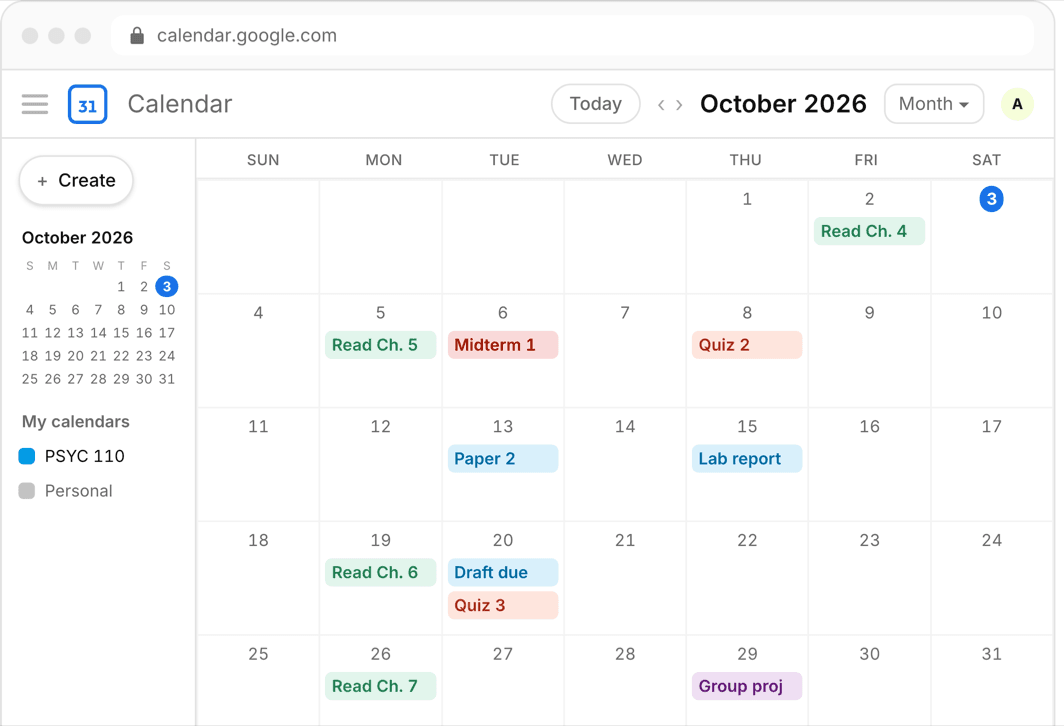
Every assignment, exam, and reading on your calendar in about 30 seconds. Free, no account.
PDF, Word, or a photo of a paper one. No syllabus handy? See a sample
Most freshman advice is useless because it’s either obvious (“go to class”) or vague (“get involved!”). You’ve heard it all at orientation. What nobody tells you is which few decisions actually compound — the ones where a small choice in week one quietly shapes your entire year.
This is that list. Not 40 tips — the handful that separate students who are thriving by October from students who are drowning by midterms. Systems, people, and professors. That’s the whole game.
Or skip all of it
Upload the syllabus. Get the calendar.
Every assignment and exam on Google, Apple, or Outlook in about 30 seconds. One syllabus free, no account, no card.
Build a system before you need one
In high school, teachers reminded you about everything. In college, your professor mentions the midterm once — on page 6 of the syllabus, in week one — and never again. The students who fall behind aren’t less smart; they’re relying on memory in an environment designed to punish that.
Week one, before the work starts: go through every syllabus and put every assignment, exam, and reading deadline somewhere you’ll actually look — a calendar, a planner, an app, anything external to your brain. This one hour is the highest-ROI hour of your semester. When week 9 hits and three things are due in four days, you’ll see it coming two weeks out instead of the night before.
Office hours are the biggest cheat code nobody uses
Office hours are scheduled time where an expert in your course sits in a room, often alone, waiting to help you specifically. Most students never go. The ones who do get their questions answered, get graded by someone who knows their name, and — two years later — have professors who can write them real recommendation letters instead of form letters.
Go in the first three weeks, before you’re struggling. Introduce yourself, ask one genuine question about the material, and leave. That’s it. You’ve just become one of the five students the professor recognizes, and every future interaction gets easier.
The people math of your first month
The first four weeks of college are the only time in your life when everyone is actively looking for friends. Say yes to things in September that you’d skip in November. The activation energy for meeting people goes up 10x once friend groups solidify — so front-load it.
- Pick 1–2 clubs and actually show up repeatedly; recurring exposure beats one-off events for making real friends.
- Get one contact in every class by week two. You will need the notes from a day you missed. This is insurance.
- Your roommate doesn’t have to be your best friend. Aim for “considerate coexistence” and treat anything more as a bonus.
- Notice who makes you feel worse after hanging out. You’re allowed to quietly drift from people you met in week one.
Protect the boring fundamentals
Sleep, food, and movement sound like mom advice until you watch your first all-nighter destroy three days of productivity. Your GPA is downstream of your energy, and your energy is downstream of boring habits.
- Sleep is a study strategy. Memory consolidates during sleep; the all-nighter before an exam is literally counterproductive.
- Schedule classes for who you actually are. If you’ve never once been a morning person, the 8am section will not fix you.
- Treat class attendance as non-negotiable, even when it’s not graded. Skipping is a habit that compounds in the wrong direction.
- Learn where the quiet study spots are before midterms, when the library becomes a war zone.
Money and credits: two quiet traps
Two mistakes cost freshmen real money and time. First, ignoring the add/drop deadline — the date after which dropping a class goes from free to a “W” on your transcript (or worse, a tuition bill you can’t recover). Find that date for your school and put it somewhere visible.
Second, drifting through course selection. Meet your academic advisor in your first semester, even if it’s not required. A 30-minute conversation can save you from taking a class that doesn’t count toward anything, or from missing a prerequisite that delays your major by a full year.
Start ugly, start now
The meta-advice underneath all of this: freshmen who struggle usually aren’t failing at effort, they’re failing at starting. Start the paper badly three days early instead of perfectly at midnight. Ask the dumb question in week two instead of staying confused until week ten. Show up to the club meeting alone instead of waiting for a friend who never commits.
And start with the system, because it carries everything else — if building it manually sounds like a chore, Classmaite turns each syllabus into a full semester calendar in about 30 seconds, and you can run your first one free at myclassmaite.com/try with no account.
Frequently asked questions
What is the biggest mistake college freshmen make?
Relying on memory instead of a system. College professors mention deadlines once — in the syllabus — and expect you to manage the rest. Students who externalize every due date in week one consistently outperform students with equal ability who wing it.
How many hours should a freshman study per week?
The standard guideline is 2–3 hours outside class per credit hour, so roughly 24–45 hours for a 15-credit load. In practice it varies wildly by course. The more useful habit is scheduling study time like a class rather than counting total hours.
Is it normal to feel lonely as a college freshman?
Extremely. Most freshmen feel lonely at some point in the first semester, even the ones who look like they’re thriving on social media. It usually fades as recurring commitments (clubs, study groups, jobs) turn acquaintances into friends by late fall.