AI Time Management for Students: Planning, Calendar Triage, and Weekly Reviews
Quick answer
AI helps students manage time in three ways: converting a list of deadlines and commitments into a realistic weekly plan, triaging overloaded weeks by what actually affects your grade, and running a short weekly review that adjusts the plan instead of abandoning it. The prerequisite is a complete, accurate list of your deadlines — AI can’t plan around dates it doesn’t know.
Drop your syllabus here
Every assignment, exam, and reading on your calendar in about 30 seconds. Free, no account.
PDF, Word, or a photo of a paper one. No syllabus handy? See a sample
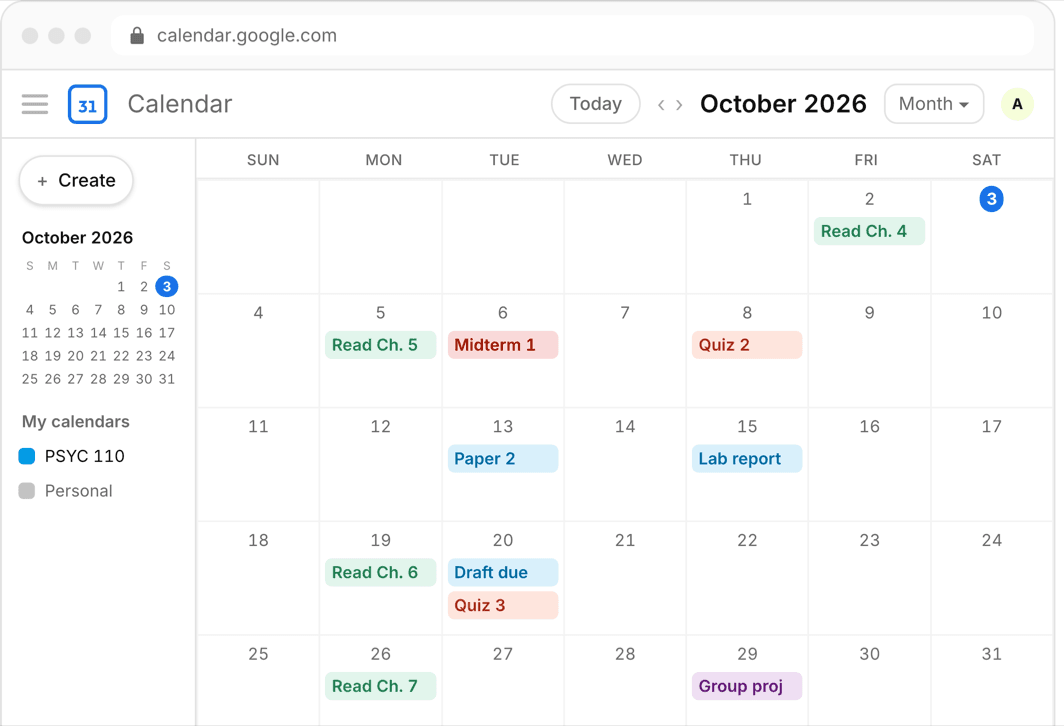
College time management fails at the same three points every semester: you don’t have all your deadlines in one place, you don’t translate them into a weekly plan, and when the plan breaks in week five you abandon it instead of adjusting it. Notice that none of these are willpower problems. They’re planning-labor problems — and planning labor is exactly what AI is good at absorbing.
This guide sets up a system where AI does the tedious parts: building the weekly plan, re-triaging when three things collide, and running the weekly review that keeps the whole thing alive past midterms. You still do the studying. You just stop doing the project management by vibes.
Or skip all of it
Upload the syllabus. Get the calendar.
Every assignment and exam on Google, Apple, or Outlook in about 30 seconds. One syllabus free, no account, no card.
What AI is actually good at (and bad at) in planning
Good at: turning a messy list of deadlines, classes, shifts, and commitments into a structured week; estimating and sequencing work backward from due dates; re-planning quickly when reality changes; being a neutral voice that says “you cannot fit nine hours of work into Thursday.”
Bad at: knowing your real energy patterns (it will cheerfully schedule deep work at 8am on a Saturday), and knowing deadlines you never told it. AI planning is garbage-in, garbage-out — which is why the system below starts with the inputs, not the prompts.
Step 1: get every deadline into one list
Before any AI planning session, you need the complete picture: every assignment, exam, quiz, and reading deadline from every syllabus, plus your fixed commitments — classes, work, practice. A plan built on 80% of your deadlines is a plan that ambushes you with the other 20%.
Do this once at the start of the semester and maintain it weekly. It’s the least fun step and the one everything else depends on.
Step 2: the weekly planning prompt
Every Sunday, paste the week into a chatbot: “Here are my fixed commitments and here’s everything due in the next two weeks, with rough hour estimates and how much each is worth. Build me a day-by-day plan with specific work blocks. Front-load the high-stakes items and leave Friday afternoon as buffer.”
Then push back — the first draft always overschedules. “I can’t study after 10pm” or “move the essay work earlier, that estimate is low” takes seconds, and two rounds of edits gets you a plan you’ll actually follow. Fifteen minutes, done.
Step 3: triage by grade impact when weeks collide
Some weeks can’t be scheduled out of — three deadlines, one exam, not enough hours. This is where students default to whatever’s due next, which is exactly wrong when the thing due next is worth 2% and the thing due Friday is worth 25%.
Give the AI the weights and let it be ruthless: “I can’t do all of this well. Here’s what each item is worth in each class and my current standing. What gets full effort, what gets a good-enough pass, what gets sacrificed?” Grade-weighted triage is an expected-value problem, and AI is a calm co-pilot for it precisely because it isn’t stressed.
Step 4: the 15-minute weekly review
Plans don’t fail from bad design; they fail from never being revisited. Sunday, same chat: what got done, what slipped, what’s newly due. Ask the AI to roll the misses forward and flag the pattern — “you’ve pushed reading twice; want to schedule it earlier in the day?”
The review reframes slippage as data instead of failure, which is the psychological trick that keeps a system alive for a whole semester. Miss a week and you restart the review, not the whole system.
Fix the input problem in 30 seconds
The weakest link in all of this is step 1 — manually mining five syllabi for every date, and keeping the list current. It’s the step most people skip, and the reason most AI plans are built on incomplete data.
It’s also the step Classmaite eliminates: drop each syllabus in and it extracts every assignment, exam, and reading deadline in about 30 seconds, then syncs them to Google Calendar, Apple Calendar, or Outlook with reminders weighted by grade impact. Your calendar becomes the reliable source your Sunday planning session reads from.
Frequently asked questions
Which AI tool is best for student time management?
Any major chatbot — ChatGPT, Claude, or Gemini — handles weekly planning and triage well; the workflow matters more than the model. The bigger differentiator is your input quality: a complete deadline list beats a better model every time. Classmaite covers that input side by extracting every deadline from your syllabi into your calendar automatically.
Can AI just manage my calendar for me?
Not autonomously in a way you should trust yet — you want to stay the editor of what lands on your calendar. The working pattern in 2026 is AI as planner and triage partner, you as the one who approves the plan and puts blocks on the calendar.
What if I fall off the system mid-semester?
Restart with one 15-minute session: current deadlines in, new weekly plan out. The system has no streak to break — that’s the point of making the weekly review the unit of the habit rather than daily perfection.