AI for Online College Classes: Structure and a Study Partner When There’s No Classroom
Quick answer
AI helps most in online classes by replacing the two things the format lacks: instant help and built-in structure. Use ChatGPT, Claude, or NotebookLM as an always-available TA for questions the discussion board would take days to answer, and use AI-assisted planning to turn the syllabus into a weekly schedule you actually follow.
Drop your syllabus here
Every assignment, exam, and reading on your calendar in about 30 seconds. Free, no account.
PDF, Word, or a photo of a paper one. No syllabus handy? See a sample
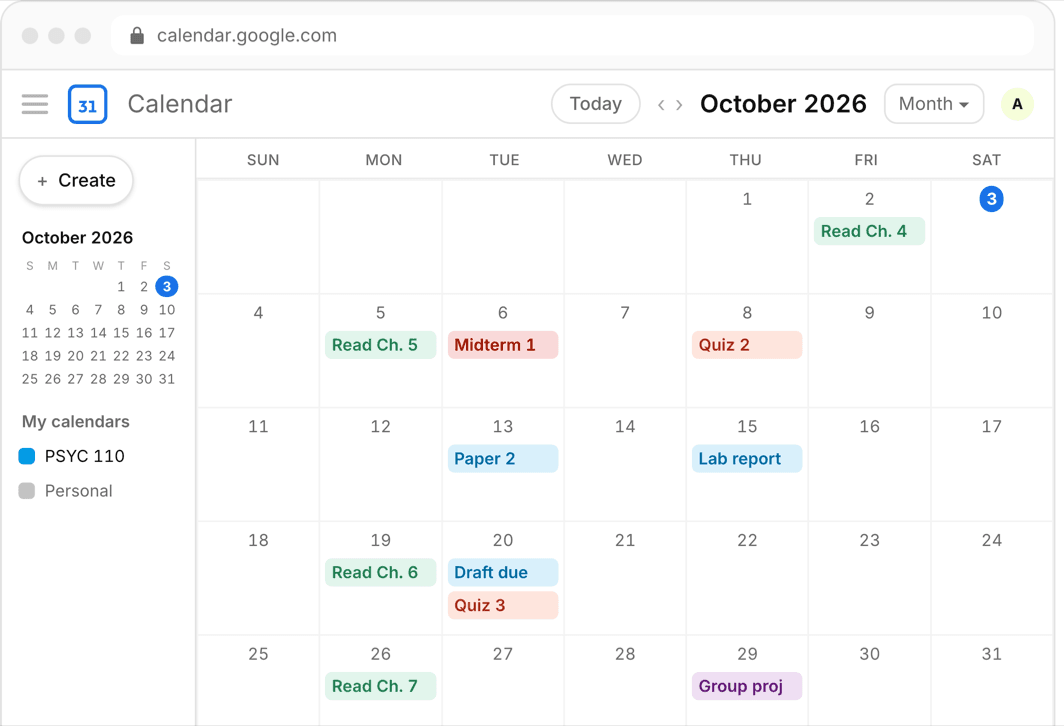
Online classes fail students in a predictable way. It’s rarely the material — it’s the missing scaffolding. No fixed class time anchoring your week, no professor noticing you’re lost, no classmates catching a deadline you missed. The course is a folder of PDFs and a due-date list, and the structure is your job now.
AI is unusually well-suited to filling exactly these gaps. It answers questions at 11pm on a Sunday when the discussion board is a ghost town, plays the study partner you don’t have, and helps convert a syllabus into a week-by-week plan. Here’s the setup that makes an online course feel less like solitary confinement.
Or skip all of it
Upload the syllabus. Get the calendar.
Every assignment and exam on Google, Apple, or Outlook in about 30 seconds. One syllabus free, no account, no card.
Why online classes are genuinely harder
In-person courses smuggle in structure you don’t notice until it’s gone: showing up twice a week forces spaced exposure to the material, lectures broadcast what the professor thinks matters, and hallway conversations surface deadlines. Online, all of that arrives as a syllabus you read once in week one.
The failure mode is always the same — three quiet weeks, then a panicked discovery that a paper, a quiz, and 120 pages of reading all land on Friday. Every tactic below is aimed at that.
Build your structure from the syllabus, in week one
Everything the course expects of you is in the syllabus and module schedule — online courses are usually more front-loaded with dates than in-person ones. Extract every due date, then assign each week’s work to specific days: lectures Monday, reading Tuesday and Wednesday, assignment Thursday, buffer Friday.
AI speeds up the planning conversation: paste your weekly commitments and the course workload and ask for a realistic weekly template, then adjust when it overestimates your free time (it will). The plan doesn’t need to be perfect; it needs to exist before week two.
Use AI as the TA the course doesn’t have
When you hit something confusing in a recorded lecture, you can’t raise your hand — but you can pause and ask Claude or ChatGPT to explain it three different ways, then quiz you to confirm it landed. That closes the loop a discussion board leaves open for days.
For document-heavy courses, NotebookLM is the standout: upload the slides, readings, and transcripts, and ask questions that get answered from your actual course materials with citations — closer to office hours than to a generic chatbot.
Replace the missing discussion with self-explanation
The hidden loss in online courses is talking through ideas — explaining things to classmates is where understanding gets stress-tested. Recreate it: after each module, explain the main concepts to the AI and ask it to poke holes, or have it take the other side of the week’s discussion question and argue with you.
One integrity note: this sharpens your thinking before you write your discussion post. Having AI write the post itself is submitted work, and most syllabi treat it accordingly.
Avoid the passive traps
- Summarizing lectures you never watched — summaries preview and review; they don’t replace the exposure
- Letting AI answers substitute for attempting the homework: the attempt is the learning, especially with nobody checking
- Skipping self-testing because nothing feels urgent — quiz yourself weekly with AI even when no exam is near
- Studying only when motivated: online courses run on schedule, not motivation, which is why the week-one structure matters more than any tool
Put the structure where you’ll actually see it
A plan buried in the LMS is a plan you check twice a semester. The deadlines need to live where you already look every day — your phone’s calendar, next to work shifts and everything else.
That’s the 30-second fix Classmaite handles: upload the syllabus (PDF, Word doc, even a screenshot), it extracts every assignment, quiz, exam, and reading deadline, you review, and it syncs to Google Calendar, Apple Calendar, or Outlook with reminders weighted by grade impact. For a class no one reminds you about, the reminders are the attendance policy.
Frequently asked questions
Do online classes have stricter AI rules than in-person ones?
Not inherently, but online courses assess more through submitted work (posts, quizzes, papers) and less through in-room exams, so more of your graded output falls under AI-policy rules. Read the syllabus policy carefully and note that online quizzes usually prohibit AI just like in-person exams do.
What’s the best AI tool for online classes specifically?
NotebookLM pairs unusually well with online courses because they come as a pile of PDFs, slides, and transcripts — exactly what it’s built to ingest and answer from. Add ChatGPT or Claude for interactive tutoring and self-quizzing.
How do I stop procrastinating in an online class?
Stop relying on willpower and start relying on structure: fixed weekly time blocks per course, every deadline in your daily calendar with reminders, and a weekly self-quiz that creates urgency before the exam does. Procrastination thrives on invisible deadlines; make them visible.