AI Lecture Transcription: Record, Transcribe, and Turn Lectures Into Notes
Quick answer
To transcribe lectures with AI, first get your professor’s permission to record — recording policies and consent laws vary — then capture audio with a tool like Otter.ai, which transcribes in real time. The transcript alone is a wall of text; the value comes from the second step of turning it into structured notes and self-quiz questions with a chatbot.
Drop your syllabus here
Every assignment, exam, and reading on your calendar in about 30 seconds. Free, no account.
PDF, Word, or a photo of a paper one. No syllabus handy? See a sample
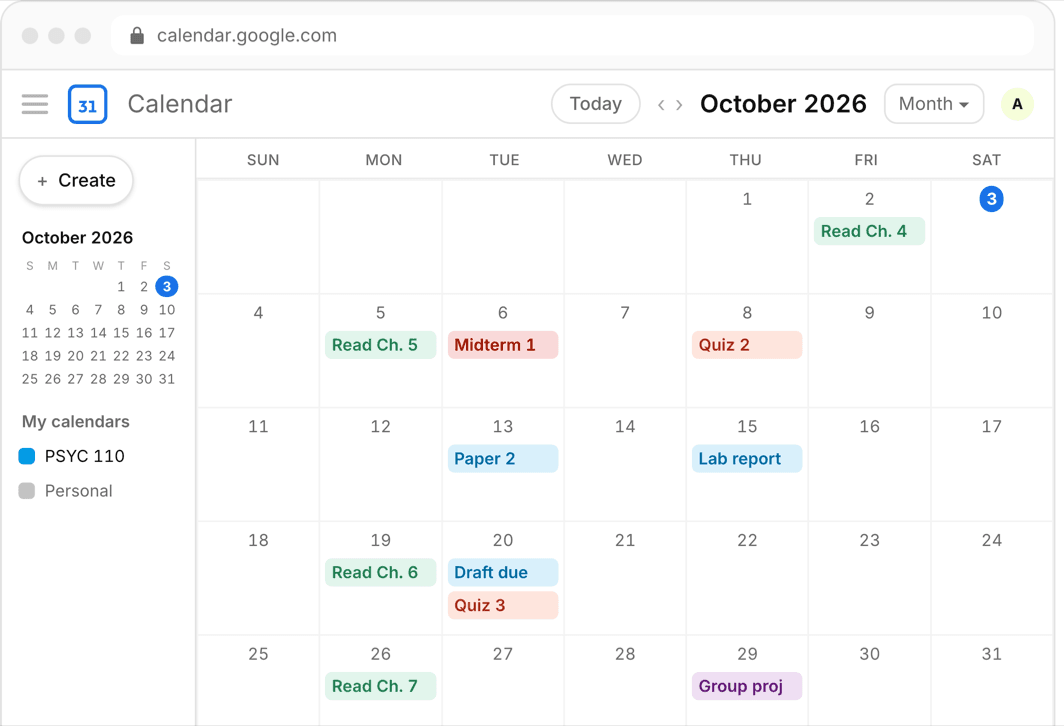
Lecture note-taking forces a bad trade: write fast enough to capture everything and you stop processing what’s being said; listen deeply and you miss half the board. Transcription dissolves the trade — the capture happens automatically, freeing you to actually think during the lecture and marking down only what the transcript can’t hold, like diagrams and emphasis.
Two things separate students who benefit from this and students who don’t. The first is asking permission before recording, which is not optional. The second is what happens after class: a raw transcript is a 6,000-word wall of text nobody rereads, and the entire payoff lives in the ten-minute AI workflow that turns it into notes and quiz questions.
Or skip all of it
Upload the syllabus. Get the calendar.
Every assignment and exam on Google, Apple, or Outlook in about 30 seconds. One syllabus free, no account, no card.
Before you record: permission, always
Recording a lecture without permission can violate your professor’s rights, university policy, and — in states requiring all parties’ consent — recording law. Professors also have legitimate reasons to say no, from guest-speaker agreements to discussion-heavy formats where recording chills participation.
So ask, in person or by email: “Would it be alright if I record lectures for my own note-taking? I won’t share the recordings.” Most professors say yes to that framing. If you have an accommodation through your disability services office, recording rights may already be covered — that office is the right channel. And check whether lectures are already recorded through the LMS, which makes the whole question moot.
Capturing and transcribing
Otter.ai is the established tool for this job: it records and transcribes in real time, letting you highlight moments live, and its free tier covers a few of your hardest lectures a month — ration it by course difficulty rather than recording everything.
Practical capture notes: sit close for audio quality, expect technical vocabulary to be mis-transcribed (skim-correct key terms after class while memory is fresh), and treat the transcript as a supplement to attendance, not a substitute. During lecture, note what audio can’t capture: board diagrams, slide references, and anything the professor says will be on the exam.
The 10-minute transcript-to-notes workflow
Same day as the lecture, paste the transcript into ChatGPT or Claude — or upload it to NotebookLM alongside the slides — and run three prompts. First: “Turn this into structured notes: main concepts, definitions, examples, and anything flagged as exam-relevant.” Second: “List anything mentioned but not fully explained that I should look up.” Third: “Write five quiz questions from this lecture and hold the answers until I try.”
The quiz is the step that converts transcription from archiving into studying — answering those five questions the same day is worth more than rereading the notes twice. By exam time, you have a semester of consistent notes plus a question bank generated from exactly what your professor said.
The traps
- Skipping class because “the transcript has it” — the transcript captures words, not the diagram, the emphasis, or the aside about what’s on the midterm; capture replaces writing, not attending
- Never processing transcripts: raw walls of text pile up unread — the same-day ten-minute workflow is the whole game
- Trusting transcripts verbatim in technical courses: mis-transcribed formulas and terms will poison your notes if you never skim-correct
- Sharing recordings: permission to record for yourself is not permission to distribute — posting a professor’s lecture can violate policy and their intellectual property
- Recording discussion sections without classmates’ consent — seminars where students speak raise consent questions a lecture hall doesn’t
Close the loop: notes need deadlines attached
Transcription solves capture; it doesn’t tell you when to study what you captured. A perfect archive of lecture notes still fails you if the exam it was meant for shows up ten days earlier than you thought.
Pair the workflow with Classmaite: drop your syllabus in and every exam, assignment, and reading deadline is extracted in about 30 seconds and synced to Google Calendar, Apple Calendar, or Outlook, with reminders weighted by grade impact. The reminder fires, and the lecture notes and quiz bank you built all semester are sitting there waiting — that’s the whole system working.
Frequently asked questions
Is it legal to record my college lectures?
It depends on your state’s recording-consent law, your university’s policy, and your professor’s permission — three separate hurdles. The safe universal path is simply asking the professor first; with permission for personal note-taking use, you’re on solid ground almost everywhere. Students with accommodations should route the request through disability services.
What’s the best AI tool for transcribing lectures?
Otter.ai is the standard choice — real-time transcription with a usable free tier. The bigger lever than tool choice is the post-processing: any transcript pasted into ChatGPT, Claude, or NotebookLM becomes structured notes and quiz questions, which is where the studying value actually is.
Can I just read transcripts instead of going to lecture?
It’s a bad trade. Transcripts miss the visual half of lectures — board work, slides, demonstrations — plus emphasis and exam hints, and skipping breaks the spaced exposure that makes material stick. Use transcription to listen better in class, not to be somewhere else.