AI Exam Prep: Turn Your Notes and Past Exams Into Practice Tests
Quick answer
To prep for an exam with AI, feed your lecture notes, slides, and any released past exams into a tool like ChatGPT, Claude, or NotebookLM and ask it to generate practice questions in the same format as the real exam. Answer them closed-book, then have the AI grade your answers and explain every miss.
Drop your syllabus here
Every assignment, exam, and reading on your calendar in about 30 seconds. Free, no account.
PDF, Word, or a photo of a paper one. No syllabus handy? See a sample
Rereading notes feels like studying. It isn’t. Decades of research on retrieval practice show that testing yourself beats rereading by a wide margin — and AI has quietly made unlimited practice tests free. Any chatbot can turn your own notes into exam-style questions in about a minute.
The catch is that most students use AI backwards: they ask it to explain things and nod along, which is just rereading with extra steps. This guide covers the workflow that actually works — source material in, realistic questions out, closed-book answers, honest grading — and how to run it in the week before the exam.
Or skip all of it
Upload the syllabus. Get the calendar.
Every assignment and exam on Google, Apple, or Outlook in about 30 seconds. One syllabus free, no account, no card.
Why practice testing beats rereading
When you reread notes, everything looks familiar, so your brain files it as “known.” Familiarity is not recall. The only way to find out what you can actually produce under exam conditions is to close the notes and try — and every failed attempt strengthens the memory more than a successful reread would.
AI removes the two things that used to make self-testing painful: writing the questions and checking the answers. You supply the material, it supplies the test.
Gather your source material first
A practice test is only as good as what you feed the AI. Generic “quiz me on organic chemistry” prompts produce generic questions that may not match your course at all.
- Lecture notes and slides — the single best signal for what your professor thinks matters
- Released past exams or sample questions — the gold standard for format and difficulty
- The exam’s stated format from the syllabus: multiple choice, short answer, problems, essays
- Homework and problem sets — exam questions are often harder cousins of these
- Tools like NotebookLM are built for this: upload your PDFs and it answers only from your sources
Generate a test that matches the real exam
Tell the AI exactly what the real exam looks like. A prompt that works: “Here are my lecture notes and one past exam. Write a 10-question practice exam in the same format and difficulty. Don’t show me the answers yet.” The last sentence matters — if the answers are visible, you’ll read instead of retrieve.
If the AI’s questions feel too easy, say so: “Make these harder — the real exam asks multi-step problems, not definitions.” Iterate until the practice feels like the past exam.
Run the grade-and-explain loop
Answer every question closed-book, in writing, before you look at anything. Then paste your answers back and ask the AI to grade them strictly, explain each mistake, and tell you which topic the mistake came from.
The misses are the whole point. Ask follow-ups until you could explain the concept to someone else, then ask for three new questions on just the topics you missed. Repeat until you stop missing them.
Space it across the week — and verify against the source
One marathon session the night before is worth less than three short sessions across the week, because spacing forces re-retrieval after forgetting starts. Run a full practice test early in the week, a misses-only round midweek, and a final full test a day or two out.
One honest caveat: AI can generate a wrong answer key, especially in technical courses. If a grading explanation contradicts your notes or textbook, trust the course materials and flag the question for office hours. The practice value survives an occasional bad key; blind trust doesn’t.
Prep hardest for the exams that count most
Not all exams deserve equal effort. A final worth 40% of your grade justifies the full week-long loop; a quiz worth 5% might get one quick round. That math lives in your syllabus’s grading breakdown — most students never do it.
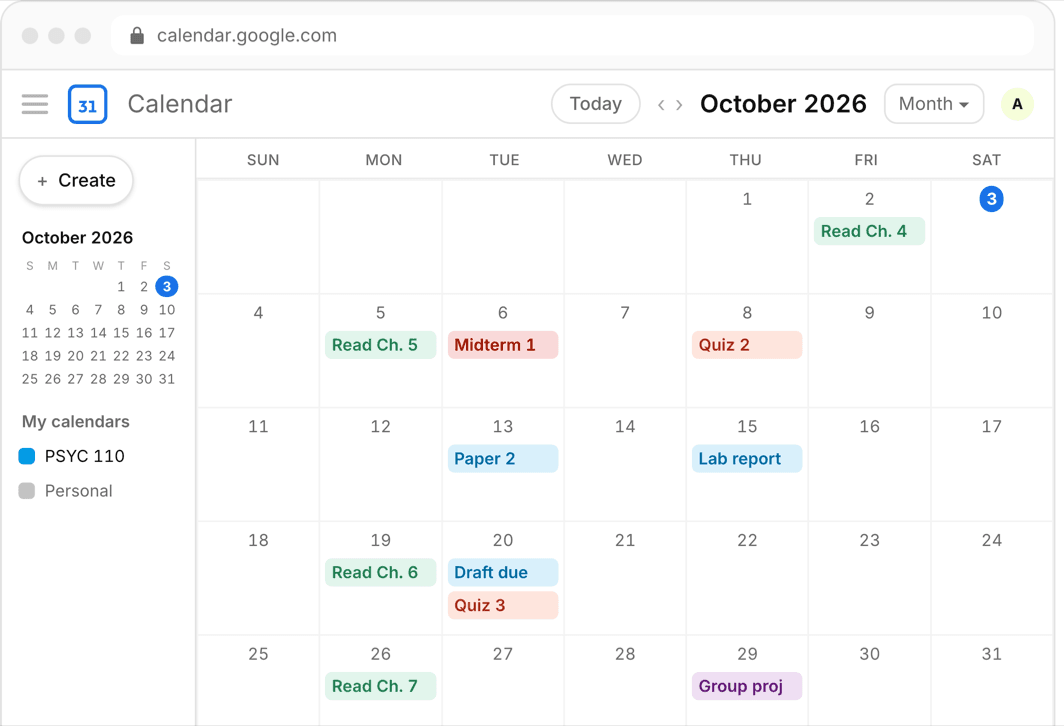
This is the part Classmaite automates: drop in your syllabus and it extracts every exam date and the grading breakdown in about 30 seconds, then syncs to your calendar with reminders weighted by grade impact. You see which exam actually moves your grade before you decide how many practice rounds it gets.
Frequently asked questions
Is using AI to make practice tests cheating?
Almost never — you’re testing yourself on course material, not submitting AI work as your own. But policies vary, so check your syllabus’s AI policy first, and never feed the AI an exam you were told not to share or an exam that’s still in use.
Which AI tool is best for exam prep?
NotebookLM is strongest when you have lots of PDFs, because it answers only from your uploaded sources. ChatGPT and Claude are better for interactive back-and-forth grading and follow-up explanations. Many students use both: NotebookLM to study the material, a chatbot to run the practice-test loop.
How many practice tests should I take before an exam?
Two to three full rounds spaced across the week before the exam, plus short misses-only rounds in between. One test tells you what you don’t know; the repeats are what fix it.