ChatGPT Prompts for Studying: Patterns That Teach Instead of Answer
Quick answer
The best ChatGPT prompts for studying make the AI ask you questions rather than answer yours: “Quiz me on [topic], one question at a time, and don’t reveal the answer until I’ve tried.” Prompts that request Socratic tutoring, strict grading, or explain-it-back checks build recall; prompts that just ask for answers don’t.
Drop your syllabus here
Every assignment, exam, and reading on your calendar in about 30 seconds. Free, no account.
PDF, Word, or a photo of a paper one. No syllabus handy? See a sample
There are two ways to prompt an AI when you study, and they produce opposite results. “Explain photosynthesis” gets you a clean explanation you’ll nod at and forget. “Quiz me on photosynthesis and grade my answers” forces you to retrieve, which is the thing that actually builds memory.
The difference is entirely in the prompt. This guide gives you the handful of prompt patterns worth memorizing — tutor mode, quiz mode, explain-back mode — with copy-paste versions of each, and shows you the failure mode to avoid: outsourcing the thinking you’re supposed to be practicing.
Or skip all of it
Upload the syllabus. Get the calendar.
Every assignment and exam on Google, Apple, or Outlook in about 30 seconds. One syllabus free, no account, no card.
The rule: prompts that teach make you do the work
A prompt teaches when your brain produces something — an answer, an explanation, a guess — before the AI evaluates it. A prompt just answers when the AI produces everything and you read it. Reading feels productive and mostly isn’t.
Every pattern below follows the same shape: set the AI’s role, make it go one step at a time, and forbid it from revealing answers until you’ve attempted them.
The tutor pattern: Socratic, one step at a time
Use this when you don’t understand something yet. Copy-paste:
“Act as a patient tutor for [course]. I’m trying to understand [topic]. Don’t lecture me — ask me one question at a time to find out what I already know, then build from there. When I’m wrong, give me a hint before giving me the answer.”
This works in ChatGPT, Claude, and Gemini alike. The one-question-at-a-time constraint is what keeps it from collapsing into a lecture.
The quiz pattern: retrieval with strict grading
Use this once you’ve studied and want to find the gaps. Copy-paste:
“Here are my notes on [topic]. Quiz me with 8 questions in [multiple choice / short answer / problem] format, one at a time. Don’t show the answer until I respond. Grade me strictly and keep a running list of what I missed. At the end, summarize my weak spots and quiz me again on just those.”
Pasting your actual notes matters — it keeps the questions aligned with your course instead of the AI’s generic version of the subject.
The explain-back pattern: the honesty check
Use this to test understanding, not just recall. Copy-paste:
“I’m going to explain [concept] to you as if you’re a student who’s never seen it. Point out every gap, error, or hand-wave in my explanation, then ask me one follow-up question that tests whether I really understand it.”
This is the Feynman technique with an infinitely patient audience. If you can’t explain it, you don’t know it yet — better to find out now than in the exam.
Prompts to avoid — and the honest caveat
- “Solve this problem for me” before you’ve attempted it — you’re practicing reading, not solving
- “Summarize this chapter” as a replacement for engaging with it — fine as a preview, fatal as a substitute
- “Write my discussion post” — that’s submission of AI work, which most syllabi prohibit; check your course’s AI policy
- Trusting the AI’s answer key blindly — models still make confident errors, especially in math-heavy courses; verify against notes or the textbook when something feels off
Make prompting a routine, not a panic move
These patterns work best on a schedule: tutor mode when new material lands, quiz mode two days later, explain-back before the exam. The students who get the most from AI study tools run short sessions tied to actual deadlines instead of one desperate session the night before.
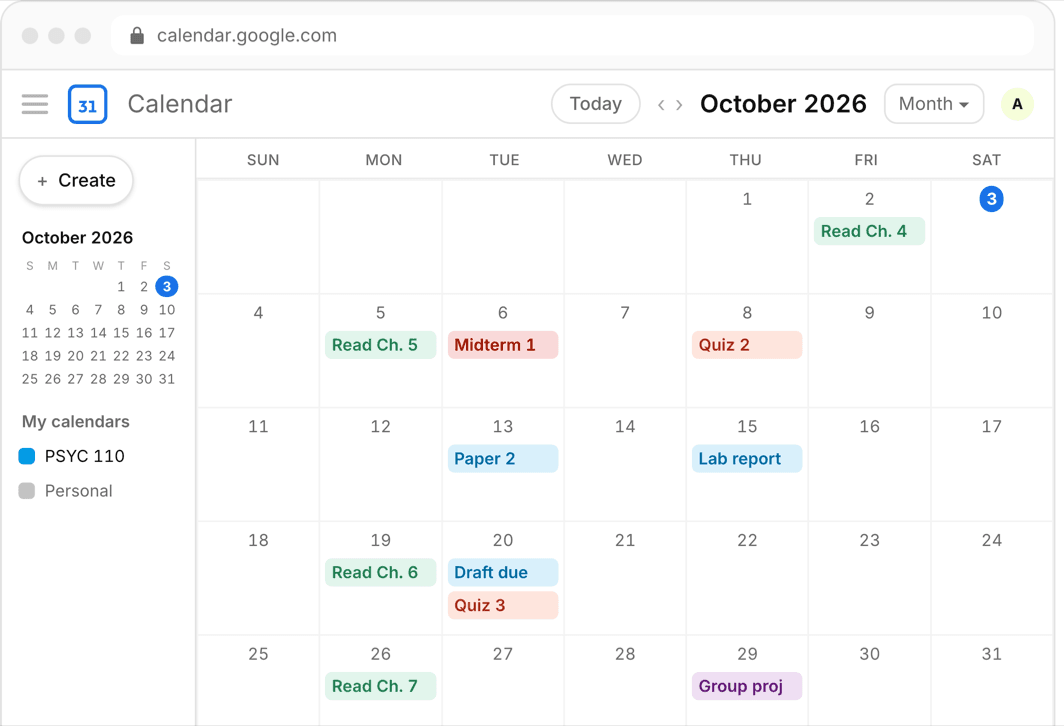
That’s easier when the deadlines are already on your calendar. Classmaite reads your syllabus and puts every exam, assignment, and reading deadline into Google Calendar, Apple Calendar, or Outlook in about 30 seconds — so “quiz me two days before each exam” becomes a reminder instead of a good intention.
Frequently asked questions
Do these prompts work in Claude and Gemini too?
Yes. The patterns — tutor, quiz, explain-back — are model-agnostic and work in ChatGPT, Claude, and Gemini. Pick whichever tool you have access to; the prompt structure matters far more than the model.
Is it cheating to use ChatGPT to study?
Studying with AI — quizzing yourself, getting explanations, checking your understanding — is allowed in most courses. Submitting AI-generated work as your own is a different act and usually isn’t. Your syllabus’s AI policy is the authority; if it doesn’t have one, ask your professor before assuming.
Why does the AI keep giving me answers instead of quizzing me?
You have to forbid it explicitly and repeat the constraint if it drifts: “one question at a time, don’t reveal the answer until I respond.” Long sessions drift more, so restart the prompt when it stops holding.