How to Use ChatGPT for Studying: 7 Workflows That Actually Work
Quick answer
The most effective ways to study with ChatGPT are asking it to re-explain concepts at different levels, generating practice questions from your notes, quizzing yourself and having it grade your answers, and building study plans. Use it to test and deepen your understanding, not to produce work you submit, and check your course’s AI policy first.
Drop your syllabus here
Every assignment, exam, and reading on your calendar in about 30 seconds. Free, no account.
PDF, Word, or a photo of a paper one. No syllabus handy? See a sample
Most students use ChatGPT the same way: paste the assignment, hope for the best. That’s both the riskiest use (check your syllabus’s AI policy — many courses ban it) and the least effective one, because it skips the part where you learn anything.
Used well, ChatGPT is closer to a patient tutor with infinite time. Here are seven workflows that hold up in practice, with prompts you can steal. Each one keeps you doing the thinking — that’s the feature, not the bug.
Or skip all of it
Upload the syllabus. Get the calendar.
Every assignment and exam on Google, Apple, or Outlook in about 30 seconds. One syllabus free, no account, no card.
Workflow 1–2: explanations that adapt to you
The baseline workflow is the adaptive explanation. Paste the concept or textbook passage that isn’t landing and ask: “Explain this like I’m a first-year who’s never seen it. Then explain it again at the level of someone about to take an exam on it.” The two-level trick matters — the simple version builds intuition, the harder version rebuilds the precision you actually need.
The second workflow is the misconception check. Instead of asking what something is, tell ChatGPT what you think it is: “Here’s my understanding of opportunity cost: [your version]. What’s wrong or missing?” This surfaces the errors rereading never catches, because rereading confirms what you already believe.
Workflow 3–4: practice questions and mock exams
Paste your lecture notes and prompt: “Write 10 exam-style questions on this material — mix of definitions, application, and one multi-step problem. Don’t show answers yet.” Answer them cold, on paper, then paste your answers back and ask for grading with specific feedback. The don’t-show-answers instruction is what turns this into active recall instead of reading.
For a full mock exam, add constraints from the real thing: “The exam is 50 minutes, 4 short-answer questions and one essay, closed book. Build a practice version from these notes.” Sit it under real conditions. One honest mock exam is worth several evenings of rereading.
Workflow 5: the Feynman loop
Explain the concept to ChatGPT in your own words as if teaching it, then prompt: “Play a skeptical student. Ask me the three follow-up questions most likely to expose gaps in my explanation.” Answer them without notes.
This is the Feynman technique with a partner who never gets bored. The gaps it exposes are precisely the ones an exam finds. When you can survive three rounds of follow-ups, you know the material.
Workflow 6–7: structuring notes and planning your week
After lecture, paste your raw notes and ask for a restructure: key concepts, how they connect, and what looks most likely to be tested. Then verify the output against your notes — ChatGPT will occasionally smooth over something you wrote or invent a connective claim. The verification pass is itself good studying.
For planning, give it your real constraints: “I have a midterm Friday covering chapters 4–6, a problem set due Wednesday, and about 2 hours a day. Build a day-by-day plan that uses practice testing, not rereading.” It’s good at spreading work backward from a deadline — the thing students are systematically bad at.
- Always verify restructured notes against the originals before trusting them
- Give planning prompts your true hours, not aspirational ones
- Ask it to schedule self-testing sessions, not “review” sessions
Guardrails, and the step before all of this
Two rules keep every workflow above legitimate. First, ChatGPT output never goes into submitted work — it quizzes you, explains to you, and plans with you, but your assignments are written by you. Second, anything factual it produces gets checked against your actual course materials, because it will state wrong things with full confidence.
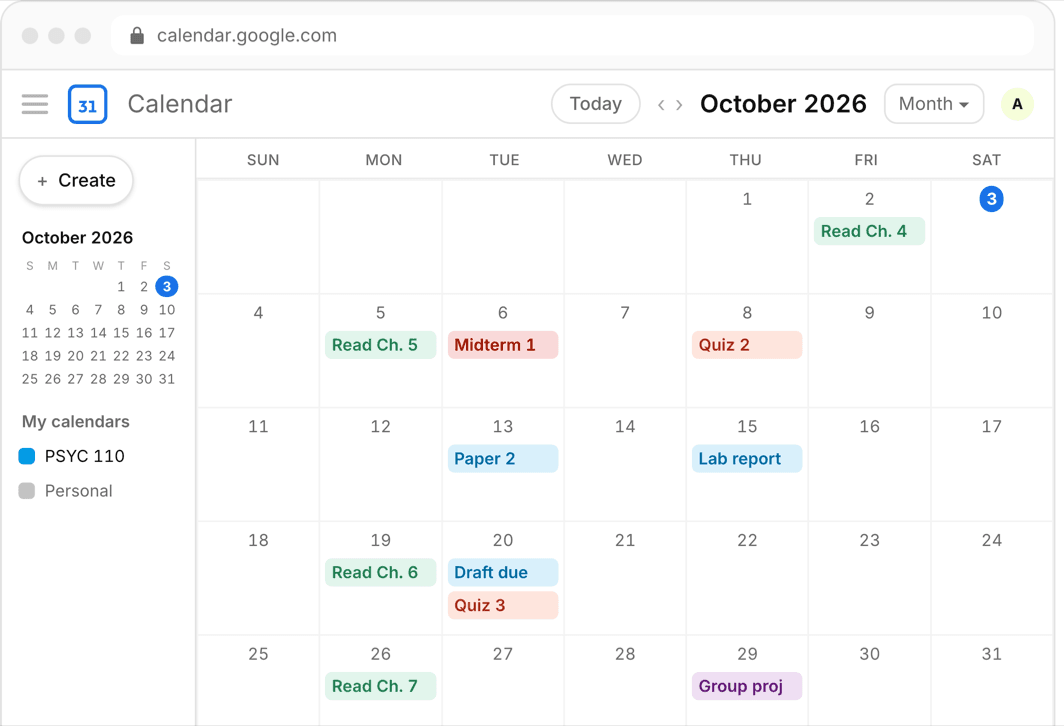
And every planning workflow depends on one input: your real deadlines. Before any of this, get them out of your syllabi and into a calendar. Classmaite automates that step — upload a syllabus and it extracts every assignment, exam, and reading with the grading breakdown in about 30 seconds, then syncs to Google Calendar, Apple Calendar, or Outlook. First syllabus is free at myclassmaite.com/try; from there, workflows 6 and 7 have real dates to work with.
Frequently asked questions
Is studying with ChatGPT considered cheating?
Using ChatGPT to explain concepts, quiz you, or plan your study time is studying, and almost no policy prohibits it. Using it to write or substantially produce graded work usually is cheating. The boundary is set per course, so read each syllabus’s AI policy before assuming anything.
How accurate is ChatGPT for studying?
Good but not trustworthy by default. It’s strong at explanations and question generation, but it can state incorrect facts, botch multi-step math, and invent citations with total confidence. Treat it like a smart study partner who is sometimes confidently wrong — verify anything checkable against your course materials.
Do I need ChatGPT Plus to study effectively?
No. The free tier handles explanations, practice questions, and planning fine for most courses. Paid tiers get you more capable models and higher limits, which matter most for long documents and heavy daily use — worth it for some students, not a prerequisite.