ChatGPT vs Claude for Students: Which Should You Study With?
Quick answer
Both are excellent study tools in 2026 and closer in quality than the internet suggests. ChatGPT has the broader feature ecosystem and is a strong all-rounder; Claude tends to shine on long readings, careful writing feedback, and following detailed instructions. Try both free tiers on your real coursework for a week and keep what fits.
Drop your syllabus here
Every assignment, exam, and reading on your calendar in about 30 seconds. Free, no account.
PDF, Word, or a photo of a paper one. No syllabus handy? See a sample
Every students-and-AI thread eventually collapses into ChatGPT-versus-Claude, and most takes you’ll read are either tribal or six months stale. The honest 2026 answer: for the core study jobs — explaining concepts, generating practice questions, giving feedback — both are genuinely good, and either one beats not using AI at all by a much wider margin than either beats the other.
The differences that do exist show up at the edges of specific study tasks, and that’s what this guide compares: tutoring, long documents, practice testing, and writing feedback, with a decision rule at the end. Everything here assumes study use within your courses’ rules — both tools will cheerfully write your essay, and your syllabus AI policy is what says whether any given use is allowed.
Or skip all of it
Upload the syllabus. Get the calendar.
Every assignment and exam on Google, Apple, or Outlook in about 30 seconds. One syllabus free, no account, no card.
The honest headline: closer than advertised
Both platforms in 2026 offer capable free tiers, paid tiers around $20/month, file and image uploads, and models strong enough for undergraduate coursework across the curriculum. Blind-preference arguments between them mostly reflect habit and prompt style, not a capability gap a student would notice week to week.
That means the switching question matters less than the workflow question. A student with good habits — attempt first, verify claims, self-test — gets more from either tool than a tool-optimizer with bad habits gets from both. Pick one, learn it well, and revisit the choice if a specific task keeps disappointing you.
Concept tutoring: effectively a tie
For the core loop — “explain this, now differently, now quiz me on it” — both are excellent, and preferences come down to texture. ChatGPT tends toward energetic, example-dense explanations; Claude tends toward patient, structured ones that build from first principles. Neither style is better; one will probably fit how you think.
The same tutoring rules apply to both: ask why, not just what; ask what you’re misunderstanding when an answer surprises you; and tell it not to give away solutions when you want hints. And verify — both models still state wrong things confidently, at similar rates, especially on niche course-specific details.
Long readings and documents: Claude’s home turf
Where students most often report a real difference: working over long material — a 60-page reading packet, several papers at once, a full draft of your thesis chapter. Claude handles long documents gracefully and is strong at faithful summary, cross-document comparison, and “where does this argument break” questions over big inputs.
ChatGPT handles documents well too, and for grounded work across a whole semester’s files, NotebookLM is a third option worth knowing — it answers only from what you upload and cites the passage. But if your major is reading-heavy — philosophy, history, law-track, literature — Claude is the one to try first.
Practice questions and problem sets: pick by subject shape
Both generate strong practice questions from pasted notes and both handle undergraduate STEM problems well, with the same caveat: confident arithmetic slips still happen, so verify anything load-bearing. ChatGPT’s broader ecosystem — study modes, voice, integrated tools — gives it an edge for students who want structured drilling without designing their own prompts.
Claude’s edge is instruction-following: “quiz me one question at a time, don’t reveal answers until I commit, get harder as I get things right” tends to be followed precisely over long sessions. If you build custom study routines in plain text, that reliability is worth a lot.
Writing feedback: both good, same integrity line
For feedback on writing you did — where the argument sags, what’s asserted but unsupported, whether the structure serves the thesis — both are genuinely useful. Claude has a reputation for more careful, less flattering critique on long drafts; ChatGPT is quick and concrete on shorter pieces. Grammarly still fills the narrower grammar-and-clarity lane if that’s all you want touched.
The line is identical on both platforms: feedback on your prose is study help; generated prose you submit is someone else’s work. Both tools will cross that line the moment you ask, so the discipline is yours — and the syllabus AI policy in each course defines exactly where it sits.
The verdict — and the tool neither of them replaces
Decision rule: if your coursework is reading- and writing-heavy, start with Claude. If you want the biggest feature ecosystem and an all-purpose default, start with ChatGPT. If you can’t decide, run both free tiers on one real week of coursework — same tasks, both tools — and keep the one you stopped thinking about. Many students keep both and route by task.
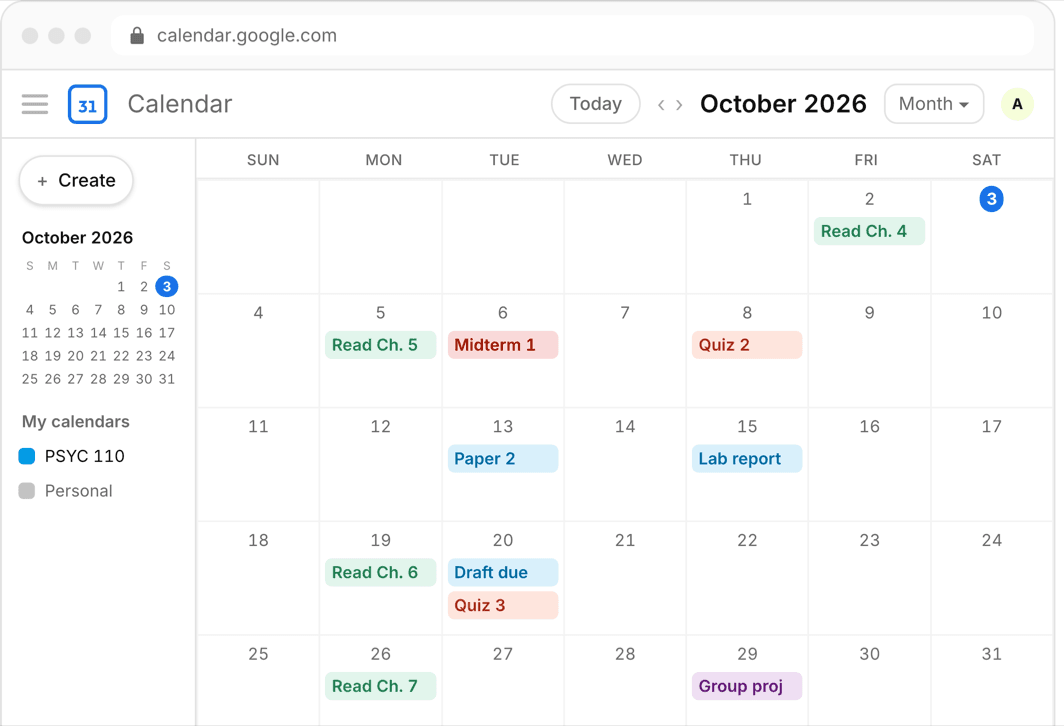
Whichever you pick, neither knows your semester. Classmaite covers that layer: upload your syllabi at myclassmaite.com/try and its AI extracts every assignment, exam, and reading deadline with the grading breakdown in about 30 seconds, then syncs to Google Calendar, Apple Calendar, or Outlook with reminders weighted by grade impact. Your chatbot handles the understanding; Classmaite makes sure you’re pointing it at the right week. First syllabus free, no account.
Frequently asked questions
Is ChatGPT or Claude better for writing essays?
Neither should write your essays — that’s submitting someone else’s work, and both tools’ output is detectable and against policy in most courses. For legitimate writing help — outlining your ideas, critiquing your drafts — both are strong; Claude is often preferred for detailed feedback on longer drafts.
Do students need the paid version of either?
Not to start. Both free tiers handle everyday study use — explanations, practice questions, feedback on short work. Paying (around $20/month either way) buys higher usage limits and stronger models, which matters most in heavy exam weeks and for long-document work. Upgrade when you actually hit the limits, not before.
Should I just use both?
It’s a reasonable strategy — both have free tiers, so routing by task costs nothing: one as your daily driver, the other for the tasks it’s better at, like Claude for long readings. The only real cost is scattered chat history. If juggling two tools makes you use both less, pick one and stop optimizing.