Claude for Students: How to Actually Study With It
Quick answer
Claude, Anthropic’s AI assistant, is particularly useful for students working with long material — full lecture note sets, PDFs, and readings — because of its large context window and file uploads. Use it to explain concepts, question you on uploaded course materials, and organize a semester’s work; keep it out of graded output and check each course’s AI policy first.
Drop your syllabus here
Every assignment, exam, and reading on your calendar in about 30 seconds. Free, no account.
PDF, Word, or a photo of a paper one. No syllabus handy? See a sample
Most “AI for studying” advice is written about ChatGPT and assumed to transfer. It mostly does — but Claude, Anthropic’s assistant, has a few genuine strengths for students that are worth using deliberately rather than by accident: it handles very long documents well, its Projects feature can hold a whole course’s materials, and it’s strong at careful, structured explanation.
Same ground rules as any AI tool: your course’s syllabus AI policy is the law, Claude’s output never becomes your submitted work, and anything factual gets verified. Within those lines, here’s how to get real study value out of it.
Or skip all of it
Upload the syllabus. Get the calendar.
Every assignment and exam on Google, Apple, or Outlook in about 30 seconds. One syllabus free, no account, no card.
Play to the strength: long documents
Claude’s standout trait for students is how much text it can work with at once. You can upload an entire PDF of lecture slides, a long reading, or a semester’s worth of notes and ask questions across all of it — “where does this contradict what the professor said in week 3?” or “trace how this concept develops across these four lectures.”
That makes it well suited to synthesis tasks that break shorter-context tools: reconciling your notes with the textbook, finding the through-line in a reading-heavy seminar, or pulling every mention of a topic out of a big document before an exam.
Use Projects as a per-course workspace
Claude’s Projects feature lets you attach files and instructions that persist across conversations. The obvious student move: one Project per course. Load the syllabus, lecture notes, and key readings, and add an instruction like “You are my study partner for BIO 201. Quiz me with active recall, never write assignment text for me, and cite which uploaded document your answers come from.”
Now every conversation starts already knowing your course. Asking “make me 15 practice questions on this week’s material” works without re-uploading anything, and the standing instruction keeps the tool in tutor mode by default.
- One Project per course, refreshed with new notes weekly
- Put your integrity rules in the Project instructions so they apply automatically
- Ask it to cite which uploaded file an answer comes from — easy hallucination check
Explanation and feedback workflows
Claude is strong at structured explanation — ask it to explain a concept, then to re-derive it from first principles, then to give you the three most common exam misconceptions about it. For quantitative courses, paste a worked problem you got wrong and ask it to identify the exact step where your reasoning diverged, rather than just showing the correct solution.
For writing-heavy courses, use it on your ideas rather than your prose: describe your essay’s argument in three sentences and ask for the strongest objection a grader might raise. You then answer that objection in your own writing. Feedback on thinking is study help; generated paragraphs are not.
What Claude is not better at
Honesty cuts both ways. ChatGPT’s ecosystem is broader — more integrations, voice options, and image generation. Gemini is woven into Google Docs and Drive, which matters if that’s where your notes live. NotebookLM is purpose-built for grounding answers in your uploaded sources. Claude competes on reasoning quality and long-document work, not on doing everything.
And like every language model, Claude fabricates. It can misquote an uploaded PDF or invent a plausible citation. The cite-your-source habit from the Projects section is not optional — it’s the difference between a study tool and a misinformation generator with a nice interface.
Feed it the one document that runs your semester
The single highest-value document you can hand any AI at the start of term is your syllabus — it contains every deadline, the grading weights, and the professor’s rules, including the AI policy itself. Reading each one carefully is the first assignment of the semester.
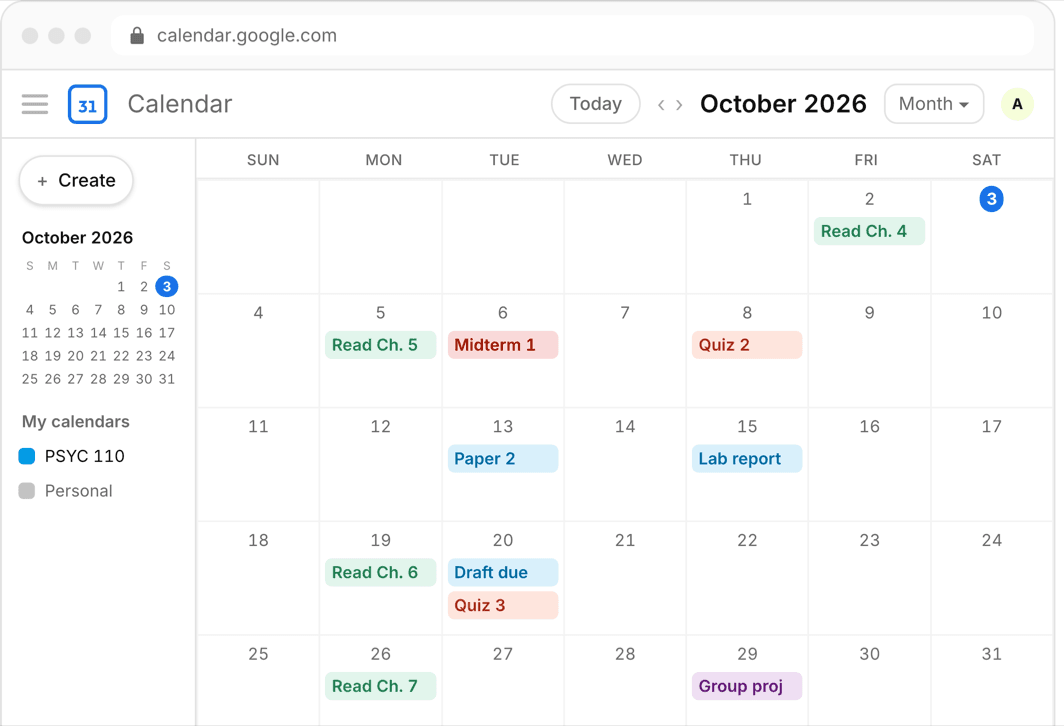
For the logistics half of that job, Classmaite is the purpose-built tool: it’s an AI that does one thing — parses your syllabus (PDF, Word doc, even a screenshot) into every assignment, exam, and reading deadline in about 30 seconds, then syncs them to Google Calendar, Apple Calendar, or Outlook with reminders weighted by how much each item counts. First syllabus free at myclassmaite.com/try, and then your Claude study sessions can focus on the material instead of the admin.
Frequently asked questions
Is Claude free for students?
Claude has a free tier that covers core study use — explanations, practice questions, and document Q&A within usage limits. Paid plans raise limits and unlock heavier use of features like Projects with large file sets. Start free and upgrade only if you hit the ceiling regularly.
Claude or ChatGPT for schoolwork?
Both handle mainstream studying well. Claude tends to be the better pick for long documents, sustained reasoning, and holding course materials in Projects; ChatGPT has the broader ecosystem and multimodal features. Many students keep both free tiers and route tasks accordingly.
Can Claude read my lecture slides or textbook PDFs?
Yes — you can upload PDFs and documents and ask questions grounded in them, which is one of Claude’s strongest student use cases. Still verify important answers against the source, since any AI can misread or overstate what a document says.