How to Use AI as a College Student (Without Getting in Trouble)
Quick answer
College students can legitimately use AI to explain difficult concepts, generate practice questions, organize notes, and plan their semester — but not to produce graded work they submit as their own. Every course sets its own AI policy, so check each syllabus before using AI for anything connected to an assignment.
Drop your syllabus here
Every assignment, exam, and reading on your calendar in about 30 seconds. Free, no account.
PDF, Word, or a photo of a paper one. No syllabus handy? See a sample
AI is now part of college whether your professors like it or not. Some courses require it, some ban it, and most sit somewhere in between. The students who get real value from it aren’t the ones using it to write their essays — they’re the ones using it as a tireless tutor, a practice-question machine, and a planning assistant.
This guide is the map: what AI is genuinely good at for students, what it’s bad at, and where the line is. One rule sits above everything else — your course’s AI policy, written in the syllabus, beats any general advice, including this guide.
Or skip all of it
Upload the syllabus. Get the calendar.
Every assignment and exam on Google, Apple, or Outlook in about 30 seconds. One syllabus free, no account, no card.
Rule one: check the syllabus AI policy first
AI policies in 2026 vary wildly by course, not just by school. The same university can have one professor who requires AI-assisted drafts and another who treats any AI use as an academic integrity violation. The only source of truth is each course syllabus, usually in a section labeled academic integrity, AI policy, or permitted resources.
If the syllabus doesn’t mention AI, don’t assume it’s allowed. Email the professor and ask — a two-line question now beats an integrity hearing later. Save the answer.
- Read the AI or academic integrity section of every syllabus in week one
- When policies differ between courses, track them per course — don’t rely on memory
- If a policy is ambiguous, ask in writing and keep the reply
- Group work counts too: your partner pasting AI text into a shared doc is your problem
Use AI to understand, not to produce
The cleanest way to think about the line: AI that improves your understanding is almost always fine; AI that produces the thing you submit is usually not. Asking Claude to explain the Krebs cycle three different ways is studying. Asking it to write your bio lab discussion section is submitting someone else’s work.
The understanding use case is also where AI is strongest. ChatGPT, Claude, and Gemini are all good at re-explaining a concept at a different level, working through a confusing textbook passage, or answering the follow-up questions you were too embarrassed to ask in lecture.
- Paste a confusing paragraph and ask for a plain-English explanation, then a harder one
- Ask “what am I misunderstanding if I think X?” — it catches wrong mental models fast
- Have it explain the same concept with a new analogy until one clicks
- Ask why an answer is wrong, not just what the right answer is
Use AI as a practice-question machine
Active recall — testing yourself instead of rereading — is one of the best-supported study techniques in learning science, and AI removes its biggest friction: making the questions. Paste your notes or a chapter summary and ask for practice questions at exam difficulty, then answer them without looking.
The key move is grading yourself honestly. Answer first, then ask the AI to evaluate your answer and explain the gaps. If you just read the questions and answers together, you’re back to passive review.
Use AI for planning and organizing
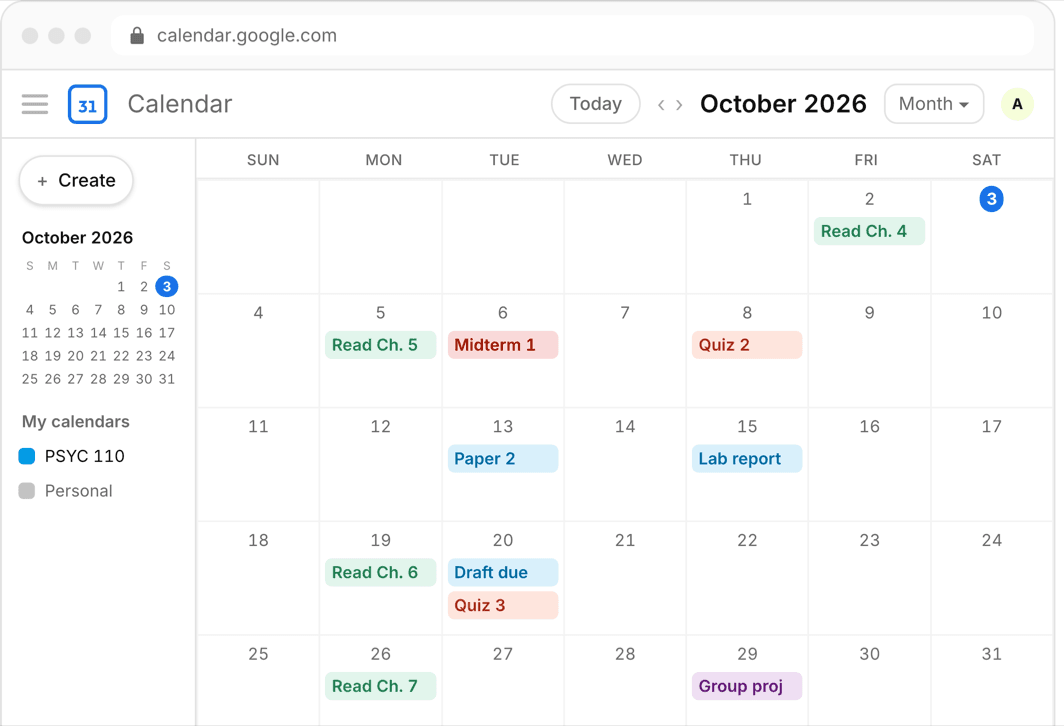
The least controversial and most underused category. No professor objects to you using AI to organize your semester: turning a syllabus into a deadline list, building a study schedule that front-loads heavy weeks, or breaking a term paper into weekly milestones.
This is also where AI compounds. A student who spends one hour in week one getting every deadline into a calendar and a rough study plan makes every later week easier. The essay-generator crowd gets a worse GPA and learns less; the planner crowd gets both.
Where students actually get burned
Most AI-related integrity cases don’t come from students who set out to cheat. They come from drift: an “outline” that becomes full paragraphs, a “grammar check” that rewrites the argument, a study group sharing an AI-written answer key. If you can’t explain and defend every sentence you submitted, you’ve drifted too far.
The second failure mode is trusting AI output as fact. Language models still fabricate citations, dates, and details with total confidence. Anything checkable — a quote, a formula, a source — gets verified against the actual source before it goes anywhere near your work.
Start with the boring, high-leverage use case
If you take one thing from this guide: the highest-leverage, lowest-risk AI use in college is logistics. Understanding what’s due, when, and how much it’s worth is the foundation every other study decision sits on — and it’s pure organization, with zero integrity gray area.
That’s the exact job Classmaite does. Upload a syllabus at myclassmaite.com/try and its AI extracts every assignment, exam, and reading deadline plus the grading breakdown in about 30 seconds, then syncs it to Google Calendar, Apple Calendar, or Outlook with reminders weighted by grade impact. Your first syllabus is free, no account needed — a fitting first AI experiment for the semester.
Frequently asked questions
Is it okay to use AI at all in college?
Usually yes, for the right things — understanding concepts, generating practice questions, and planning your time are broadly accepted uses. Whether AI is allowed on graded work depends entirely on each course’s policy, so check every syllabus and ask the professor when it’s unclear.
Which AI tool should a college student start with?
Any major assistant — ChatGPT, Claude, or Gemini — covers the core study use cases: explanations, practice questions, and planning help. Pick one, learn to prompt it well, and add specialized tools like NotebookLM or a flashcard generator only when you hit their specific use case.
Will professors know if I use AI?
Sometimes, and detection isn’t the point. AI detectors are unreliable in both directions, but professors also compare your submitted work to your in-class writing and exam performance. The bigger risk is practical: if AI did the learning for you, exams — which are still mostly AI-free — will expose the gap.