Is Using AI for Homework Cheating? It Depends — Here’s On What
Quick answer
Using AI for homework is cheating when your course’s policy prohibits it or when you submit AI-generated work as your own; it is not cheating when the course permits it or when you use AI to understand material — explanations, practice questions, planning — rather than to produce the submitted work. There is no universal rule: each course’s syllabus policy decides.
Drop your syllabus here
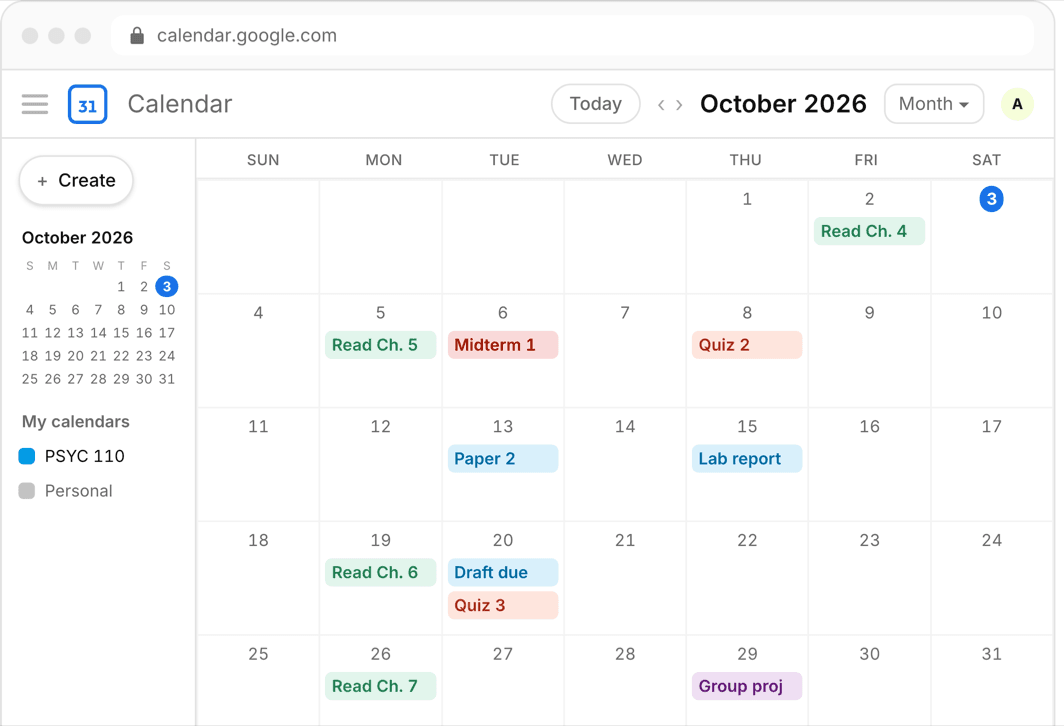
Every assignment, exam, and reading on your calendar in about 30 seconds. Free, no account.
PDF, Word, or a photo of a paper one. No syllabus handy? See a sample
This question has an unsatisfying honest answer: it depends. Not as a dodge — it depends on two specific things you can actually check. What your course’s policy says, and what you’re using the AI to do. Get clarity on those two and nearly every gray area resolves.
This guide walks both dimensions, with concrete examples of what’s almost always fine, what’s almost always cheating, and how to handle the genuinely ambiguous middle. The goal isn’t to help you find loopholes; it’s to let you use AI aggressively for learning without ever wondering if you’re one screenshot away from an integrity hearing.
Or skip all of it
Upload the syllabus. Get the calendar.
Every assignment and exam on Google, Apple, or Outlook in about 30 seconds. One syllabus free, no account, no card.
Dimension 1: what your course policy says
Academic integrity is defined per institution and, increasingly, per course. In 2026 it’s normal for one professor to require AI use, another to permit it with disclosure, and a third to ban it outright — in the same department, in the same term. The syllabus is the binding document; university-wide policy usually sets a floor that courses can tighten.
So the first move is never philosophical, it’s clerical: read the AI section of each syllabus. If it’s missing or vague, email the professor and keep the reply. “Everyone in my class uses it” is not a policy, and it has never once worked as a defense.
Dimension 2: understanding vs. production
Where policy allows AI or stays silent, the ethical line tracks a simple distinction. Using AI to understand — explanations, worked examples of similar problems, quizzing, feedback on your thinking — is the modern version of a tutor or study group. Using AI to produce the artifact you submit — the essay, the code, the problem-set answers — is misrepresenting authorship, which is what cheating has always meant.
A reliable self-test: could you reproduce or defend this work, alone, on demand? If the professor asked you to explain your answer at a whiteboard, does the knowledge live in you or in the chat history?
Almost always fine
- Asking AI to explain a concept from lecture until it makes sense
- Generating practice problems similar to homework and working them for practice
- Asking why your attempted answer was wrong after you attempted it
- Summarizing and restructuring your own notes for review
- Building a study schedule or organizing deadlines with AI
- Getting the strongest counterargument to an essay thesis you came up with
Almost always cheating
- Submitting AI-written essays, paragraphs, or code as your own work
- Pasting homework questions in and copying the answers over
- Using AI during a quiz or exam that prohibits outside help
- Paraphrasing AI output to beat a detector — the evasion is itself the admission
- AI use on group work that the course prohibits, even if a teammate did the pasting
The gray zone, and how to handle it
Real ambiguity exists: AI-suggested code fixes in a programming class, grammar tools that edge into rewriting, brainstorming that shapes an essay’s structure. The resolution procedure is boring and bulletproof — disclose or ask. A one-line email describing exactly what you want to do gets you either permission in writing or a clear no.
Two habits make the gray zone safe permanently: keep your drafts and chat history so your process is reconstructible, and when a course allows AI with disclosure, disclose specifically (“used ChatGPT to generate practice problems and check my reasoning on question 3”) rather than generically.
The use case with no gray zone at all
Note what never appears in any prohibited list: logistics. No academic integrity policy anywhere objects to using AI to know what’s due, when it’s due, and what it’s worth. Organization is the one category where you can use AI at full strength with zero policy risk — and it’s also the category with the most reliable GPA payoff, because missed and rushed deadlines sink more grades than hard material does.
That’s the lane Classmaite occupies: upload a syllabus at myclassmaite.com/try and its AI extracts every assignment, exam, and reading deadline plus the grading breakdown in about 30 seconds, then syncs to Google Calendar, Apple Calendar, or Outlook with reminders weighted by grade impact. First syllabus free, no account. Use AI boldly where it’s unambiguous; be careful only where it isn’t.
Frequently asked questions
Can professors tell if I used AI on homework?
Often enough that betting against it is foolish — not mainly through AI detectors, which are unreliable, but by comparing homework to your in-class writing and exam performance. The deeper problem is that AI-completed homework leaves you unprepared for exams, which no detector is needed to notice.
Is it cheating if the syllabus doesn’t mention AI?
Silence is not permission. Most universities’ general integrity policies about unauthorized assistance still apply, and interpretations vary by professor. Ask directly and keep the written answer — it takes two minutes and removes the entire risk.
Is using AI to check my homework answers cheating?
Checking work you already did — and asking why an answer is wrong — sits on the understanding side of the line and is fine under most policies. It becomes production the moment “checking” turns into replacing your answers with the AI’s before submitting.