How to Use AI for Math Homework (Learn It, Don’t Copy It)
Quick answer
Use AI on math homework to explain the step you’re stuck on, check work you’ve already attempted, and generate practice variants — not to copy answers. Homework is typically a small slice of your grade; the exams it exists to prepare you for are the bulk, and copied answers don’t come with you into the exam room.
Drop your syllabus here
Every assignment, exam, and reading on your calendar in about 30 seconds. Free, no account.
PDF, Word, or a photo of a paper one. No syllabus handy? See a sample
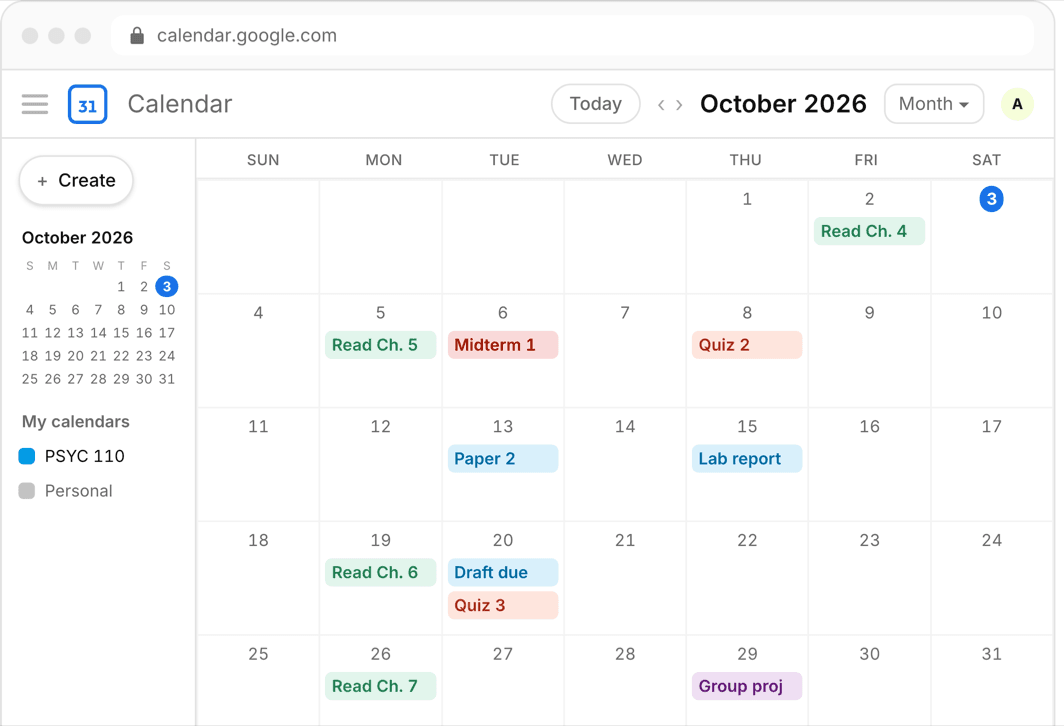
Math homework is where AI shortcuts look most tempting and cost the most. Modern models solve most undergraduate problem sets convincingly, so the copy-paste route is genuinely available — and it fails on a schedule. Homework in most math courses is worth 10–20% of the grade; the midterms and final it trains you for are worth the rest, taken in a room where the chatbot isn’t.
The good news is the same models are excellent math tutors when you point them at understanding instead of answers. This guide covers the workflow that compounds: attempt first, ask for the stuck step, verify the reasoning, and drill variants. Check your course’s syllabus AI policy before any of it — some math courses explicitly ban AI on graded problem sets, and that setting overrides everything here.
Or skip all of it
Upload the syllabus. Get the calendar.
Every assignment and exam on Google, Apple, or Outlook in about 30 seconds. One syllabus free, no account, no card.
Do the math on your math grade first
Before deciding how to use AI, look at the grading breakdown in your syllabus. A typical split — homework 15%, midterms 40%, final 35% — means homework’s real value isn’t its points. It’s the only structured practice you get before the 75% that’s exam-taken, closed-book, and solo.
Copying AI answers converts that practice into nothing. You bank a few homework points, walk into the midterm never having struggled with the material, and lose points ten times over. Every workflow below is designed around that arithmetic: use AI to make the practice work better, never to skip it.
Attempt first, then ask for the step — not the answer
The rule that separates tutoring from copying: you write an attempt before the AI sees the problem. Get as far as you can, then paste the problem and your work and ask a narrow question — “I got to this integral and I’m stuck; what technique applies here and why?” — rather than “solve this.”
Even better, tell it not to solve: “Don’t give me the answer. Give me a hint for the next step, and if I’m still stuck I’ll ask for another.” ChatGPT, Claude, and Gemini all follow that instruction well, and it keeps the productive struggle — the part that actually builds skill — in your hands.
- Paste your work, not just the problem — the mistakes in it are what the AI should target
- Ask “what concept does this step use?” so the explanation transfers to other problems
- Request hints one at a time instead of full solutions
- If you needed the full solution, redo the problem from scratch the next day without it
Use AI to check work you’ve already done
The second legitimate mode: finish the problem yourself, then ask the AI to check it. “Here’s the problem and my full solution — is my reasoning valid, and where’s the first error if not?” This catches sign flips, dropped terms, and misapplied rules while the attempt is still fresh enough to learn from.
When it flags an error, don’t just accept the correction. Ask why your version fails — “what rule did my step violate?” — and rework the problem. An error you understand is a point you won’t lose twice; an error silently fixed is a point you’ll lose again on the exam.
Generate practice variants until the method is boring
This is AI’s biggest edge over the textbook: infinite problems. Once you can solve a homework problem, ask for three variants at the same difficulty, then two harder ones — “same concept, different numbers and framing.” Work them cold, then have the AI check your answers.
Before exams, go broader: paste the topics list from the syllabus or your notes and ask for a mixed problem set at exam difficulty. Mixed practice — where you have to recognize which method applies — is what exams test and what problem sets, grouped by chapter, systematically undertrain.
Verify — models still fumble math with confidence
Models in 2026 are far better at math than their predecessors, but they still make arithmetic slips and occasionally commit to a wrong approach with perfect confidence — especially on multi-step computations and problems with unusual constraints. Treat AI math output the way you’d treat a smart classmate’s: probably right, worth checking.
Cross-check anything load-bearing against your textbook’s worked examples or a computational tool, and be suspicious when the AI’s answer disagrees with your instincts and its explanation feels hand-wavy. Asking “verify this by solving it a second, different way” catches a surprising share of its errors.
The habit that makes all of this work: never doing math at midnight
Every workflow above — attempt first, hints not answers, redo tomorrow — needs time, and problem sets started the night they’re due get the copy-paste treatment no matter what anyone intends. The real prerequisite for using AI well in a math course is starting the set days early, which means knowing when every set lands.
Classmaite covers that part: upload your syllabus at myclassmaite.com/try and its AI extracts every problem set, quiz, and exam with the grading breakdown in about 30 seconds, then syncs them to Google Calendar, Apple Calendar, or Outlook with reminders weighted by grade impact — so the weekly sets surface early and the 40% midterm never sneaks up. First syllabus free, no account required.
Frequently asked questions
Is using AI for math homework cheating?
Depends on the use and the course. Getting step explanations, checking your own attempts, and generating practice problems is tutoring and widely accepted; submitting AI-produced solutions as your work is cheating almost everywhere. Some courses ban AI on graded sets entirely — the syllabus AI policy is the ruling, so read it first.
Can AI actually solve college math correctly?
Usually, at the undergraduate level — 2026 models handle most calculus, linear algebra, and statistics problems well. But they still make confident arithmetic and setup errors on multi-step problems, so verify anything that matters against your textbook or by asking the model to re-solve a different way.
Won’t I fall behind classmates who just copy the answers?
Only until the first midterm. Homework is typically 10–20% of a math grade and exams are the rest; the copiers bank a few homework points and then face 70%+ of the grade with no practice behind them. Attempt-first AI use is slower per problem and dramatically better per course.