How to Build a Study Schedule With AI (From Your Actual Syllabus)
Quick answer
Give AI your real constraints — every deadline, exam date, and grade weight from your syllabi, plus your class times and weekly commitments — and ask for a week-by-week plan that front-loads heavy weeks. Scheduling is the one AI use in college with zero academic-integrity gray area and some of the highest leverage.
Drop your syllabus here
Every assignment, exam, and reading on your calendar in about 30 seconds. Free, no account.
PDF, Word, or a photo of a paper one. No syllabus handy? See a sample
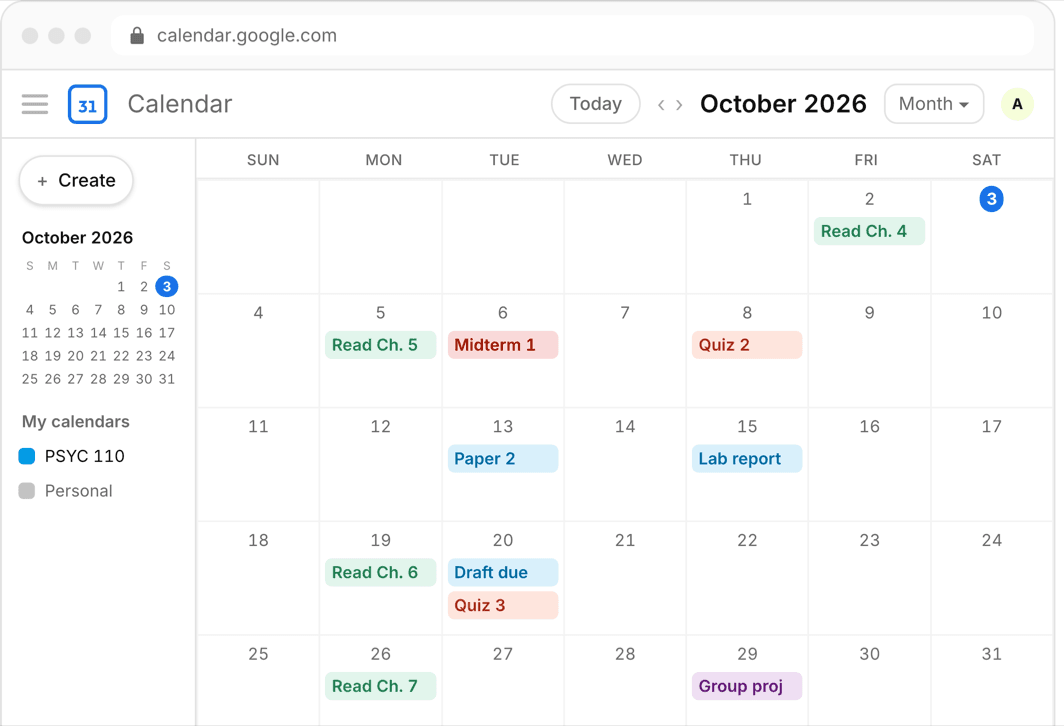
Most students don’t fail courses on ability — they fail on discovering in week 11 that three exams and a paper share the same five days. A study schedule is the fix, and AI has collapsed the cost of building one from an afternoon of spreadsheet work to a twenty-minute conversation.
This guide is the workflow: what to feed the model (garbage in, garbage schedule out), the prompt structure that produces a plan you’ll actually follow, and the weekly ritual that keeps the schedule alive past September. No integrity caveats needed for once — no professor anywhere objects to planning — though the deadlines you feed it should come straight from your syllabi, which is where this process starts.
Or skip all of it
Upload the syllabus. Get the calendar.
Every assignment and exam on Google, Apple, or Outlook in about 30 seconds. One syllabus free, no account, no card.
Why AI scheduling beats winging it (and generic templates)
A schedule’s value is entirely in its specificity. Generic advice — “study two hours per credit hour” — ignores that your semester has shape: a brutal week 8, a paper due the Monday after fall break, a course where the final is 50% and another where it’s 20%. AI is good at exactly this kind of constraint-juggling, but only when you hand it the real constraints.
The output to aim for is a week-by-week plan, not a daily hour-by-hour grid. Weekly plans survive contact with real life; daily grids collapse the first time a lab runs long, and abandoned schedules are worse than none because they take the credibility of planning down with them.
Step 1: get every deadline out of your syllabi
The schedule is only as good as its inputs, and the inputs live in your syllabi: every assignment, exam, quiz, project milestone, and reading, each with its due date and its share of the grade. Go course by course and pull all of it — the grade weights matter as much as the dates, because they’re what the plan will prioritize by.
Also list your fixed commitments: class meetings, work shifts, practice, standing obligations. The AI needs to know which hours are actually available before it allocates them. Ten minutes of honest input here is the difference between a plan and a fantasy.
- Every graded item from every syllabus, with due date and percentage weight
- All exam dates, including the final exam schedule
- Fixed weekly commitments: classes, work, athletics, clubs
- Honest constraints: your dead hours, your best focus windows, your actual wake time
Step 2: prompt for a week-by-week plan
With inputs assembled, the prompt is straightforward: “Here are all my deadlines with grade weights, my exam dates, and my weekly commitments. Build a week-by-week study plan for the semester. Front-load work before heavy weeks, start papers at least two weeks out, and schedule exam review across multiple sessions rather than the night before.”
ChatGPT, Claude, and Gemini all handle this well. Then interrogate the draft: “Which week is most overloaded? What would you move if I got sick in week 9? Where am I under-preparing relative to grade weight?” Two or three refinement rounds produce a plan that fits your semester rather than an average one.
Step 3: let grade weight set the priorities
The most common self-made scheduling error is allocating time by deadline pressure instead of grade impact — three evenings on a 2% homework while a 30% paper sits untouched. Make the weights do the work: ask the AI to rank every week’s tasks by grade impact and to flag any week where low-weight busywork is crowding out high-weight preparation.
A useful standing rule to encode in the plan: anything worth 20% or more of a course grade gets attention starting two weeks out, minimum. Spaced work on the big-ticket items is worth more than perfect completion of the small ones, and a good plan makes that tradeoff visible before you have to make it under pressure.
Keep it alive: the ten-minute weekly re-plan
Every schedule drifts — you fall behind, an exam moves, a problem set turns out to be double-length. The schedules that survive are the ones that expect this. Once a week, same time every week, paste the current plan back into the chat with what actually happened: “Here’s the plan, here’s what I finished and didn’t. Rebalance the next two weeks.”
This takes ten minutes and is the entire difference between a semester-long system and a September artifact. The plan isn’t the deliverable; the weekly contact with your own deadlines is.
Automate the tedious half
Step 1 — manually transcribing every deadline and grade weight out of five syllabi — is the part students skip, and skipping it quietly ruins the plan. It’s also the part that’s now automated: upload each syllabus at myclassmaite.com/try and Classmaite’s AI extracts every assignment, exam, and reading deadline with the full grading breakdown in about 30 seconds.
From there it syncs everything to Google Calendar, Apple Calendar, or Outlook with reminders weighted by grade impact, giving you a clean, complete deadline list to hand your AI planning chat — and a calendar that keeps enforcing the plan after the chat ends. First syllabus is free, no account needed.
Frequently asked questions
Can ChatGPT really make me a good study schedule?
Yes — if you feed it real inputs. Given your actual deadlines, grade weights, and weekly commitments, ChatGPT, Claude, or Gemini will produce a genuinely useful week-by-week plan. Given a vague request, it produces generic advice. The quality of the schedule is set almost entirely by the quality of what you paste in.
What’s the fastest way to get my deadlines into an AI planner?
Extracting them from the source documents automatically. Classmaite (myclassmaite.com/try) reads an uploaded syllabus — PDF, Word doc, or even a screenshot — and returns every assignment, exam, and reading deadline with grade weights in about 30 seconds, which you can sync to your calendar and use as the input for any AI planning session. The first syllabus is free.
What do I do when I fall behind the schedule?
Re-plan, don’t abandon. Falling behind is the expected case, which is why the weekly ten-minute re-plan exists: paste the plan back in with what actually happened and ask the AI to rebalance the coming weeks, protecting the highest grade-weight items first. A schedule that adapts weekly survives the whole semester.