How to Make a Study Guide With AI (From Notes to Exam-Ready)
Quick answer
To make a study guide with AI: gather your lecture notes, slides, and the syllabus; give the AI the exam’s actual scope; ask it to organize the material into key concepts, relationships, and likely question types; then verify every claim against your course materials and convert the guide into practice questions. The verification and self-testing steps are what make it studying rather than reading.
Drop your syllabus here
Every assignment, exam, and reading on your calendar in about 30 seconds. Free, no account.
PDF, Word, or a photo of a paper one. No syllabus handy? See a sample
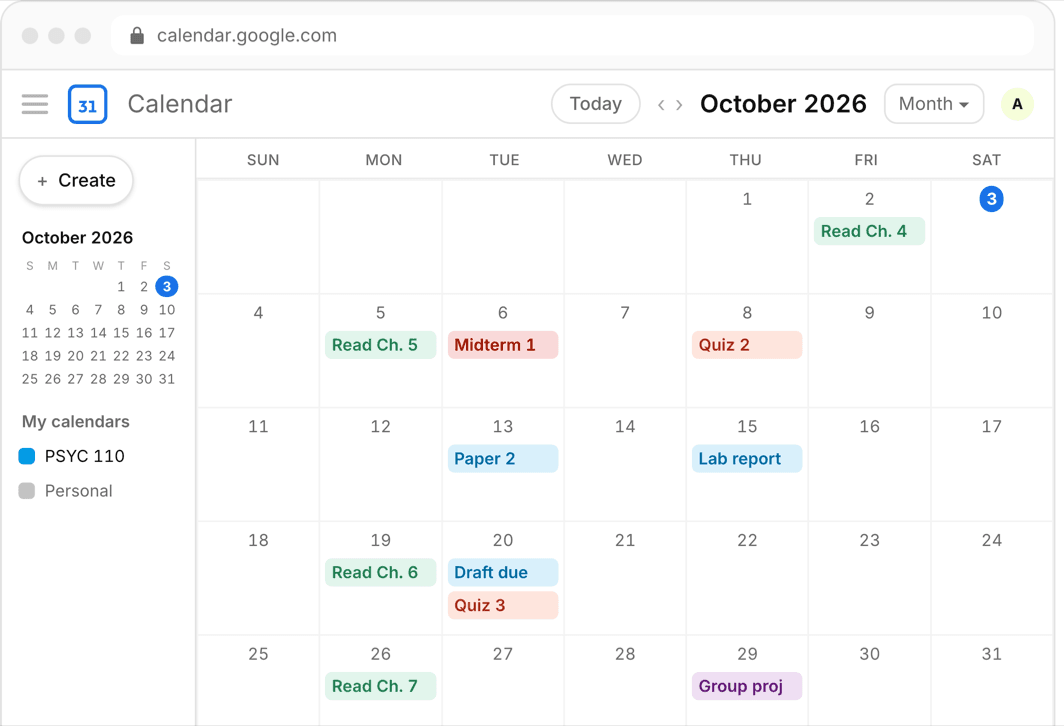
A study guide used to cost an evening of collating notes before you learned anything from it. AI collapses that evening into minutes — which is only a win if what comes out is accurate and organized around what your exam actually covers, not what the model finds generically important.
This is the workflow that keeps both properties: source everything from your real course materials, scope it with the syllabus, verify the output, and finish by turning the guide into questions. Check your course’s AI policy first — for personal study material this is almost always fine, but almost always isn’t always.
Or skip all of it
Upload the syllabus. Get the calendar.
Every assignment and exam on Google, Apple, or Outlook in about 30 seconds. One syllabus free, no account, no card.
Step 1: gather sources — including the syllabus
A study guide is only as good as its inputs. Collect your lecture notes, slides, problem sets, and any professor-provided review sheet. Then add the document most students skip: the syllabus. It defines the exam’s scope, the weight of each topic, and often the professor’s stated priorities — which is exactly the structure a study guide should mirror.
Feed the AI course materials, not just a topic name. “Make me a study guide on cell biology” gets you a generic textbook summary. Your notes plus your syllabus gets you a guide to your course.
Step 2: prompt for structure, not just summary
Paste your materials into Claude or ChatGPT (Claude’s file uploads handle big PDF sets well; NotebookLM is a strong alternative because it cites which source each claim came from) and ask for a specific shape: “Organize this into a study guide for an exam covering weeks 1–6. For each topic: core concepts with definitions, how the topics connect, one worked example, and the two most likely exam questions. Flag anything in my notes that looks incomplete.”
The flag-what’s-incomplete instruction is quietly the most valuable line — it turns the AI from a summarizer into a gap detector, and gaps are what exams find.
Step 3: verify before you memorize
Read the draft against your source materials before you study a word of it. AI summarization errors are smooth and confident — a slightly wrong definition or an invented connection reads exactly like a correct one. Correct errors, cut anything your exam doesn’t cover, and add whatever the model underweighted.
This pass is faster than it sounds and doubles as your first review session. A study guide you haven’t verified isn’t a study guide; it’s a plausible document.
- Check every definition against notes or textbook
- Delete topics outside the exam’s stated scope
- Rewrite at least the key sections in your own words — that’s encoding, and it’s free learning
Step 4: turn the guide into questions
A study guide you only reread produces fluency, not recall — the material feels familiar and then the blank exam page proves otherwise. Convert the guide: ask the AI for practice questions from it, answer them closed-book, then have it grade you and explain the misses.
Cycle the misses back in. The sections you failed become tomorrow’s flashcards or re-derivations. By the second pass, the guide has done its real job: telling you precisely what you don’t know yet.
Step 5: give the guide a timeline
The best study guide fails if it gets opened for the first time the night before the exam. Work backward from the exam date: verify the guide a week out, first question pass five days out, weak-topic cycles across the remaining days. Spaced beats crammed, every time it’s been measured.
That scheduling depends on actually knowing your exam dates — all of them, across every course, before they’re close enough to be scary. Classmaite handles that part: upload each syllabus at myclassmaite.com/try and its AI pulls every exam, assignment, and reading deadline plus grading weights in about 30 seconds, then syncs them to Google Calendar, Apple Calendar, or Outlook with reminders weighted by grade impact. First syllabus free, no account — so the guide you built gets studied on time.
Frequently asked questions
Is making a study guide with AI cheating?
Making study material for your own learning is almost universally fine — it’s the digital version of writing a review sheet. It would only cross a line if a course explicitly restricts AI for all coursework or if the guide is itself a graded deliverable, so check the syllabus policy first.
What’s the best AI for making study guides?
Claude handles large sets of notes and PDFs well, NotebookLM grounds every claim in your uploaded sources with citations, and ChatGPT is a capable default. The tool matters less than the workflow: real course materials in, verification against sources, and practice questions out.
How long before an exam should I make a study guide?
Build it about a week out. That leaves time to verify it, run two or three spaced self-testing passes, and cycle back through weak topics. A guide made the night before can only be reread, and rereading is among the weakest study methods.