AI Flashcard Generators: Faster Cards, Same Rules of Recall
Quick answer
AI flashcard generators — Quizlet’s AI features, or ChatGPT/Claude prompted to output card pairs from your notes — remove the slowest part of flashcard study: making the cards. They work best when you generate from your own course materials, edit the deck to cut trivia and fix errors, and review with a spaced repetition system rather than cramming the whole deck at once.
Drop your syllabus here
Every assignment, exam, and reading on your calendar in about 30 seconds. Free, no account.
PDF, Word, or a photo of a paper one. No syllabus handy? See a sample
Flashcards work because of two of the strongest effects in learning science: active recall and spaced repetition. The historical problem was that making good cards took longer than most students were willing to spend, so decks never got made or got made badly. AI fixes the making part in minutes.
It does not fix the quality part. Auto-generated decks skew toward shallow definition cards, occasionally contain confident errors, and tempt you into reviewing 300 cards you never curated. Here’s how to get the speed without the garbage.
Or skip all of it
Upload the syllabus. Get the calendar.
Every assignment and exam on Google, Apple, or Outlook in about 30 seconds. One syllabus free, no account, no card.
Generating cards: tools and prompts
Quizlet’s AI features can build a deck directly from uploaded notes, and the result lands in an app already built for studying. The general-assistant route is more controllable: paste notes into ChatGPT or Claude and prompt for exactly the card style you want — “Create 25 flashcards from these notes. Front: a question requiring recall or application, not just a term. Back: a concise answer. Mix definitions, why-questions, and one-step problems. Output as Question | Answer pairs.”
The pipe-separated output matters: most flashcard apps, including Anki, import delimited text directly, so your generated deck drops straight into a real review system.
The quality pitfalls, and the edit pass
Three failure modes show up in nearly every raw AI deck. Trivia cards: technically true, never on the exam. Recognition cards: fronts that give away the answer, testing familiarity instead of recall. And straight errors: a wrong date or flipped definition that you will now diligently memorize.
The fix is a 10-minute edit pass against your course materials — delete, sharpen, correct. This pass is not overhead; deciding what deserves a card is itself high-value studying, and it’s the step that separates a deck you trust from a deck you abandon.
- Cut any card you can’t imagine the professor testing
- Rewrite fronts that contain their own answer
- Verify factual cards against notes or textbook before first review
- Cap decks around 30–50 curated cards per exam topic — coverage beats volume
Pair generation with spaced repetition
Generation is half the system; scheduling is the other half. Spaced repetition — reviewing a card right before you’d forget it, at expanding intervals — is what moves material into long-term memory. Anki remains the reference implementation, and Quizlet’s own study modes apply similar spacing.
The practical rhythm: generate and curate cards weekly as material arrives, then let the app schedule daily reviews of ten to twenty minutes. Fifteen minutes a day for three weeks reliably beats a three-hour session the night before, and it’s not close.
Write the hard cards AI won’t
AI generators default to what’s easy to extract: terms and definitions. The cards that predict exam performance are usually the ones connecting ideas — “why does X imply Y?”, “what changes if this assumption breaks?”, “which method fits this scenario and why?” Ask the AI explicitly for application and why-cards, then write a handful yourself for the concepts you keep getting wrong.
A useful ratio to aim for: no more than half the deck pure definitions, the rest application, comparison, and reasoning cards. If every card in your deck could be answered by a glossary, the deck is studying vocabulary, not the course.
Schedule the reviews against real exam dates
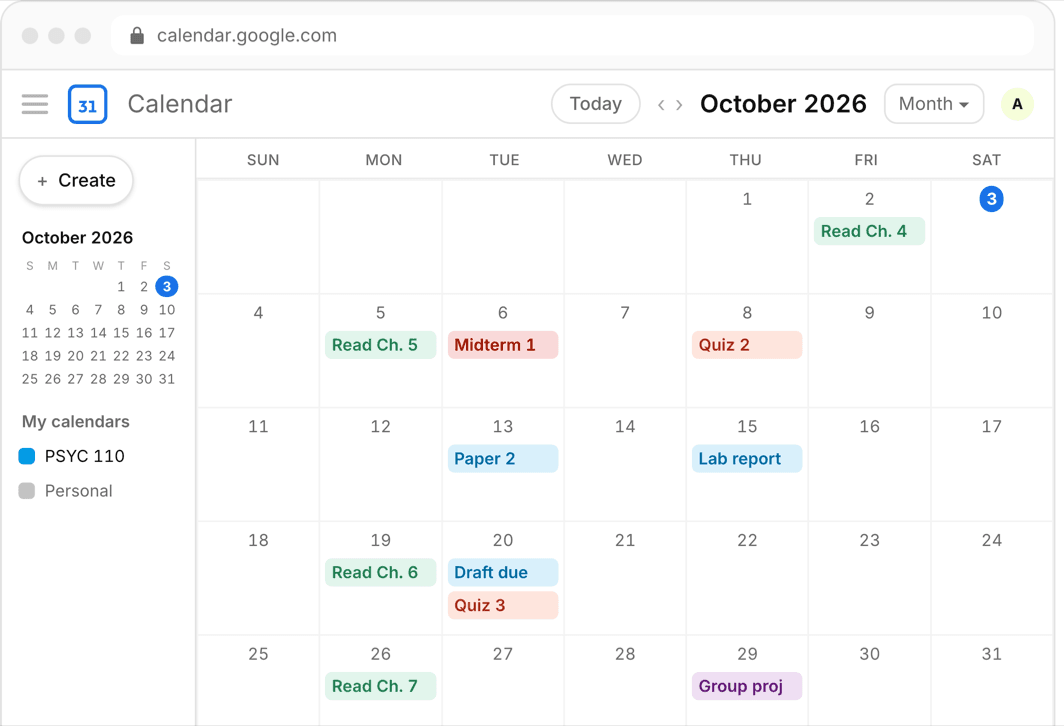
Spaced repetition has one dependency: starting early enough for the spacing to exist. That means knowing every exam date at the moment the deck is born, not ten days out — across all your courses at once, since exam weeks love to collide.
Classmaite covers that dependency: upload each syllabus at myclassmaite.com/try and its AI extracts every exam and assignment date plus the grading breakdown in about 30 seconds, syncing them to Google Calendar, Apple Calendar, or Outlook with reminders weighted by how much each one counts. First syllabus is free, no account — so your deck’s review clock starts when the semester does.
Frequently asked questions
Do AI-generated flashcards actually work?
Yes, if you treat generation as a draft. The learning benefit comes from active recall and spaced review, which AI cards support as well as handmade ones — but raw AI decks contain trivia, giveaway fronts, and occasional errors, so a short curation pass against your course materials is what makes them effective.
What’s the best AI flashcard generator?
Quizlet’s AI features are the most direct notes-to-deck path inside a study app. For more control, prompting ChatGPT or Claude to output delimited question–answer pairs and importing into Anki combines flexible generation with the strongest spaced repetition scheduler available.
How many flashcards should I make per exam?
Fewer than you think — roughly 30–50 well-curated cards per major topic. Beyond that, review time balloons and marginal cards crowd out important ones. Aim for at least half the deck testing application and connections rather than bare definitions.