How to Summarize Lecture Notes With AI (and Actually Learn Them)
Quick answer
Paste your lecture notes into ChatGPT, Claude, or NotebookLM and ask for a structured summary — key concepts, definitions, and open questions — then verify it against your original notes before trusting it. Summaries are the input to active recall, not a replacement for studying.
Drop your syllabus here
Every assignment, exam, and reading on your calendar in about 30 seconds. Free, no account.
PDF, Word, or a photo of a paper one. No syllabus handy? See a sample
Raw lecture notes are a mess by design — you were writing at the speed of speech. AI is very good at the cleanup: turning forty minutes of fragmented typing into an organized page of concepts, definitions, and relationships. Done right, this takes minutes per lecture and makes every later study session cheaper.
Done wrong, it produces a stack of tidy summaries you’ve read once and can’t recall under exam pressure — or worse, summaries with quiet errors you never caught. This guide covers the workflow that works: a structured prompt, a verify-against-source habit that takes two minutes, and the recall step that turns summaries into grades. Summarizing your own notes is uncontroversial almost everywhere, but if your course restricts AI use broadly, the syllabus policy still comes first.
Or skip all of it
Upload the syllabus. Get the calendar.
Every assignment and exam on Google, Apple, or Outlook in about 30 seconds. One syllabus free, no account, no card.
What AI summarizing is actually for
Be clear about the job: an AI summary organizes material so you can study it efficiently — it is not the studying. Reading a clean summary feels like learning because it’s fluent, and fluency is famously a false signal; recognition is not recall. The summary’s value is as raw material for self-testing and as a fast re-entry point before the next lecture.
The realistic payoff is time: condensing each week’s notes while the lecture is fresh means exam prep starts from organized material instead of an archaeology dig through six weeks of fragments.
The workflow: messy notes in, structure out
Take notes however you take them — the workflow tolerates mess. Within a day of lecture, paste the raw notes and prompt for structure, not just brevity: “Summarize these lecture notes into key concepts with one-line explanations, all terms with definitions, any processes as numbered steps, and a list of things that seem important but that I noted unclearly.”
That last item is the underrated one — it surfaces the gaps in your notes while you can still fix them from the textbook, a classmate, or office hours. For semester-scale material, NotebookLM is worth a look: it grounds every answer in the note files you upload and shows you exactly which passage each claim came from.
- Summarize within a day of lecture, while you can still repair gaps from memory
- Ask for structure — concepts, definitions, processes, unclear points — not just “make it shorter”
- Keep one running summary document per course, in lecture order
- Flag anything the AI marked unclear and resolve it before the next lecture
The verify-against-source habit
Every summary gets a two-minute read against your original notes before you trust it. Models drop details that didn’t look important, smooth over ambiguity in your shorthand, and occasionally add a plausible “fact” the lecture never contained. If a claim in the summary surprises you, that’s your cue to check it — surprise usually means the AI filled a gap in your notes with a guess.
This habit matters more than it seems, because summary errors compound: they flow into your study guide, your flashcards, and eventually an exam answer. Two minutes per lecture is cheap insurance, and it doubles as a first review pass — which is studying.
Turn summaries into recall, or they’re decoration
The step most students skip. Once a summary is verified, immediately have the AI convert it into practice: “Turn this summary into ten exam-style questions, mixed formats. Don’t show answers until I respond.” Answer from memory, get graded, and note what you missed — the misses are next week’s review list.
Before exams, merge the summaries and repeat at scale: mixed questions across all lectures, which forces the recognize-which-concept-applies skill that exams actually test. The summaries make this cheap; the questions make it work.
Per-lecture summaries need a semester-level map
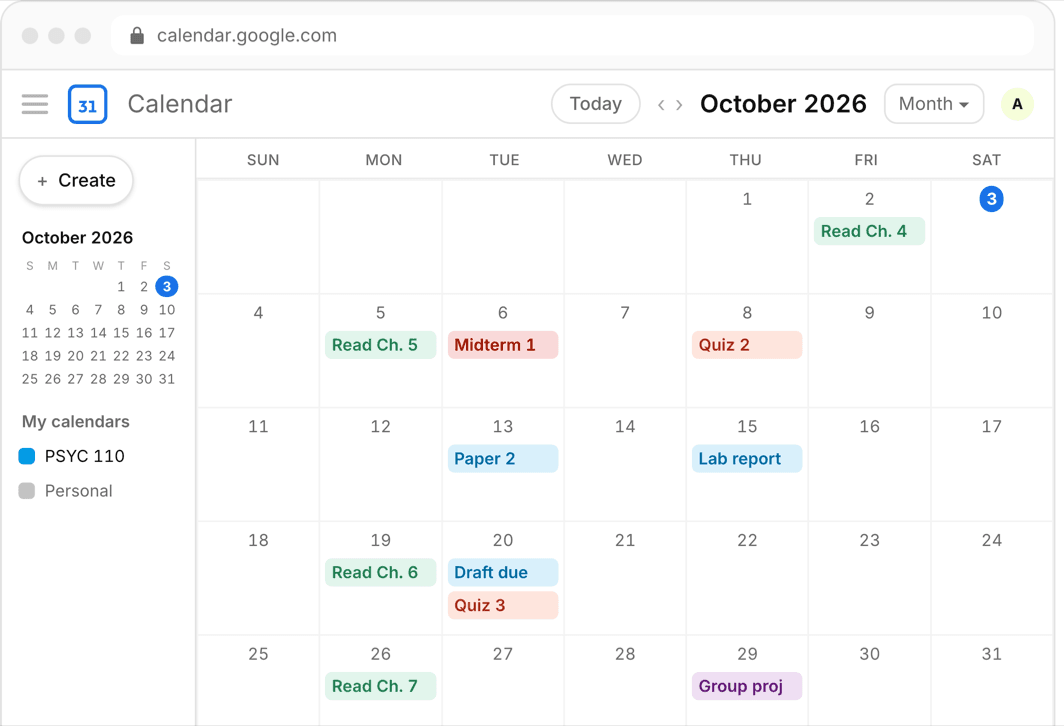
A summary pipeline tells you what to study, but not when — which lectures feed the midterm worth 30% versus the quiz worth 5%, and how many days you have. That context lives in your syllabus, and it’s worth having in your calendar rather than your memory.
Classmaite handles that layer: upload your syllabus at myclassmaite.com/try and its AI extracts every exam, quiz, and reading deadline with the grading breakdown in about 30 seconds, then syncs to Google Calendar, Apple Calendar, or Outlook with reminders weighted by grade impact. Your summaries cover the content; the calendar tells you which week to point them at. First syllabus free, no account.
Frequently asked questions
What’s the best AI for summarizing lecture notes?
ChatGPT, Claude, and Gemini all summarize pasted notes well, and the differences are small at this task. NotebookLM stands out for semester-scale material because it grounds answers in your uploaded files and cites the exact passage — useful when you need to trace a claim back to its source.
Is summarizing my notes with AI cheating?
Summarizing your own lecture notes for your own studying is fine essentially everywhere — it’s organization, not graded work. The caveats: don’t submit AI summaries for assignments that grade your notes or annotations, and if your course has an unusually broad AI ban, check the syllabus policy first.
Do AI summaries miss important things?
Yes, routinely — models compress by dropping what looks minor, and “minor” is judged without knowing your professor’s exam habits. That’s why the verify step exists: skim each summary against your original notes, and add back anything the lecture emphasized that the summary lost.