AI Note Taking for Students: What Works, What Doesn’t
Quick answer
AI note-taking works in three ways: transcribing recorded lectures, summarizing and restructuring notes you took yourself, and answering questions grounded in your notes (as NotebookLM does). It’s a strong second pass, but taking your own notes still matters — the act of writing them is where much of the learning happens, and AI summaries can contain errors you must check against the source.
Drop your syllabus here
Every assignment, exam, and reading on your calendar in about 30 seconds. Free, no account.
PDF, Word, or a photo of a paper one. No syllabus handy? See a sample
AI note-taking sounds like the dream: record the lecture, get perfect notes, never write anything again. The reality is more useful and less magical. AI is excellent at the second pass — cleaning, structuring, and interrogating notes — and a poor replacement for the first pass, because writing notes yourself is a large part of how the material gets into your head.
Here’s the honest breakdown: the three workflows that work, the tools that fit each, and the two limits that don’t go away no matter how good the models get.
Or skip all of it
Upload the syllabus. Get the calendar.
Every assignment and exam on Google, Apple, or Outlook in about 30 seconds. One syllabus free, no account, no card.
Workflow 1: record and transcribe lectures
Transcription tools like Otter.ai — and the recording features built into many note apps — turn a lecture into searchable text. That’s genuinely valuable for fast-talking professors, dense technical courses, and reviewing the exact wording of something you half-caught.
Two caveats. First, ask before recording: some professors prohibit it, and some jurisdictions require consent. Second, a transcript is raw material, not notes — nobody learns from a 6,000-word wall of text. It only pays off combined with workflow 2.
Workflow 2: summarize and restructure your own notes
Paste your messy lecture notes into ChatGPT or Claude and ask for structure: key concepts, how they relate, definitions pulled out, and open questions flagged. This turns the notes you scribbled at speed into something reviewable — and the prompt “what looks incomplete or contradictory in these notes?” regularly catches real gaps before an exam does.
The non-negotiable habit: verify the restructured version against your originals. Summarization is where AI errors hide best, because everything reads smoothly whether or not it’s faithful. A summary you haven’t checked is a rumor about your own notes.
Workflow 3: question-answering over your notes
NotebookLM is built for this: upload your notes, slides, and readings, and it answers questions using only those sources, with citations back to them. Before an exam, that means asking “what did we say were the three causes of X?” and getting an answer grounded in your actual course, not the internet’s version of it.
Claude’s Projects and file uploads serve the same job with more general reasoning attached. Either way, the grounding is the point — it converts your semester’s materials from a pile into something you can interrogate.
The limits: encoding and errors
Limit one is cognitive. Decades of research on note-taking show much of its value is in the encoding — the act of deciding what matters and writing it in your own words. Outsource the first pass entirely and you skip that processing; the notes exist, but the learning they were supposed to create doesn’t. Take your own notes, even rough ones, and let AI improve them afterward.
Limit two is reliability. Transcripts mangle technical terms, and summaries occasionally invent or flatten claims. AI notes are a draft until checked. The check is fast, and skipping it means studying confidently from errors.
- Take first-pass notes yourself — by hand or keyboard, but by you
- Use AI for the second pass: structure, summarize, question
- Verify summaries against originals; correct technical terms in transcripts
- Ask permission before recording any lecture
Notes tell you what — something still has to tell you when
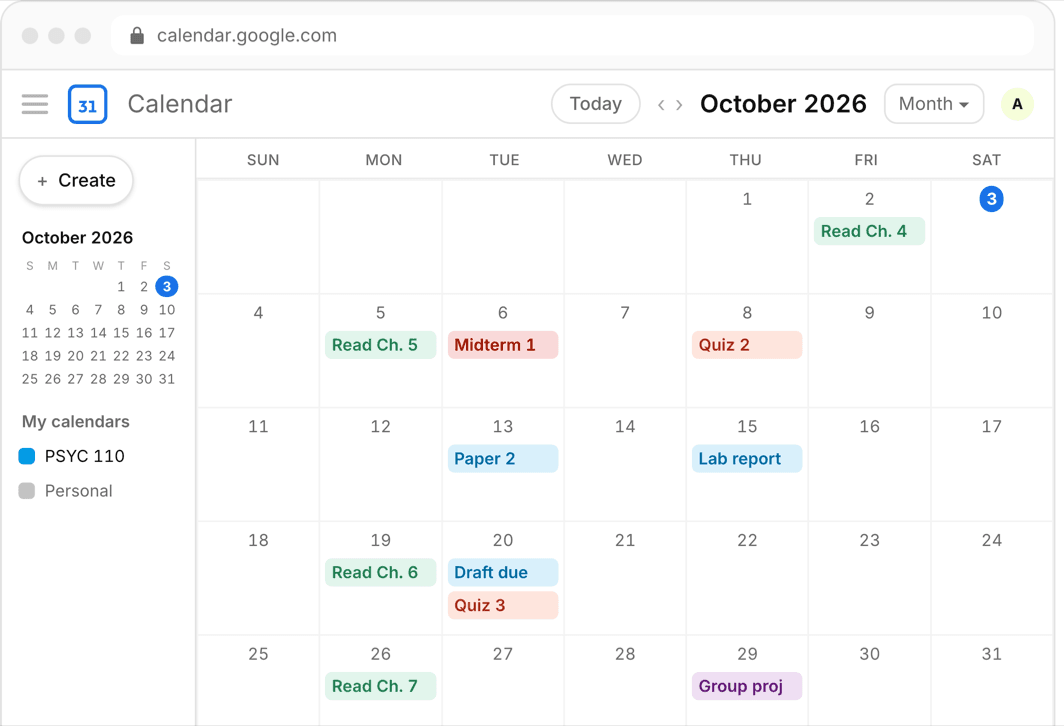
A perfectly organized notes system has a blind spot: it knows everything about the material and nothing about the calendar. What’s due Friday, which exam is worth 35%, which reading actually gets checked — that lives in your syllabus, and no notes workflow surfaces it.
Pairing a notes stack with Classmaite closes the loop: upload each syllabus once and its AI extracts every assignment, exam, and reading deadline plus the grading breakdown in about 30 seconds, then syncs it all to Google Calendar, Apple Calendar, or Outlook with reminders weighted by grade impact. First syllabus free, no account, at myclassmaite.com/try — your notes handle the what, your calendar handles the when.
Frequently asked questions
Is it better to take notes by hand or let AI do it?
Take them yourself, then use AI to improve them. The act of choosing and phrasing what to write is a big part of how note-taking helps you learn — a transcript or AI summary skips that step. The strongest setup is your own rough notes plus an AI second pass for structure and review.
What’s the best AI tool for student notes?
NotebookLM is the standout for studying from notes, because it answers questions using only the materials you upload, with citations. For cleaning and restructuring raw notes, any strong assistant — ChatGPT or Claude — does the job. Otter.ai covers lecture transcription where recording is permitted.
Can AI notes be wrong?
Yes, and confidently so. Transcription garbles technical vocabulary, and summarization can flatten or invent claims while reading perfectly smoothly. Treat AI-generated notes as a draft and verify them against the lecture materials before you study from them.