The Best AI Tools for College Students in 2026 (By Category)
Quick answer
The core AI stack for a college student in 2026 is one general assistant (ChatGPT, Claude, or Gemini), NotebookLM for source-grounded studying, a flashcard tool with AI generation like Quizlet, Grammarly for writing feedback, and a planning tool that gets deadlines out of syllabi and into a calendar. Most have free tiers that cover typical student use.
Drop your syllabus here
Every assignment, exam, and reading on your calendar in about 30 seconds. Free, no account.
PDF, Word, or a photo of a paper one. No syllabus handy? See a sample
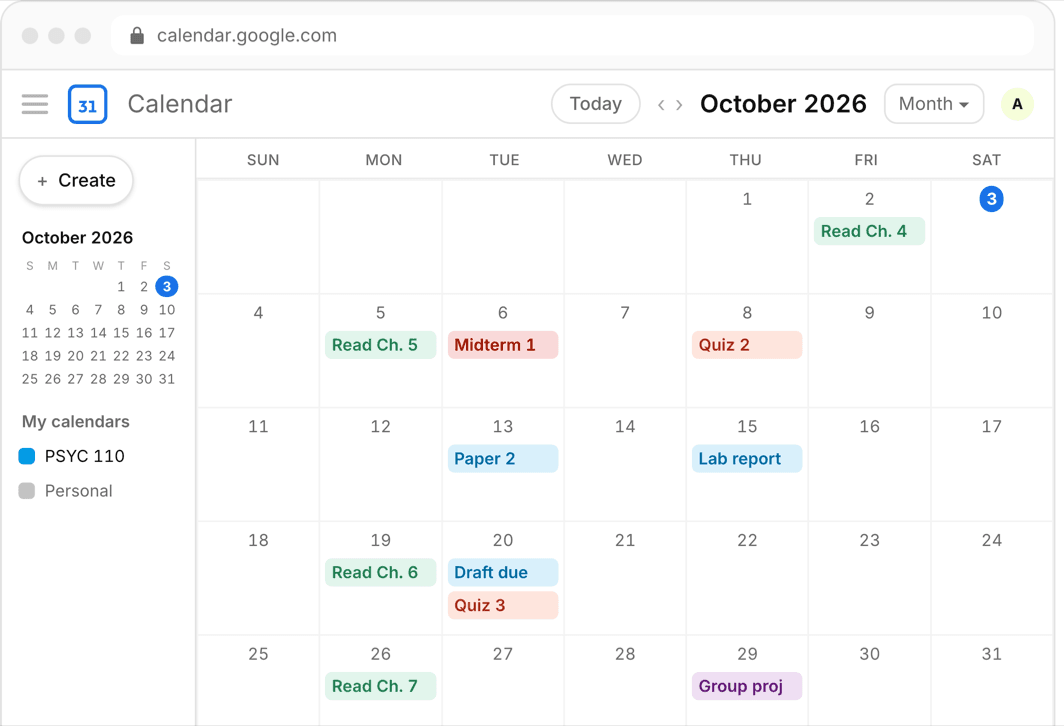
Every “best AI tools for students” list is fifty tools long and half of them are the same chatbot with a different landing page. You don’t need fifty tools. You need one good general assistant plus a small set of specialized tools that each do one job better than the chatbot does.
This list is organized by job, not by hype. For each category: the honest pick, what it’s actually good at, and what it costs a student. Standing reminder before any of them touch coursework — check each course syllabus’s AI policy first.
Or skip all of it
Upload the syllabus. Get the calendar.
Every assignment and exam on Google, Apple, or Outlook in about 30 seconds. One syllabus free, no account, no card.
General assistants: ChatGPT, Claude, Gemini
Pick one and learn it well; all three cover the core study jobs — explaining concepts, generating practice questions, giving feedback on your thinking, and planning. ChatGPT (OpenAI) has the broadest ecosystem and multimodal features. Claude (Anthropic) is the strongest with long documents and offers Projects for holding a course’s materials. Gemini (Google) is the natural pick if you live in Google Docs and Drive, since it’s integrated there.
All three have free tiers that handle typical student workloads. Pay for one only when you’re consistently hitting limits — and if long readings and big PDF sets are your bottleneck, Claude is usually the upgrade that matters.
Research and source-grounded study: Perplexity and NotebookLM
Perplexity is a search-first assistant: it answers with citations to real web sources, which makes it better than a plain chatbot for finding starting-point sources and getting oriented in a topic. It does not replace your library database, and every citation still gets clicked and checked.
NotebookLM (Google) flips the model: instead of searching the web, it answers only from sources you upload — lecture notes, readings, slide decks. That grounding makes it one of the lower-hallucination options for studying your actual course materials, and its generated audio overviews are a genuinely useful way to review on a commute.
Flashcards and recall: Quizlet and Anki
Quizlet’s AI features can generate flashcard sets from your notes, which removes the main friction of card-based study. The catch is quality: auto-generated cards skew toward surface definitions, so edit the deck before trusting it — cut trivia, add the application-level cards AI rarely writes.
Anki remains the gold standard for spaced repetition itself — the scheduling algorithm that decides when you review. A common power combo: generate draft cards with an AI assistant from your notes, curate them by hand, and run them through Anki for the actual reviewing.
Writing feedback: Grammarly, used narrowly
Grammarly’s core value for students is unchanged: catching grammar, clarity, and tone issues in writing you already produced. That’s the safe zone. Its heavier AI writing features — generating or substantially rewriting text — drift into territory many course policies prohibit, so know which mode you’re in.
A reasonable rule: tools may polish sentences you wrote; they don’t write sentences for you. If a suggestion changes your meaning or argument rather than your mechanics, that’s your call to make manually.
What you can skip
- “AI essay writers” — the output is submittable-looking, which is exactly the problem; policy risk plus zero learning
- AI detector / “humanizer” tools marketed to students — evading detection is the cheating, repackaged
- Single-feature wrappers that just call ChatGPT with a template you could type yourself
- Any tool whose pitch is doing the assignment rather than helping you learn it
Semester planning and organization
The unglamorous category that pays off the longest. Your general assistant can build study plans, but only if it knows your real deadlines — and those live in syllabi, which someone has to extract. Google Calendar or any calendar app is the destination; the extraction step is the gap.
Classmaite is our tool, built for exactly that gap, so weigh the bias accordingly — but the mechanics are simple to judge: upload a syllabus (PDF, Word doc, or screenshot) and it extracts every assignment, exam, reading deadline, and the grading breakdown in about 30 seconds, then syncs to Google Calendar, Apple Calendar, Outlook, or any .ics calendar with reminders weighted by grade impact. The first syllabus is free with no account at myclassmaite.com/try, so you can judge it against your own messiest syllabus in under a minute. Notion AI is a reasonable alternative if you already run your life in Notion and don’t mind building the system yourself.
Frequently asked questions
What AI tools should a college student actually pay for?
Start by paying for nothing — free tiers of ChatGPT, Claude, Gemini, NotebookLM, and Quizlet cover most student use. Upgrade the one tool you hit limits on weekly. For most students that’s their main assistant ($20/mo) or a niche tool tied to their major, not five subscriptions.
What’s the best free AI tool for students?
NotebookLM is arguably the best free-tier value for pure studying, because grounding answers in your uploaded course materials fits student work unusually well. For a general assistant, the free tiers of ChatGPT, Claude, and Gemini are all capable — pick whichever interface you’ll actually use.
Is Classmaite free?
Your first syllabus is free with no account required — upload it at myclassmaite.com/try, review what it extracted, and sync to your calendar. Unlimited syllabi and the full feature set are $9/month on Pro.