How to Use AI Without Plagiarizing: Rules That Actually Hold Up
Quick answer
To use AI without plagiarizing: keep AI output out of your submitted text, use it for understanding and feedback instead of production, disclose AI assistance when your course requires it, and cite AI content in APA or MLA format on the rare occasions you’re permitted to include it. Verify any sources AI mentions, since it can fabricate citations that don’t exist.
Drop your syllabus here
Every assignment, exam, and reading on your calendar in about 30 seconds. Free, no account.
PDF, Word, or a photo of a paper one. No syllabus handy? See a sample
Plagiarism has always meant presenting someone else’s work or ideas as your own. AI didn’t change the definition — it just made the “someone else” available at 2 a.m. for free, which makes the line easier to cross and more important to hold. The good news: staying on the right side of it requires a handful of concrete habits, not constant anxiety.
This guide covers the four habits: policy first, understanding over production, disclosure, and citation — plus the AI-specific trap of fabricated sources, which can make you an accidental plagiarist even when your own conduct was clean.
Or skip all of it
Upload the syllabus. Get the calendar.
Every assignment and exam on Google, Apple, or Outlook in about 30 seconds. One syllabus free, no account, no card.
Start where it always starts: the course policy
Every rule below operates inside whatever your course allows. Some professors permit AI with disclosure, some permit it for specific stages like brainstorming, some ban it entirely. The syllabus AI policy defines your playing field, and when it’s unclear, a short email to the professor — answered in writing — settles it.
Don’t generalize across courses. The disclosure format your history professor loves may be prohibited conduct in your writing seminar down the hall.
The core habit: AI informs, you write
The cleanest anti-plagiarism posture is structural: AI output never enters your document. Use it to explain the material, stress-test your argument, suggest what a stronger structure would cover, or quiz you on the readings — then close the chat and write from your own understanding. If the words in the submission are all yours, the plagiarism question mostly evaporates.
Watch for laundering — the gradual slide where “rephrase my sentence” becomes “improve my paragraph” becomes AI prose with your name on it. Paraphrasing AI text doesn’t make it yours; unattributed ideas are plagiarism even in fresh words, which has been true since long before AI.
Disclose like you mean it
When a course allows AI with disclosure, specific beats vague. “AI was used in this assignment” protects no one; “I used Claude to generate practice questions on chapters 3–4 and to critique my thesis statement; all text is my own” shows exactly where the tool sat in your process.
Keep receipts: drafts, notes, and chat transcripts. If your work is ever questioned, a reconstructible process is the strongest defense that exists — and maintaining one changes your behavior for the better all semester.
- Name the tool, the task, and the scope in every disclosure
- State explicitly that the submitted text is your own
- Save chats and drafts until final grades post
Citing AI, and the fabricated-source trap
For the narrow cases where you’re permitted to include or reference AI output, both APA and MLA now provide formats for citing generative AI — typically naming the tool, the provider, the date, and describing the prompt. Follow whichever style your course uses; the citation exists so your reader knows what came from where, which is the entire ethic in one sentence.
The sneakier risk: AI-fabricated citations. Language models invent plausible-looking papers, authors, and page numbers. Submit one and you’ve cited a source that doesn’t exist — academic misconduct in most codes, regardless of intent. Every source an AI surfaces gets verified in a library database or on the actual publisher’s page before it enters your bibliography. No exceptions; the fakes look identical to the real ones.
Give the honest habits some breathing room
Most AI plagiarism isn’t planned — it’s committed at 1 a.m. the night before a deadline, when the blank page and the chatbot are both right there. The integrity habits above are easy for a student with time and nearly impossible for one in a panic. Deadline management is, quietly, integrity infrastructure.
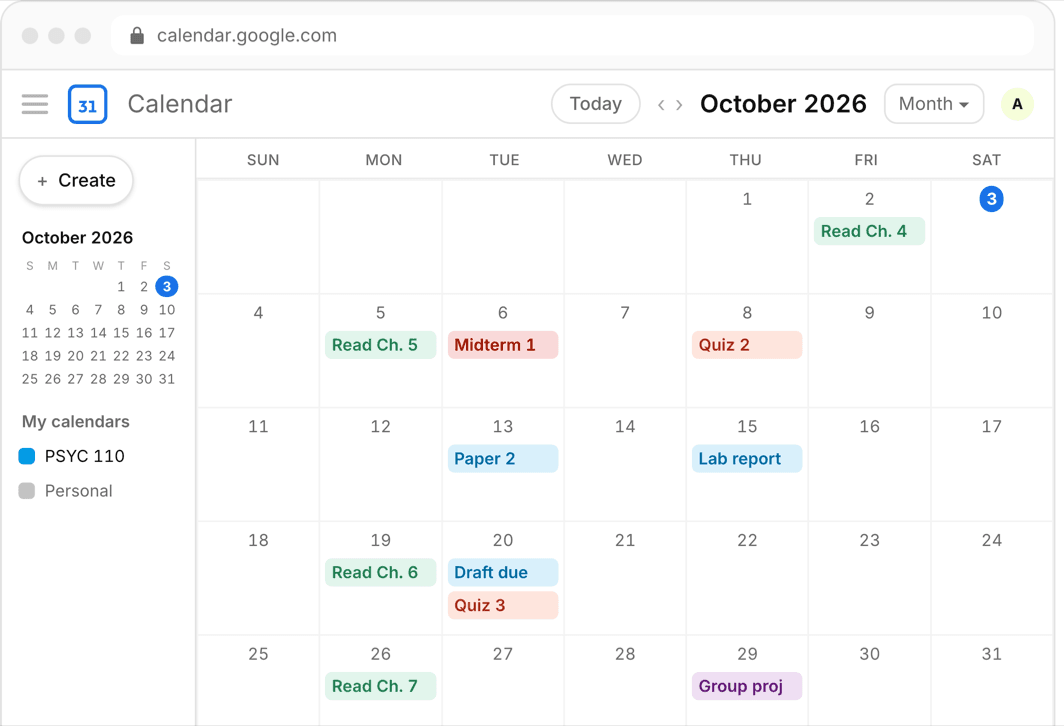
That’s the practical case for Classmaite: upload each syllabus at myclassmaite.com/try and its AI extracts every assignment, exam, and reading deadline with the grading breakdown in about 30 seconds, then syncs to Google Calendar, Apple Calendar, or Outlook with reminders weighted by grade impact — so papers start when there’s still time to write them yourself. First syllabus free, no account required.
Frequently asked questions
How do I cite ChatGPT or Claude in a paper?
APA and MLA both have generative-AI citation formats: broadly, name the tool and provider (e.g., ChatGPT, OpenAI; Claude, Anthropic), the date, and the nature of the prompt, per your style guide’s current template. Cite only when your course permits AI content at all — citation doesn’t override a course ban.
If I cite AI, is it still plagiarism?
Proper citation addresses the plagiarism issue, but not the authorization issue — a course that prohibits AI use isn’t satisfied by a citation. And submitting a paper that is mostly cited AI text fails most assignments on the merits, since the assignment was your analysis.
Why does AI make up citations?
Language models generate plausible text rather than looking facts up, so they produce realistic-looking author-title-journal combinations that don’t exist. Always verify AI-suggested sources in a library database or the publisher’s site before citing — fabricated references in submitted work are misconduct even when unintentional.