How to Use AI to Outline an Essay (Without It Writing the Essay)
Quick answer
AI is a legitimate outlining tool when it structures your ideas — proposing organizations, stress-testing your thesis, flagging gaps — and you write all the prose yourself. Check each course’s syllabus AI policy first: a few professors treat even AI-assisted outlines as unauthorized help.
Drop your syllabus here
Every assignment, exam, and reading on your calendar in about 30 seconds. Free, no account.
PDF, Word, or a photo of a paper one. No syllabus handy? See a sample
Outlining is the sweet spot of AI-assisted writing: it’s where AI adds the most thinking value while touching none of the sentences you’ll submit. A good outline session with Claude or ChatGPT feels like arguing with a sharp TA — you leave with a tighter thesis and a clearer structure, and every word of the eventual draft is still yours.
This guide covers the workflow: how to feed AI your ideas instead of asking it for ideas, the prompts that pressure-test an argument, and the exact point where “outlining help” drifts into ghostwriting. One caveat before anything else — a minority of courses prohibit AI at any stage of writing, so read the syllabus AI policy before you open a chatbot.
Or skip all of it
Upload the syllabus. Get the calendar.
Every assignment and exam on Google, Apple, or Outlook in about 30 seconds. One syllabus free, no account, no card.
Why outlining is the defensible AI use
The integrity line in most 2026 AI policies runs between structure and prose. Help organizing your own ideas — the job outlines do — is broadly treated like talking a paper through with a writing center tutor. Generated sentences you submit are treated like sentences someone else wrote, because they are.
Outlining also happens to be where AI is genuinely useful. Models are mediocre essayists but good editors of structure: they spot when two sections make the same point, when your thesis doesn’t match your evidence, and when an objection goes unanswered. Use them there, and keep the drafting for yourself.
Start with your ideas, not a blank prompt
The failure mode is opening with “outline an essay about X.” You’ll get a generic five-part structure assembled from the internet’s average take — which is both weak and conspicuously not yours. The fix is to brain-dump first: type your rough thesis, the evidence you have, the readings you’re working from, and what confuses you.
Then ask for structure on top of your material: “Here’s my thesis and evidence. Propose two or three ways to organize this into an argument, and tell me the tradeoffs of each.” Now the AI is arranging your thinking rather than substituting for it — and the outlines it returns are ones you can actually defend in office hours.
- Dump your thesis, evidence, and course readings into the prompt before asking for anything
- Ask for two or three candidate structures with tradeoffs, not one “best” outline
- Reject any section you couldn’t explain the purpose of out loud
- Keep your notes and prompt history — it’s proof the thinking was yours
Prompts that stress-test your argument
The highest-value move isn’t generating the outline — it’s attacking it. Once you have a structure, ask: “What’s the strongest objection to this thesis? What evidence would change my conclusion? Which section is doing the least work?” Every objection you can’t rebut is a paragraph your essay needs, found before your grader finds it.
You can also run the reverse test. Ask the AI to argue the opposing position as persuasively as it can, then outline your response. Essays written against a real counterargument read a full letter grade sharper than essays written into a vacuum.
From outline to draft: the line to hold
The drift from outlining to ghostwriting rarely happens in one step. It happens when “expand this bullet a little” becomes a topic sentence, then a paragraph. Hold a bright line: the outline can contain claims, evidence pointers, and structure — never finished sentences you paste into the draft.
Write the draft in a separate document with the chatbot closed. If you want AI feedback afterward, paste your finished draft back and ask where the argument sags — that’s feedback on writing you did, which is a different and far more defensible activity than submitting writing you didn’t.
- Outline bullets stay fragments — if it reads like a sentence from the essay, delete it
- Draft with the chatbot closed; reopen it only for feedback on your finished prose
- Never paste AI text into the draft “just as a placeholder” — placeholders get submitted
Good outlines need lead time
Everything above assumes you’re outlining days before the deadline, not hours. The stress-test loop — outline, attack, revise, draft — is what makes AI outlining worth doing, and it dies when the paper is due at midnight. Most ghostwriting temptation is really a scheduling failure wearing a disguise.
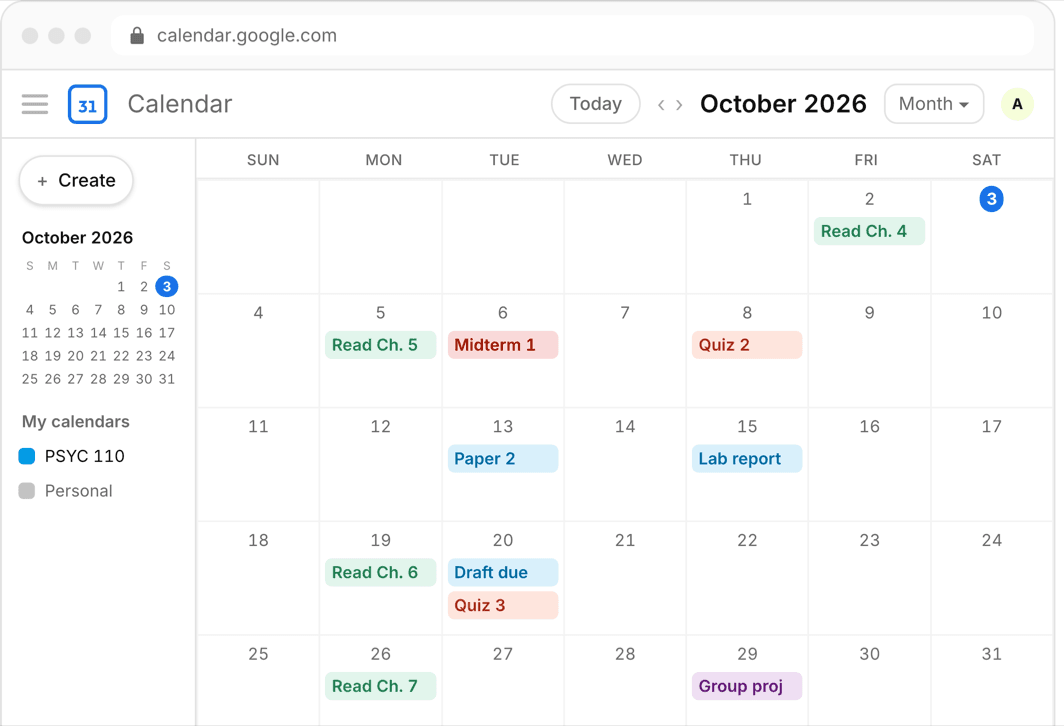
That’s the part worth automating. Upload your syllabi at myclassmaite.com/try and Classmaite’s AI pulls every paper deadline, exam, and reading — with the grading breakdown — in about 30 seconds, then syncs them to Google Calendar, Apple Calendar, or Outlook with reminders weighted by grade impact. The 25%-of-your-grade essay shows up on your radar while there’s still time to outline it properly. First syllabus is free, no account needed.
Frequently asked questions
Is using AI to outline an essay cheating?
In most courses, no — organizing your own ideas with AI is generally treated like working with a tutor, as long as every submitted sentence is yours. But policies vary by professor, and some prohibit AI at any stage of writing. The syllabus AI policy is the only answer that counts; when it’s ambiguous, ask in writing.
Will an AI-assisted outline make my essay sound like AI?
Not if you hold the line at structure. Detection concerns attach to AI-generated prose — phrasing, rhythm, vocabulary — not to the order of your arguments. An essay drafted entirely in your own words from an AI-pressure-tested outline reads like you, just better organized.
What’s the best AI for outlining essays?
ChatGPT, Claude, and Gemini all handle outlining well; Claude is often preferred for long source material and detailed argument critique. The tool matters far less than the workflow: feed it your ideas, ask for structures and objections, and write the prose yourself.