AI for Research Papers: What It Speeds Up, What It Sabotages
Quick answer
AI helps research papers at the edges: finding starting-point literature with citation-backed tools like Perplexity, summarizing papers you’ve collected, outlining, and critiquing your structure and argument. It cannot be trusted to supply citations — language models fabricate convincing fake references — and it shouldn’t write the paper itself. Verify every source independently and check your course’s AI policy before using any of it.
Drop your syllabus here
Every assignment, exam, and reading on your calendar in about 30 seconds. Free, no account.
PDF, Word, or a photo of a paper one. No syllabus handy? See a sample
A research paper is really four jobs: find sources, understand them, build an argument, and write it. AI is legitimately useful in three of those jobs and actively dangerous in the parts of them most students want to outsource — above all, anything involving citations, where language models confidently invent papers that have never existed.
Here’s the honest map, job by job, with the workflow that gets the speed without the sabotage. As with all coursework AI: your course or department’s policy governs, and research courses often have stricter rules than average — check before you start, not after.
Or skip all of it
Upload the syllabus. Get the calendar.
Every assignment and exam on Google, Apple, or Outlook in about 30 seconds. One syllabus free, no account, no card.
Literature discovery: good starting points, never endpoints
For orientation in an unfamiliar topic, citation-backed tools beat plain chatbots. Perplexity answers with linked sources you can actually click; research-specific tools like Elicit search real paper databases and summarize findings across them. Ten minutes with these can rough out a topic’s landscape — key debates, recurring names, obvious search terms — faster than cold database searching.
Then the real work moves to Google Scholar and your library’s databases. AI discovery tools miss things, overweight what’s popular, and summarize papers imperfectly. They tell you where to dig; they are not the dig.
The citation warning, in bold
Never ask a chatbot for sources and put them in a bibliography. ChatGPT, Claude, and Gemini all fabricate references — real-sounding authors, plausible titles, journals that exist, page numbers that don’t. This is the single most common way AI wrecks student research papers, and it constitutes academic misconduct in most integrity codes even when unintentional.
The rule that makes you immune: every citation in your paper corresponds to a source you personally opened. Found via AI, fine — but verified in a database or on the publisher’s page, and read at least in relevant part, by you. If you can’t produce the PDF, it doesn’t go in the paper.
Understanding sources you’ve collected
Once you have real PDFs, AI becomes a legitimate reading accelerator. Upload papers to Claude or NotebookLM and ask for the argument, methods, and limitations; ask how two papers disagree; ask what a paper would say about your thesis. NotebookLM is particularly suited here since it grounds every answer in your uploaded sources and shows citations back to them.
Use summaries for triage — deciding which papers deserve a full read — not as a substitute for reading the ones you cite. Anything you quote or lean on, you read directly; models flatten nuance and occasionally reverse a finding.
Outlining and argument-testing
This is AI’s strongest legitimate contribution to the writing side. Describe your thesis and evidence and ask for candidate structures — organized by theme versus chronology versus methodological camp — with tradeoffs. Then attack your own argument: “What’s the strongest objection to this thesis? What evidence would change the conclusion? Where is the logical gap?” Every answer you can’t rebut is a paragraph your paper needs.
Draft-stage structure checks work the same way: paste your draft and ask whether each section advances the thesis, where a reader loses the thread, and what’s asserted but never supported. That’s feedback on writing you did — the defensible use — as opposed to generated prose, which in most research courses is both prohibited and, frankly, mediocre at the level graders read for.
The paper AI can’t save is the one started too late
Every workflow above assumes weeks, because research papers are sequential: sources take time to arrive, reading takes time to compound, arguments take drafts. The failure mode AI genuinely cannot fix is the paper started four days out — that’s where the fake-citation shortcuts and generated paragraphs start looking tempting, and where they get caught.
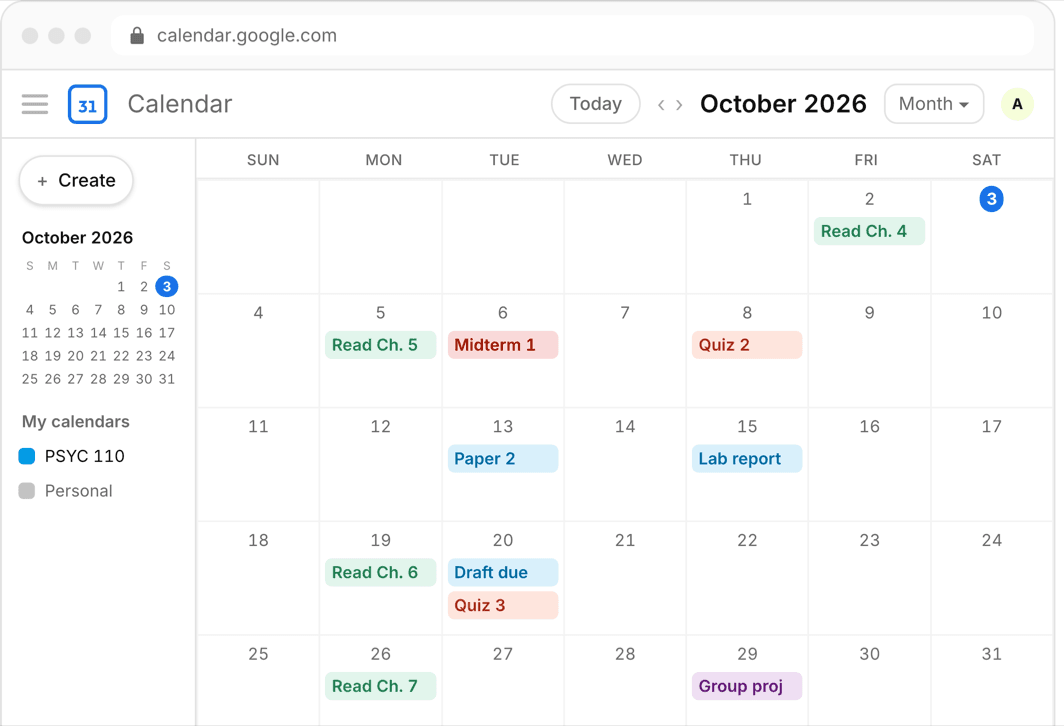
So treat the timeline as part of the method. Classmaite handles the tracking half: upload your syllabi at myclassmaite.com/try and its AI extracts every paper deadline, exam, and reading with the grading breakdown in about 30 seconds, then syncs to Google Calendar, Apple Calendar, or Outlook with reminders weighted by grade impact — surfacing the 30%-of-your-grade paper while there’s still time to write it honestly. First syllabus free, no account.
Frequently asked questions
Can I use AI to find sources for a research paper?
Yes, for discovery: Perplexity and research tools like Elicit surface real, linked literature and are useful starting points. Never take citations from a plain chatbot answer — models fabricate convincing fake references. Verify and personally read anything that ends up in your bibliography.
Will my professor know if AI wrote my research paper?
The risk is high and multi-layered: voice mismatch with your other writing, hallmark AI phrasing, and — most fatally — fabricated or subtly wrong citations, which professors in the field spot quickly. A single fake reference typically triggers scrutiny of the entire paper.
Is it okay to have AI summarize journal articles?
For triage, yes — summaries help you decide which papers merit a full read. For papers you actually cite, read the relevant sections yourself; AI summaries flatten nuance and occasionally misstate findings, and your argument inherits every one of those errors.