AI for STEM Classes: Problem Sets, Derivations, and Debugging Without Cheating Yourself
Quick answer
In STEM classes, use AI after you attempt a problem, not instead of attempting it: try the problem, then ask the AI to explain where your approach went wrong, check your derivation step by step, or help you interpret a bug. Copying AI solutions works until the exam, where you’ll sit alone with a pencil.
Drop your syllabus here
Every assignment, exam, and reading on your calendar in about 30 seconds. Free, no account.
PDF, Word, or a photo of a paper one. No syllabus handy? See a sample
STEM courses have a brutal feedback mechanism that most other classes lack: closed-book, no-AI exams that are usually worth most of your grade. That changes the calculus on AI use entirely. In an essay course, over-relying on AI risks an integrity case. In a STEM course, it also quietly guarantees you’ll bomb the midterm, because problem-solving is a skill you build by struggling, not by reading solutions.
Used correctly, though, AI is the best problem-set companion STEM students have ever had — an always-awake TA that explains any step, checks any derivation, and never makes you feel dumb for asking the same question three times. The line between those outcomes is one habit: attempt first.
Or skip all of it
Upload the syllabus. Get the calendar.
Every assignment and exam on Google, Apple, or Outlook in about 30 seconds. One syllabus free, no account, no card.
The golden rule: attempt first, ask second
Every legitimate STEM use of AI starts after a genuine attempt. Struggle for twenty minutes, get stuck, and you’ve earned the question — and more importantly, your brain now has a hook for the explanation. Skip the attempt and the AI’s solution slides past you without leaving a trace.
This also happens to be where most syllabus AI policies draw the line: getting help understanding is usually fine, submitting generated solutions usually isn’t. Check your course’s policy — STEM departments vary widely, and some prohibit AI on problem sets entirely because the sets are the practice.
The problem-set explanation loop
When you’re stuck, don’t ask for the solution. Ask for the next move: “Here’s the problem and here’s my work so far. Don’t solve it — tell me if my setup is right and give me a hint toward the next step.” Then go back and finish it yourself.
If you had to be walked most of the way through, the loop isn’t done. Ask the AI for a similar problem with different numbers and solve that one cold. Being able to reproduce the method on a fresh problem is the only evidence that you learned it.
Derivation checking: AI as a second pair of eyes
Type or photograph your derivation and ask: “Check this step by step. Flag any algebra errors, sign errors, or unjustified steps.” This catches the dropped negative in line four that would otherwise cost you an hour.
Two warnings. First, models still make confident math mistakes — if the AI flags a step you believe is right, work it by hand or verify with a second tool before conceding. Second, checking your derivation is not the same as asking it to produce the derivation. The first is proofreading; the second is outsourcing.
Code debugging without outsourcing the skill
Debugging is the skill CS courses are secretly teaching, so protect it. A clean escalation ladder: first, read the error and form a hypothesis yourself. Second, paste the error and ask the AI to explain what it means — not to fix it. Third, if you’re still stuck, share the relevant snippet and ask for the category of bug, then find the line yourself.
Letting AI write your assignment code from scratch fails on both fronts: many intro courses prohibit it outright, and even where it’s allowed you graduate from the assignment having practiced nothing. Save code generation for the courses and jobs where the skill being assessed isn’t “can you write this yourself.”
The exam reality check
Here’s the self-test that keeps you honest: could you redo this week’s problem set right now, closed-book, without the AI? If the answer is no, your problem-set grade is writing checks your exam grade can’t cash.
Schedule one AI-free session per week where you re-solve a sampling of recent problems cold. It’s the cheapest insurance in college — and pairs perfectly with the AI practice-exam loop in the week before a midterm.
Pace the struggle — it needs calendar room
Attempt-first studying has one requirement copy-pasting doesn’t: time. You can paste a problem into ChatGPT at 11:40pm for an 11:59 deadline, but you can’t struggle productively in nineteen minutes. The whole approach collapses without a head start.
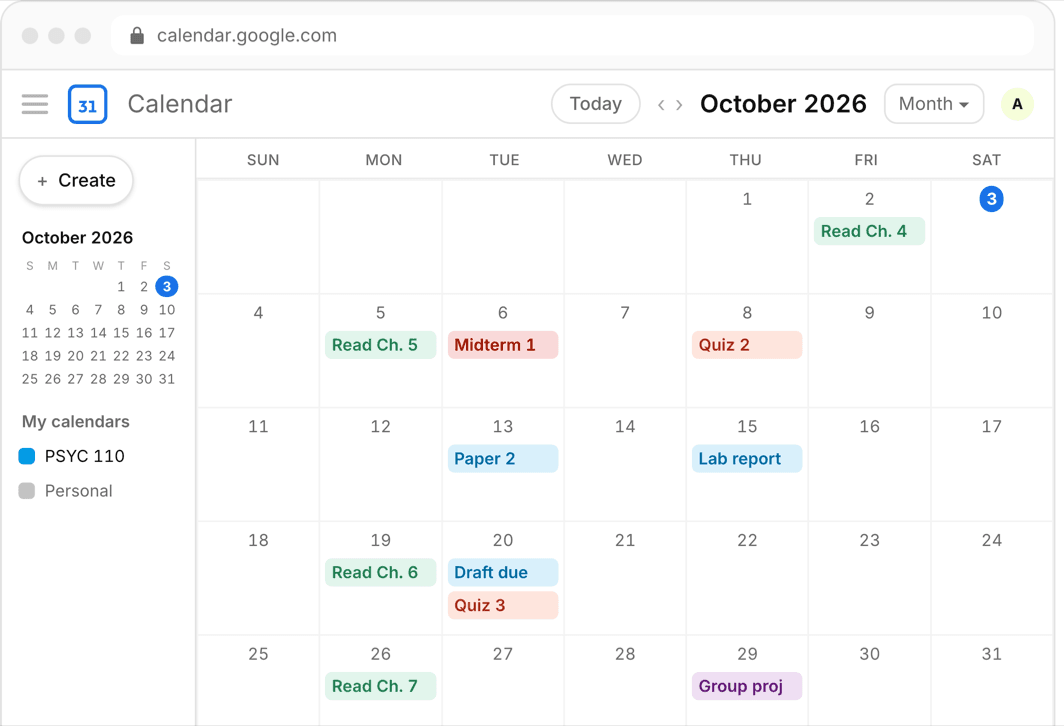
That’s a scheduling problem, and it’s solvable in 30 seconds: drop your syllabus into Classmaite and every problem set, lab, and exam lands in your calendar with reminders weighted by grade impact — so the struggle time exists before the deadline does.
Frequently asked questions
Can I use AI on problem sets at all?
Depends on the course — check the AI policy in your syllabus, and ask the professor if it’s silent. Where it’s allowed, the line that keeps you both compliant and competent is: attempt first, use AI to understand your mistakes, and confirm you can re-solve similar problems without it.
Is AI actually reliable for college-level math and physics?
It’s good and improving, but not trustworthy enough to be your answer key. Models still make confident errors in multi-step algebra and edge-case physics. Use AI to check reasoning and explain steps, and verify anything surprising against your textbook or by hand.
What’s the best AI tool for STEM courses?
ChatGPT, Claude, and Gemini all handle step-by-step math and code explanation well, and all accept photos of handwritten work. For studying from lecture PDFs and textbooks, NotebookLM is useful because it answers only from your uploaded materials. Try your top choice on a solved problem first to gauge its reliability in your specific course.