The Best Assignment Tracker Apps for College in 2026
Quick answer
MyStudyLife is the best free dedicated assignment tracker, Todoist is the best if you want one system for coursework and life, and a spreadsheet is the most flexible free option. Classmaite is the pick if your bottleneck is entering assignments at all — it extracts them from your syllabi automatically and puts them on your calendar.
Try it with your own syllabus
Every assignment, exam, and reading on your calendar in about 30 seconds. Free, no account.
PDF, Word, or a photo of a paper one. No syllabus handy? See a sample
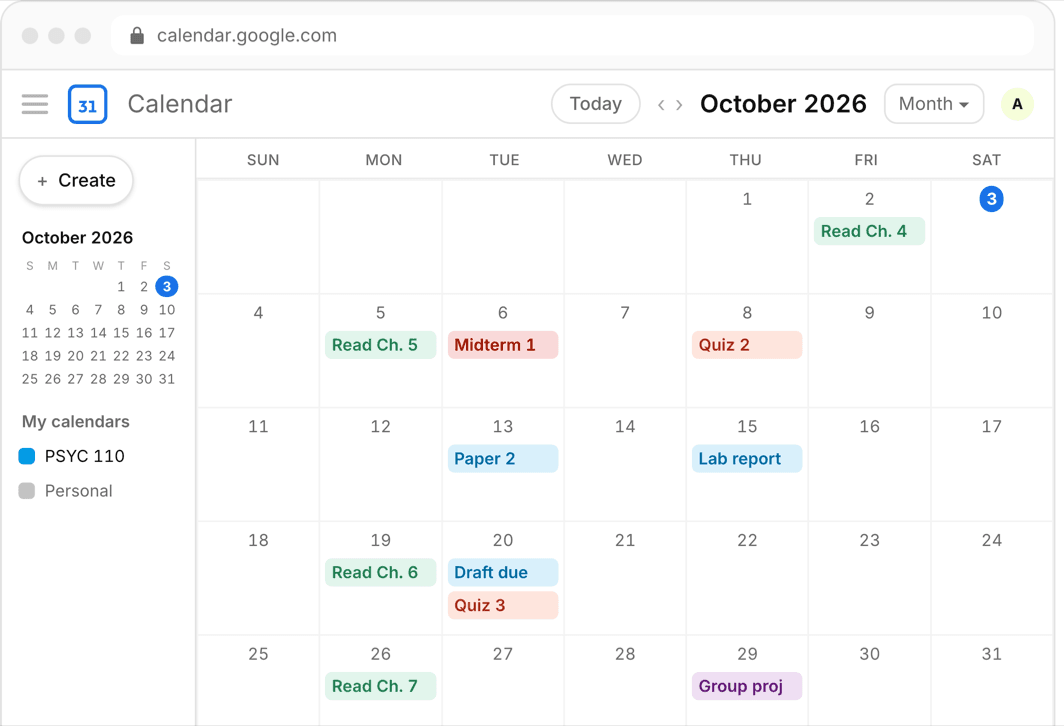
Tracking assignments sounds simple — a list with due dates — but the failure mode is always the same: the list falls out of date the first week you are too busy to maintain it, which is precisely the week you needed it most.
So this comparison judges assignment trackers on two axes: how good the tracking experience is, and how much work it takes to get assignments into the tracker and keep them current. The second axis is where most tools quietly lose.
Or skip all of it
Upload the syllabus. Get the calendar.
Every assignment and exam on Google, Apple, or Outlook in about 30 seconds. One syllabus free, no account, no card.
The dedicated trackers: MyStudyLife and Todoist
MyStudyLife is free and built for exactly this: assignments and exams attached to classes, with your timetable alongside. If you want a purpose-built academic tracker without building anything, start here. Todoist is the stronger pure task manager — natural-language entry, projects per course, recurring tasks — and the better choice if you want club work, applications, and chores in the same trusted system as coursework.
Both share the same cost: every assignment is entered by hand, and neither knows that your history final is worth twenty times your weekly quiz. They track what you type; the typing is on you.
The flexible builds: Notion and spreadsheets
A Notion database with columns for course, due date, status, and weight is a genuinely great assignment tracker, and free student templates get you most of the way. Sort by due date for a to-do view, group by course for a semester view. A plain Google Sheet achieves the same with less polish and even more flexibility — plus painless sorting, formulas for grade projections, and zero learning curve.
Both are blank canvases: powerful if you enjoy building and maintaining a system, and prone to abandonment if you do not. Every row is manual entry, and neither sends reminders without extra setup.
The built-ins: LMS to-do lists and Google Tasks
Canvas, Blackboard, and Moodle each surface a built-in to-do or upcoming list of assignments professors have entered, and it updates itself — genuinely zero-maintenance for whatever it covers. Google Tasks is the minimal free option that integrates directly with Google Calendar for anything you add yourself.
The LMS list has the coverage problem: it only shows what instructors entered, which routinely misses readings, participation deadlines, and entire paper-syllabus courses. Google Tasks is deliberately bare — fine as a lightweight inbox, thin as a full tracking system.
Classmaite — when the problem is entry, not tracking
Classmaite comes at the problem from the other end. Instead of giving you a nicer empty list, it fills the list: upload each syllabus (PDF, Word, or a screenshot) and it extracts every assignment, exam, and reading deadline plus the grading breakdown in about 30 seconds. You review and correct anything, then sync the lot to Google Calendar, Apple Calendar, or Outlook, with reminders weighted by grade impact so the big-ticket work surfaces earliest. First syllabus free, no account needed; $9/month for unlimited syllabi.
To be clear about what it is not: Classmaite is not a day-to-day task manager. There is no place for “email advisor” or “laundry.” It solves start-of-semester entry and deadline awareness, and pairs naturally with a simple tracker — or just your calendar — for daily work.
How to choose
- Want a free, purpose-built academic tracker: MyStudyLife.
- Want one system for every task in your life: Todoist.
- Enjoy building and customizing your own setup: Notion, or a Google Sheet if you want maximum simplicity.
- Professors enter everything into the LMS: the built-in LMS to-do list may honestly be enough.
- Dread the data entry more than the tracking: Classmaite to extract and calendar everything, plus the lightest tracker you will actually maintain.
Frequently asked questions
Is a spreadsheet really good enough to track assignments?
Yes — a well-kept Google Sheet with course, task, due date, weight, and status columns is one of the most effective trackers there is, and it is free. Its weaknesses are no reminders and manual upkeep, so pair it with calendar events for anything you cannot afford to miss.
Why not just use the Canvas to-do list?
Use it — it is free and self-updating. Just check its coverage against each syllabus in week one. Most students find some professors enter everything and others enter almost nothing, so the LMS list works as one input, not as the whole system.
Do I need both an assignment tracker and a calendar?
They answer different questions: the tracker knows what is due and its status; the calendar knows when you will do it. Small course loads can survive on either one alone. Heavier loads benefit from deadlines on the calendar (for visibility and reminders) plus a simple list for working status.