The Best Student Planner Apps in 2026 (By Student Type)
Quick answer
There is no single best student planner — MyStudyLife is the best free purpose-built planner, Notion is best for students who enjoy building their own system, Todoist is the best pure task manager, and Classmaite is best if your priority is getting syllabus deadlines onto a calendar without manual entry. Pick based on how much setup you will actually do.
Try it with your own syllabus
Every assignment, exam, and reading on your calendar in about 30 seconds. Free, no account.
PDF, Word, or a photo of a paper one. No syllabus handy? See a sample
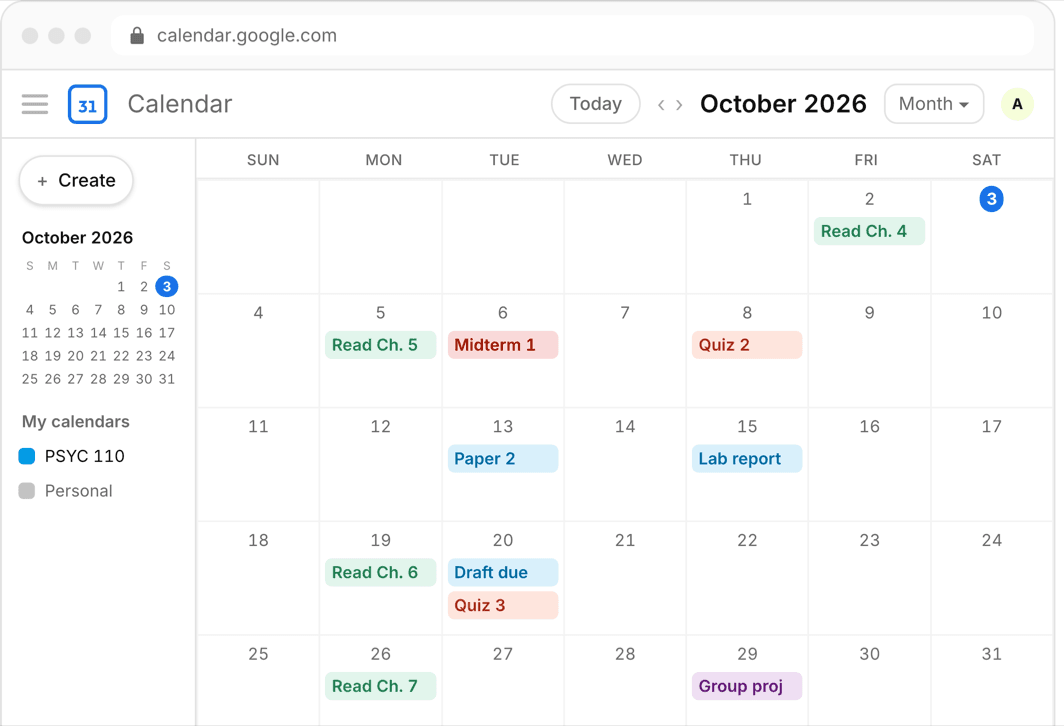
Every “best planner app” list promises one winner, but student organization is not a one-winner category. A pre-med tracking 140 deadlines, a tinkerer who loves customizing dashboards, and a student who has abandoned three apps already need genuinely different tools.
This roundup covers the six approaches that actually survive contact with a real semester — MyStudyLife, Notion, Todoist, Google Calendar, Classmaite, and the humble paper planner — with an honest read on who each one fits and where each one falls down.
Or skip all of it
Upload the syllabus. Get the calendar.
Every assignment and exam on Google, Apple, or Outlook in about 30 seconds. One syllabus free, no account, no card.
MyStudyLife — best free purpose-built student planner
MyStudyLife is designed specifically for students: it understands class schedules (including rotating timetables), tasks, and exams as first-class concepts, and it is free. If you want an app that already speaks “student” — periods, subjects, exam dates — without building anything yourself, this is the strongest free option in the category.
The tradeoff is manual entry: your classes, assignments, and exams all go in by hand. For students happy to spend an evening setting up the semester and a few minutes a week maintaining it, that is a fair deal. Best for: students who want a dedicated, free student planner and do not mind typing in their schedule.
Notion — best for students who love building systems
Notion is a flexible workspace, not a planner — which is exactly why some students swear by it. Notes, assignment databases, reading trackers, and semester dashboards all live in one place, and thousands of free student templates give you a head start. If organizing is something you genuinely enjoy, Notion is the most capable option on this list.
The same flexibility is the trap: Notion does nothing until you build it, and elaborate setups have a way of becoming procrastination with extra steps. Every due date is still entered by hand. Best for: tinkerers who want notes and planning unified, and who will actually maintain what they build.
Todoist — best pure task manager
Todoist is an excellent general task manager with fast natural-language input (“essay draft friday 5pm #history” just works), clean cross-platform apps, and enough structure for projects, labels, and recurring tasks without drowning you in options. For managing everything in your life — chores, applications, club work, and coursework — it is hard to beat.
It has no awareness of syllabi, courses, or grade weights; a 40% final and a 2% quiz look identical in the list. Best for: students who want one trusted system for all of life’s tasks and are fine adding coursework deadlines manually.
Google Calendar and paper planners — the timeless baselines
Google Calendar is free, on every device, and connected to everything — it is where deadlines are most likely to actually be seen, because you already look at it. Time-blocking study sessions next to classes and work shifts is where it shines. But it is a calendar, not a planner: no task states, no course concepts, and every event is created by hand or imported. Best for: students who mainly need to see their time laid out.
Paper deserves a real place on this list too. Writing deadlines by hand helps memory, a paper planner never shows you a notification for something else, and flipping to a week spread is faster than any app. The costs are structural — no reminders, no sync, no backup if it is lost, and rescheduling means rewriting. Best for: students who find screens distracting and check the planner daily without fail.
Classmaite — best for automatic syllabus-to-calendar setup
Classmaite attacks the step every other app on this list leaves to you: getting the semester’s deadlines into the system in the first place. Upload each syllabus — PDF, Word doc, or a photo — and it extracts every assignment, exam, grading weight, and reading deadline in about 30 seconds. You review and edit the results, then sync to Google Calendar, Apple Calendar, or Outlook, with reminders weighted by how much each item affects your grade. The first syllabus is free with no account; unlimited syllabi and full sync are $9/month.
It is deliberately not a general planner — no habit tracking, no notes, no life to-dos. Many students pair it with one of the tools above: Classmaite populates the calendar, something else handles day-to-day tasks. Best for: students whose real bottleneck is the hours of data entry at the start of each semester.
The honest matchmaking table
- Want a free, dedicated student planner and don’t mind manual entry: MyStudyLife.
- Love customizing and want notes + planning in one place: Notion.
- Want one task system for coursework and everything else in life: Todoist.
- Mostly need to see your time and already live in Google: Google Calendar.
- Hate the start-of-semester data entry more than anything: Classmaite (first syllabus free).
- Focus best away from screens: a paper planner, possibly with a synced calendar as backup for reminders.
Frequently asked questions
What is the best free planner app for college students?
MyStudyLife is the strongest free dedicated student planner — it handles class schedules, tasks, and exams out of the box. Google Calendar is the best free option if you mainly need time management, and Notion’s free plan is the best if you want to build a custom system. All three require manual entry of your deadlines.
Should I use more than one of these apps?
Often yes. A common stack is one calendar (Google or Apple) as the single source of truth for time, one tool to populate it (manual entry, an LMS feed, or Classmaite), and optionally one task manager or notes tool. Two or three tools with clear jobs beats one tool doing everything badly.
Why do most students abandon planner apps by October?
Usually because the setup and upkeep cost more effort than the app returns. Systems that require entering every deadline by hand tend to decay the first busy week. Lowering the maintenance burden — automatic feeds, syllabus extraction, or a radically simple paper system — is what makes a planner survive midterms.