The Best Syllabus Organizer Apps in 2026, Compared Honestly
Quick answer
Classmaite is the most direct syllabus-to-calendar tool: upload a PDF and every deadline lands in Google, Apple, or Outlook Calendar in about 30 seconds, first syllabus free with no account. DormWay is the best fully free option if you are happy living in a separate app, Due Gooder is the pick for an iPhone-native app with widgets, and Coursicle fits schools where every professor uses the LMS.
Try it with your own syllabus
Every assignment, exam, and reading on your calendar in about 30 seconds. Free, no account.
PDF, Word, or a photo of a paper one. No syllabus handy? See a sample
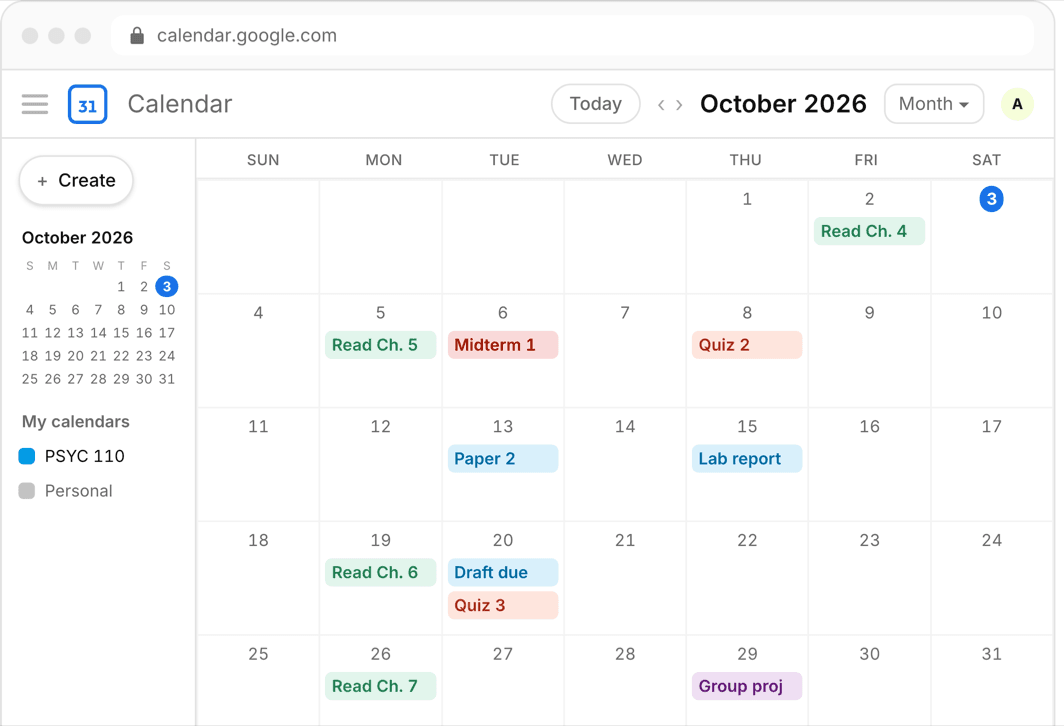
Every semester starts the same way: a stack of syllabus PDFs, each hiding twenty or thirty dated deadlines in a wall of text, and a calendar that knows about none of them. In 2026 there are at least eight syllabus organizer apps built to close that gap, and they differ far more on price, platform, and what happens after the import than on the import itself.
We make Classmaite, so read the ranking with that in mind. Every fact about a competitor below was checked against that app’s own website or App Store listing on September 16, 2026 — not against other roundups — and where a listing does not say, we say so rather than guess. Prices change; check before you pay.
Or skip all of it
Upload the syllabus. Get the calendar.
Every assignment and exam on Google, Apple, or Outlook in about 30 seconds. One syllabus free, no account, no card.
The short version
- Best for getting deadlines into the calendar you already use: Classmaite (Google, Apple, Outlook, or .ics; first syllabus free, then $9/mo).
- Best fully free: DormWay (unlimited syllabus uploads at $0 on its own pricing page; web plus Apple apps).
- Best iPhone-native experience: Due Gooder (Home Screen widgets, class share codes, 30-minute pre-class alerts; Pro from $4.99/mo).
- Best if you want to be texted: Wick (SMS reminders timed to when you should start).
- Best for planning study hours, not just deadlines: Shovel (time-blocking planner; no free tier, 7-day trial).
- Best if every professor lives in Canvas or Blackboard: Coursicle (LMS sync, no syllabus parsing).
- Best free scanner for one class: Sylly (free iPhone app, Apple Calendar only).
1. Classmaite — syllabus in, real calendar out
Classmaite does one job first: you upload a syllabus (PDF, Word, or a photo of a paper handout), and in about 30 seconds it extracts every assignment, exam, reading, and class meeting time, plus the grading table. You review it, fix anything it misread — including the class times — and sync to Google Calendar, Apple Calendar, or Outlook, or download an .ics. Reminders are weighted by grade impact, so a final worth 35% gets more notice than a 2% quiz.
Because it reads the grading table, it also does the math nobody else on this list does the same way: enter the scores you have back, pick a target, and it tells you what you need on what is left. Seeing where you stand is free; working backwards from a target is Pro. A class can be shared with a six-character code so a whole section gets the dates from one upload.
It runs on the web, so it works on Android, iPhone, and any laptop. The first syllabus is free with no account and no card; Pro is $9/mo after a 24-hour trial, cancel in one click. It is deliberately narrow: no lecture recording, no file locker, Canvas sync is in beta and other LMSs are not supported.
2. DormWay — the free one
DormWay’s pricing page lists unlimited syllabus uploads, Canvas sync, an AI syllabus analyzer, an assignment tracker, and a GPA and grade calculator at $0 per year, and its App Store listing says there are no premium tiers or paywalls. A Pro plan is described as in development but not for sale. For a student on a budget that is hard to argue with.
The trade-offs are platform and age of the product. It is a web app with Apple companion apps that require iOS, iPadOS, or macOS 26; Android is listed as coming soon. Direct integrations are Canvas and Google Calendar, with Brightspace, Blackboard, Moodle, Google Classroom, and Schoology handled through calendar-feed import. The App Store listing had two ratings when we checked.
3. Due Gooder — iPhone-native, with widgets and share codes
Due Gooder is the closest thing to Classmaite in scope, built as an Apple app first. Upload a syllabus or connect Canvas or Brightspace, get a morning summary of what is due, reminders before deadlines, a heads-up 30 minutes before class, Home Screen widgets, and a share code to join a classmate’s course. The AI tier adds lecture recording with chapter-marked notes, a file “Locker,” flashcards, and practice tests.
Pricing on the App Store listing is Pro at $4.99/mo or $29.99/yr and AI Pro at $9.99/mo or $49.99/yr; the marketing site does not publish prices, and what the free download includes is not spelled out. It runs on iPhone, iPad, Mac, and Apple Vision, with no Android app. The listing showed 3.2 stars across 44 ratings when we checked, and we found no grade tracking or what-do-I-need-on-the-final feature on the site or listing. Full comparison: Classmaite vs Due Gooder.
4. Wick — deadlines by text message
Wick pulls assignments from Canvas, Moodle, Blackboard, D2L, and syllabus uploads into a daily plan, then texts you SMS reminders timed to when you should start, not just when things are due. It is on iOS, Android, and the web, which makes it one of the few apps here that covers every phone.
Its App Store listing shows Premium at two monthly prices ($4.99 and $9.99) and two annual prices ($39.99 and $79.99) without explaining the difference, and the free tier’s exact limits are not published on Wick’s own pages. 4.3 stars across 65 ratings when we checked.
5. Shovel — a study-time planner, not just a calendar
Shovel is a time-blocking planner: you upload a PDF syllabus or connect Canvas, Brightspace, Moodle, or Google Classroom, tell it when you are in class and asleep, and it shows a “cushion” — whether you actually have enough hours to finish what is due. It tracks weighted grades and has a Home Screen calendar widget.
There is no free planner tier: the free items are a schedule-builder and study-skills content, and the planner is $9.79/mo or $39/yr after a 7-day trial. Its App Store listing notes you must set up your account on the web first; the mobile app is a companion. 4.2 stars across 223 ratings.
6. UpAhead — AI syllabus import with grade tracking
UpAhead reads an uploaded syllabus or LMS feed (Canvas, Moodle, Blackboard, D2L) in about 30 seconds, builds a dated task list, tracks grades, and sends SMS or email reminders. It also lets a student choose to share progress with a parent. Web plus an iPhone app.
Web pricing is behind the login. The App Store lists Premium at $6.99 a week, $19 a month, $119 a year, or $199.99 lifetime — the priciest monthly on this list. 4.1 stars across 61 ratings.
7. Coursicle — LMS sync and schedule building, no syllabus parsing
Coursicle is on most “syllabus app” lists but does not parse syllabi: it syncs assignments from Canvas, Blackboard, Brightspace, and Moodle, builds your class schedule, alerts you when a full section opens a seat, and has Home Screen, Lock Screen, and Mac widgets. If every one of your professors enters deadlines into the LMS, it is a strong free-to-start choice; if your deadlines live in PDFs, it will not see them.
It requires your school to be supported (there is a request form), and the free download has in-app purchases listed at $4.99, $29.99, and $99.99 without named periods.
8. Sylly — free, one syllabus at a time
Sylly is a free iPhone scanner: photograph or upload a syllabus and it extracts assignments and exams into a weekly view you can export to Apple Calendar. No subscriptions, no ads, no in-app purchases on its listing, and 4.9 stars across 51 ratings. The limits are the platform — iPhone and Apple Calendar only, no LMS, no Google Calendar — and that it stops at the export; there is no grade tracking, no reminders, no sharing.
Two unrelated products use the same name (sylly.ai and mysylly.com), so make sure the listing says “AI Syllabus Scanner.”
The free fallbacks
If your professors keep every due date in the LMS, Canvas, Blackboard, and Moodle each publish a calendar-feed URL you can subscribe to from Google or Apple Calendar for free. Coverage is the weak point: many instructors post the syllabus PDF and enter only the big assignments.
Manual entry always works. A five-course load carries 100–150 dated items, which is two to four hours of typing and a redo every time a date moves. That is the cost every app on this list is trying to erase.
Which one should you actually use?
- Your deadlines live in syllabus PDFs and you want them in the calendar you already use: Classmaite. The first syllabus is free with no account, so test it on your own documents first.
- You want everything free and do not mind a separate app: DormWay, with the caveat that Android is not out yet.
- You are all-in on iPhone and want widgets, share codes, and a cheaper calendar tier: Due Gooder.
- You want to be texted when to start, on any phone: Wick.
- Your problem is finding the hours, not knowing the dates: Shovel, if you will pay for it.
- Every professor uses Canvas or Blackboard religiously: Coursicle or a free LMS feed.
- One class, one syllabus, iPhone: Sylly, for free.
Frequently asked questions
Which syllabus-to-calendar app is completely free?
DormWay lists unlimited syllabus uploads, Canvas sync, and a grade calculator at $0 on its own pricing page, and Sylly is a free iPhone scanner with no in-app purchases. Classmaite, Due Gooder, Wick, and UpAhead each offer a free tier or trial with paid plans above it; Shovel has a 7-day trial and no free planner.
Which syllabus apps work on Android?
Wick has an Android app, and any web-based tool — Classmaite, DormWay, Shovel, UpAhead — works in an Android browser. Due Gooder and Sylly are Apple-only as of September 2026; DormWay lists Android as coming soon.
Can Google Calendar read a syllabus PDF directly?
No. Google Calendar has no built-in way to extract events from a PDF. You either enter events by hand, subscribe to an LMS feed, or use an extraction tool like Classmaite that syncs the events or produces an .ics file.
Is a syllabus-to-calendar tool worth paying for?
It depends on your load. One or two light courses are manageable by hand. Five courses with 100+ dated deadlines are hours of entry each semester, which is where a $5–$10 a month tool pays for itself. Most apps here let you try one syllabus free, so judge accuracy on your own documents before deciding.