Classmaite vs Google Calendar Alone: Do You Need Both?
Quick answer
This is not either/or: Classmaite feeds Google Calendar rather than replacing it. Google Calendar alone works fine if you will honestly spend two to four hours entering a semester’s deadlines by hand and maintaining them. Classmaite automates that step — syllabus in, reviewed events synced to Google Calendar in minutes.
Try it with your own syllabus
Every assignment, exam, and reading on your calendar in about 30 seconds. Free, no account.
PDF, Word, or a photo of a paper one. No syllabus handy? See a sample
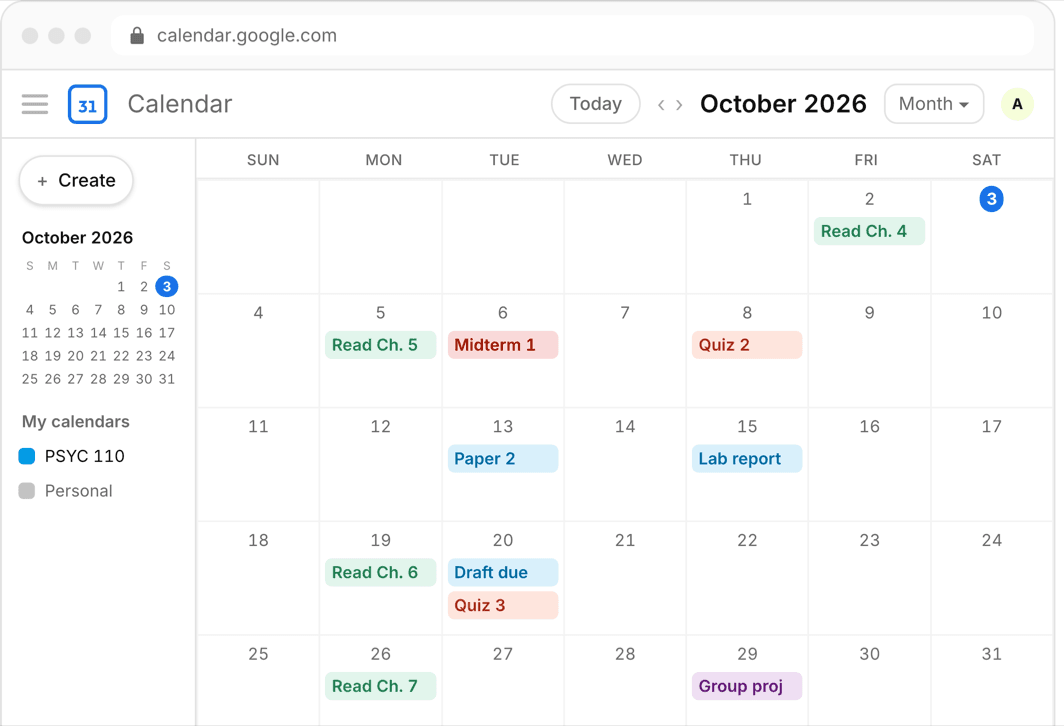
Google Calendar for school is a genuinely good system. It is free, it is on every device you own, professors’ office hours and club meetings already live there, and color-coded course calendars make a week legible at a glance. Nothing in this article argues against using it.
The question is narrower: how do a semester’s worth of syllabus deadlines get into it? That step — not the calendar itself — is where the manual approach gets expensive, and it is the only step Classmaite changes.
Or skip all of it
Upload the syllabus. Get the calendar.
Every assignment and exam on Google, Apple, or Outlook in about 30 seconds. One syllabus free, no account, no card.
The case for Google Calendar alone
Manual entry is free, requires no new tools, and has one underrated benefit: typing every deadline forces you to actually read each syllabus closely, and some students find the semester sticks in their head better for it. If you carry two or three courses with light schedules — say 30 or 40 dated items total — an hour on a Sunday covers it, and the case for paying anything is weak.
Google Calendar also handles recurring events (lectures, labs, sections) natively and well. No extraction tool is needed for the repeating parts of your schedule.
The honest math on manual entry
A full load changes the numbers. Five courses typically carry 20 to 30 dated items each — assignments, quizzes, readings, exams, project milestones — call it 100 to 150 events. At one to two minutes per event (open syllabus, find date, create event, name it, set a reminder), that is roughly two to four hours of pure data entry, per semester.
Then the maintenance tax: professors revise dates, and every revision is a manual edit you have to notice and make. And manual entry treats every event identically — Google Calendar has no idea your final is worth 35% and your discussion post is worth 1%, so reminders are uniform unless you configure each one individually.
What Classmaite adds on top
Classmaite is the input layer: upload each syllabus (PDF, Word doc, or a photo of a handout) and it extracts every assignment, exam, grading weight, and reading deadline in about 30 seconds. You review the extraction — this step matters, and you can edit anything — then sync straight to Google Calendar (Apple Calendar, Outlook, and .ics export also work). Reminders are weighted by grade impact automatically, so high-stakes work gets earlier, louder nudges.
The result lands in the same Google Calendar you were already going to use. Your first syllabus is free with no account, which is enough to judge the extraction accuracy on your own documents. Beyond that it is $9/month for unlimited syllabi — the honest question is whether that beats two to four hours of your time plus a semester of manual upkeep.
Who should skip Classmaite
- Light course loads (roughly 40 dated items or fewer) — manual entry is an hour, and free wins.
- Professors who put everything in the LMS — subscribe to the free Canvas/Blackboard/Moodle calendar feed instead; it also auto-updates.
- Students who genuinely value the close reading that manual entry forces — that benefit is real; keep it.
- Anyone who needs a general task manager — Classmaite only handles syllabus deadlines; it will not track “buy textbook” or “email advisor.”
The verdict
Keep Google Calendar either way — it is the right foundation. Add Classmaite when the entry-and-upkeep cost of a real course load outweighs $9/month, which for most five-course semesters it does. Test the free syllabus first; if the extraction is accurate on your messiest syllabus, the rest of the decision is simple arithmetic about your time.
Frequently asked questions
Does Classmaite replace Google Calendar?
No — it feeds it. Classmaite extracts deadlines from your syllabi and syncs them as events to Google Calendar (or Apple Calendar, Outlook, or an .ics file). You keep using Google Calendar exactly as before; it just starts the semester full instead of empty.
How long does manual syllabus entry into Google Calendar actually take?
For a five-course load with 100–150 dated items, plan on two to four hours at one to two minutes per event, plus ongoing edits whenever professors change dates. For two or three light courses, an hour is realistic and manual entry is a perfectly good free option.
Can Google Calendar prioritize deadlines by how much they’re worth?
Not on its own — Google Calendar treats all events equally, and per-event reminder customization is manual. Grade-weighted reminders (bigger assignments get earlier, more prominent notice) are a Classmaite feature, driven by the grading breakdown it extracts from each syllabus.