Paper Planner vs App in College: An Honest Comparison
Quick answer
Paper planners win on focus, retention, and simplicity — writing deadlines by hand helps you remember them, and paper never interrupts you. Apps win on reminders, sync, and updates. The strongest setup for many students is hybrid: automatic calendar reminders as the safety net, paper for daily and weekly planning.
Try it with your own syllabus
Every assignment, exam, and reading on your calendar in about 30 seconds. Free, no account.
PDF, Word, or a photo of a paper one. No syllabus handy? See a sample
Any honest comparison has to start here: paper planners work. Students have organized brutal course loads with a $12 weekly planner for generations, the act of handwriting genuinely aids memory, and a paper spread never buzzes with someone else’s notification while you are looking at your week. If your paper system works, this article will not talk you out of it.
But paper has structural limits that have nothing to do with discipline — it cannot remind you of anything, it does not sync, and it cannot be restored if it is lost. The interesting question is not paper versus apps in the abstract; it is which failure modes you personally need to defend against.
Or skip all of it
Upload the syllabus. Get the calendar.
Every assignment and exam on Google, Apple, or Outlook in about 30 seconds. One syllabus free, no account, no card.
Where paper honestly wins
- Focus: a planner page contains only your plans. No notifications, no adjacent apps, no feed one thumb-slip away.
- Retention: handwriting engages memory in ways typing does not — students who write deadlines down often just know their week without checking.
- Speed for daily use: flipping to today is faster than unlocking, opening, and navigating any app.
- Simplicity: no setup, no sync conflicts, no subscription, no learning curve. A planner never ships a redesign that breaks your system.
- Ritual: the Sunday planning session with a physical spread is a habit many students keep precisely because it feels different from screen work.
Where paper structurally loses
- No reminders: paper only helps if you open it. The deadline you forgot to look at is the one that gets you.
- No sync: your planner is wherever you left it; your phone is always with you.
- Rescheduling: professors move dates, and paper rescheduling means crossing out and rewriting — repeatedly, in a busy semester.
- No backup: a lost planner in week ten is a small catastrophe with no undo.
- Entry cost twice over: copying 100+ syllabus deadlines into a planner by hand takes the same hours as typing them into a calendar — with no automation option at all on the paper side.
What apps actually buy you
The app advantage compresses to three things: reminders that fire whether or not you remembered to check, sync so your deadlines are on whatever device you are holding, and editability so a moved exam is a ten-second fix. For students whose organizational failures are forgetting-to-look failures — not planning failures — these three cover exactly the gap.
What apps do not automatically buy you is entry. A calendar app starts as empty as a fresh planner, and typing a semester into either takes the same hours. This is the step where automation exists only on the digital side: Classmaite reads each syllabus (PDF, Word, or a photo of a paper handout) and extracts every assignment, exam, and reading with its grading weight in about 30 seconds, then syncs reviewed events to Google, Apple, or Outlook calendars with reminders scaled to grade impact. First syllabus free; $9/month beyond that.
The hybrid workflow: paper in front, calendar behind
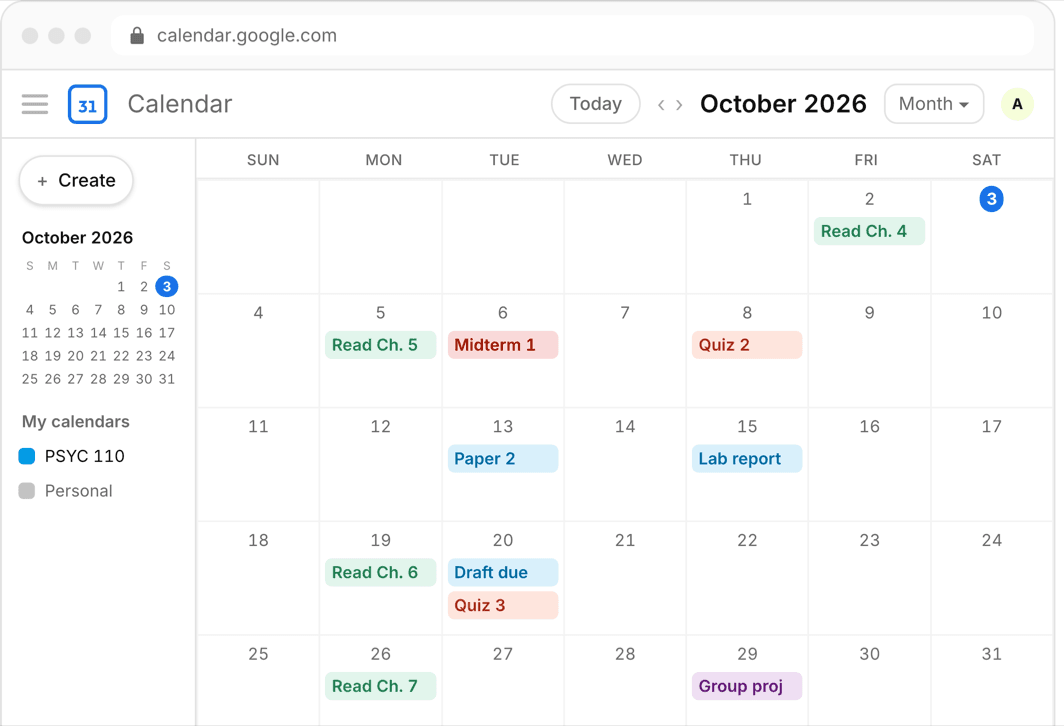
The setup that keeps paper’s strengths without its risks: maintain a complete digital calendar as the safety net — every deadline, with reminders — and do your actual daily and weekly planning on paper. Sunday evening, open the calendar, copy the coming week’s deadlines into your paper spread, and plan study blocks by hand. Through the week, live on paper; let the phone stay in your bag.
The digital layer exists for the failure cases: the reminder that fires for the thing you did not copy over, the exam date that moved, the planner left in a lecture hall. If you automate the digital layer’s setup (LMS feeds where professors use them, Classmaite for the syllabus-only rest), the hybrid costs you fifteen minutes at semester start plus your Sunday ritual — which you were keeping anyway.
Verdict
Pure paper is a legitimate choice for students with strong daily habits and forgiving schedules — respect to anyone running it well. Pure app is right for students who need reminders to function and feel no pull toward paper. For everyone in between, the hybrid is quietly the best answer: paper where paper is better (thinking, planning, focus), digital where digital is better (remembering, syncing, updating), and automation so the digital half costs minutes instead of hours.
Frequently asked questions
Is a paper planner enough for college?
It can be — many successful students use nothing else. It works best when you check it daily without fail and your professors rarely change dates. Its real risks are missed reminders, lost planners, and date changes, which is why many paper devotees keep a minimal digital calendar as a backstop.
Does writing things down really help you remember them?
Research on handwriting and note-taking consistently suggests writing by hand engages memory and processing more deeply than typing. For planning, the practical upshot is that students who hand-copy their week often need to check it less — a genuine paper advantage.
How do I set up the hybrid system without hours of data entry?
Automate the digital layer: subscribe to your LMS calendar feed for whatever professors enter there, and run syllabi through Classmaite for the rest — it extracts deadlines from each syllabus in about 30 seconds and syncs them with reminders (first syllabus free). Then your only manual step is the weekly copy of upcoming deadlines into your paper planner, which doubles as your planning ritual.