Google Calendar for Students: The Complete Setup
Quick answer
The best Google Calendar setup for students is one calendar per course (plus one for personal life), a consistent color per course, default reminders set per calendar, deadlines entered as events with alerts rather than tasks, and every syllabus deadline loaded in during the first week of the semester.
Drop your syllabus here
Every assignment, exam, and reading on your calendar in about 30 seconds. Free, no account.
PDF, Word, or a photo of a paper one. No syllabus handy? See a sample
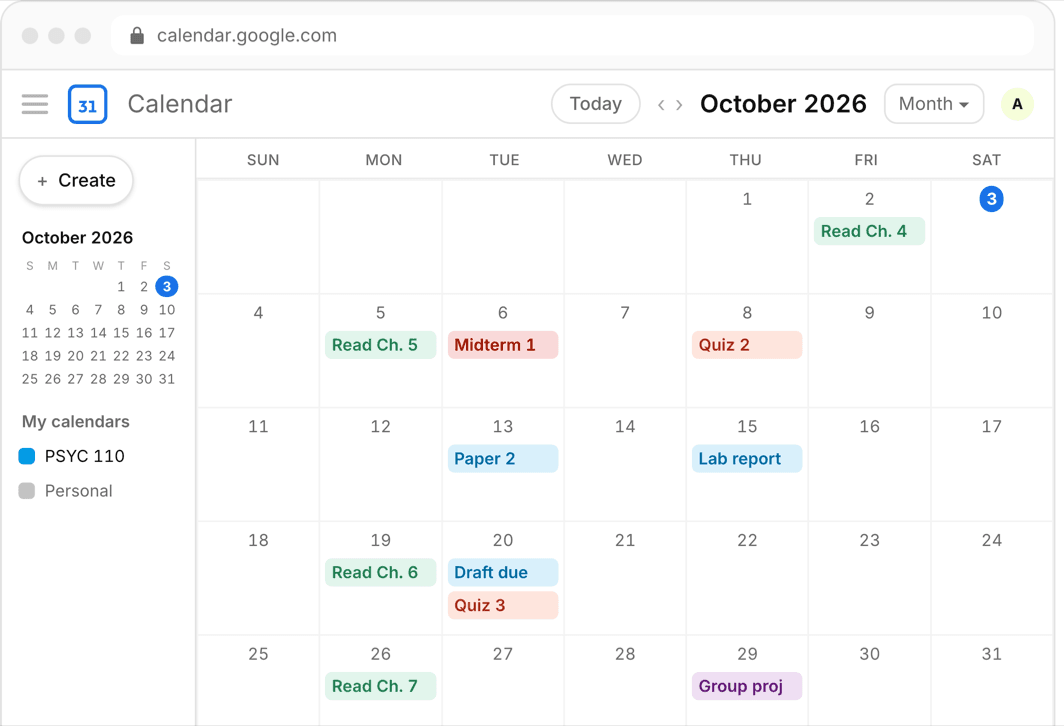
Google Calendar is free, on every device you own, and better at reminding you of things than any planner, app, or LMS. Most students still use maybe ten percent of it: a few one-off events, default settings, everything in one undifferentiated calendar.
Set it up properly once — about thirty minutes at the start of a semester — and it becomes the closest thing college offers to autopilot. Here is the full setup, in order.
Or skip all of it
Upload the syllabus. Get the calendar.
Every assignment and exam on Google, Apple, or Outlook in about 30 seconds. One syllabus free, no account, no card.
Create one calendar per course
In the desktop sidebar, click the plus next to Other calendars and choose Create new calendar. Make one per course — BIO 201, ECON 110 — plus one for personal commitments. It feels like overkill for about a day.
Then it pays off permanently: you can toggle a single course on and off, give each its own color and its own default reminders, and delete a course cleanly when the semester ends. One-calendar setups turn into an unreadable wall by midterms.
Use color with intent
Assign each course a fixed color and keep it all semester — your eye learns that green means chem lab faster than it reads titles. Reserve one loud color (red works) for exams and major due dates only, overriding the course color on individual high-stakes events.
The test of a good color scheme is the month view: you should be able to see the shape of a hard week without reading a single event title.
Set default reminders per calendar
In each course calendar settings, set default notifications so every event you add inherits sane alerts without per-event fiddling. The Google default of ten minutes before is built for meetings, not deadlines.
- Class-session calendars: 30 minutes before, enough to get across campus
- Deadline-heavy course calendars: one day before, plus a same-day morning alert
- Exams and papers: add manual extra reminders a week out — that is when studying can still change the outcome
- Personal calendar: whatever keeps you honest, but keep it different from course alerts
Events vs Google Tasks: use both, differently
Google Calendar shows two datable things: events and tasks. Use events for anything with a fixed time or a hard deadline — classes, exams, due dates — because events carry the layered notifications. Use tasks for the floating to-dos that precede them: draft the outline, do the problem set, email the professor.
The pattern that works: the deadline is an event with real alerts; the work leading up to it is two or three tasks scheduled on earlier days. Tasks roll over when unfinished, which is honest; deadlines do not, which is the point.
Add your class schedule as recurring events
Enter each class meeting once, then set a custom recurrence — weekly on its meeting days — with an end date of the last day of classes. Add the building and room in the location field; future you, sprinting before a final in a building you have been to twice, will be grateful.
Check that your calendar timezone matches your campus timezone before creating these, especially if you set up your account at home in a different zone. A schedule created in the wrong timezone shifts every class by hours the moment you land on campus.
Load the semester in week one
The setup above is scaffolding. The value comes from what you load into it: every assignment, exam, quiz, paper, and reading deadline from every syllabus, entered during syllabus week while your workload is at its lightest. Manually, that is 15–30 minutes per course of careful transcription.
This is exactly what Classmaite automates: you drop in the syllabus PDF and it extracts the assignments, exam dates, grading breakdown, and reading schedule, then pushes them to Google Calendar — into the per-course calendars you just made — or hands you an .ics file, in about thirty seconds per course.
Frequently asked questions
Should students use Google Tasks or events for assignments?
Use an event for the deadline itself — events carry stronger notifications — and tasks for the work sessions leading up to it. Tasks roll over when unfinished; deadlines should never be allowed to.
How many calendars should a student have in Google Calendar?
One per course plus one personal calendar is the sweet spot. Per-course calendars give you individual colors, individual default reminders, and clean end-of-semester deletion.
Can Google Calendar sync with Canvas or other LMS platforms?
Yes — most LMS platforms (Canvas, Blackboard, Moodle, Brightspace) publish a personal .ics feed URL you can subscribe to via Other calendars, From URL. The feed only contains items professors entered with due dates, so pair it with syllabus deadlines you add yourself.