How to Add Your Class Schedule to Google Calendar
Quick answer
Create one event per class in Google Calendar at its first meeting time, then set recurrence to Custom, choose weekly on the days it meets, and set Ends On to the last day of classes. Before creating any events, confirm your calendar timezone matches your campus timezone, or every class will display at the wrong hour when you travel.
Drop your syllabus here
Every assignment, exam, and reading on your calendar in about 30 seconds. Free, no account.
PDF, Word, or a photo of a paper one. No syllabus handy? See a sample
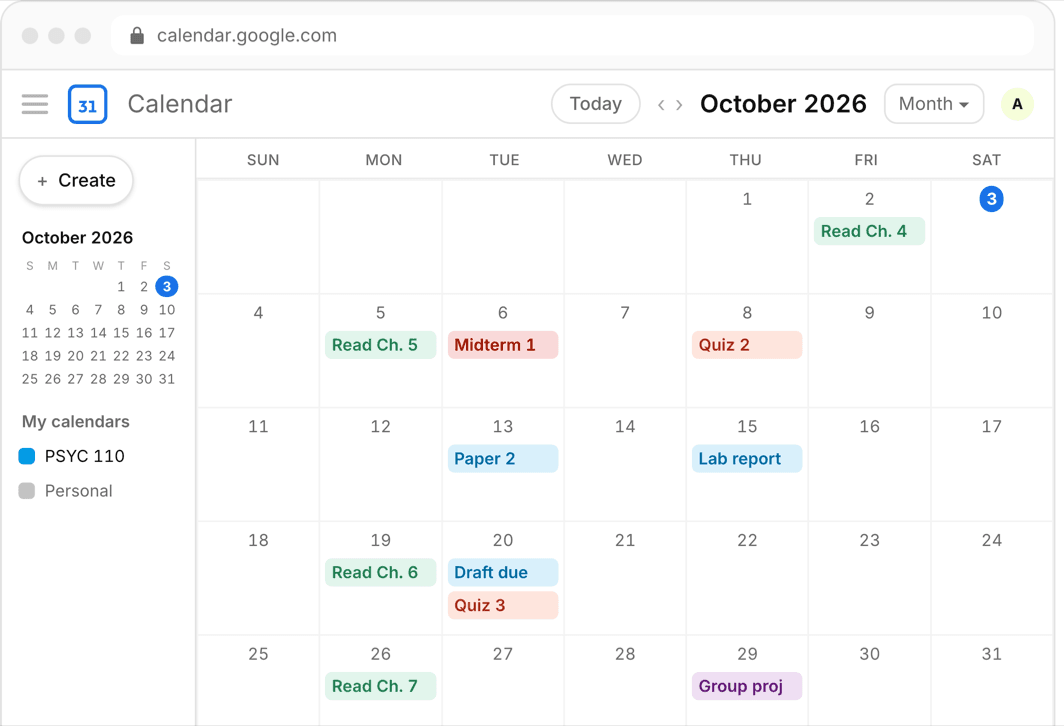
Your class schedule is the skeleton of your week for the next four months, and it belongs in Google Calendar as properly built recurring events — not screenshots of the registration portal that you squint at for the first two weeks.
The build takes about ten minutes for a full load. There are exactly three details that separate a schedule that works all semester from one that betrays you: the recurrence pattern, the end date, and the timezone. Here is each one.
Or skip all of it
Upload the syllabus. Get the calendar.
Every assignment and exam on Google, Apple, or Outlook in about 30 seconds. One syllabus free, no account, no card.
Step 1: Create the first event with custom recurrence
- Open Google Calendar and click the first meeting slot of a class — say Monday 10:00 to 10:50
- Title it with course code and number: BIO 201
- Click the repeat dropdown (default: Does not repeat) and choose Custom
- Set repeat to every 1 week and tick the meeting days — M, W, F for a MWF class
- One event now covers every session of that class for the semester
Step 2: Set the end date — do not skip this
In the same custom recurrence dialog, set Ends On to the last day of classes from your academic calendar. Skip this and the class repeats forever — your calendar shows a 10 a.m. lecture in July, over winter break, and into years you will not be enrolled.
Cleaning up a never-ending recurrence later means editing this and following events from the right spot, which is fiddly. Ten seconds now saves the mess. Note that recurrence cannot skip weeks, so classes will still display over fall or spring break — most students ignore that; the fastidious delete just those occurrences.
Step 3: The campus timezone gotcha
Google Calendar events are pinned to a timezone, and events inherit your calendar default timezone at creation. If you build your schedule from home in one timezone before moving to a campus in another, every class is pinned to the wrong zone — and once you arrive, each one displays shifted by the difference. A 9:00 class created in Pacific time displays at noon once your phone is on Eastern.
The fix is preventive: before creating any events, open Google Calendar settings and set your timezone to the campus timezone. If the damage is already done, edit each recurring event and correct its timezone rather than nudging the displayed times by hand.
Step 4: Location, color, and a reminder that fits the walk
Put the building and room in the location field — on a phone this links straight to the map, which matters most during the first two weeks and again during finals in unfamiliar exam rooms. Put all classes on a dedicated calendar, or give each course a consistent color, so the week grid reads at a glance.
Set the notification to your actual walking time plus a margin — ten minutes if everything is close, thirty if the campus sprawls. The default reminder is tuned for people joining video calls, not people crossing a quad.
Step 5: Add the other half of the semester
The recurring grid tells you where to be. It says nothing about what is due — the assignments, exams, papers, and readings that live in each syllabus and land on specific dates. A schedule without the deadline layer is a calendar that looks organized while letting the actual grade-bearing dates blindside you.
This is exactly what Classmaite automates: you drop in the syllabus PDF and it extracts the assignments, exam dates, grading breakdown, and reading schedule, then pushes them to Google Calendar, Apple Calendar, or an .ics file in about thirty seconds — deadlines layered over the class grid you just built.
Frequently asked questions
How do I make a class repeat on specific days in Google Calendar?
Create the event at its first meeting time, open the repeat dropdown, choose Custom, set it to repeat weekly, and tick the exact days it meets — for example Monday, Wednesday, Friday. Set Ends On to the last day of classes.
Why are my classes showing at the wrong time in Google Calendar?
Almost always a timezone mismatch: the events were created while your calendar was set to a different timezone than your campus. Fix your calendar timezone in settings, then edit each recurring event to the campus timezone.
Can Google Calendar skip spring break in a recurring event?
Not automatically — weekly recurrence has no skip-these-weeks option. Either ignore the phantom classes during break or delete just those occurrences by opening one and choosing to delete this event only.