Class Schedule Maker: Build Your Weekly College Grid
Quick answer
To make a class schedule, list every fixed commitment — class meetings, labs, work shifts, commute time — and place them on a weekly grid using a spreadsheet or any schedule-builder tool. Then recreate the grid as recurring weekly events in Google or Apple Calendar with an end date on the last day of classes, so it travels on your phone with reminders.
Drop your syllabus here
Every assignment, exam, and reading on your calendar in about 30 seconds. Free, no account.
PDF, Word, or a photo of a paper one. No syllabus handy? See a sample
A class schedule maker sounds like it should be complicated software. It is not — it is a weekly grid, and the tool matters far less than what you put on it. Most schedules fail because they map classes and nothing else, as if the other 150 hours of the week will organize themselves.
Here is how to build a grid that reflects your actual week, and — the step most students skip — how to move it off the pretty PNG and onto a calendar that can remind you of things.
Or skip all of it
Upload the syllabus. Get the calendar.
Every assignment and exam on Google, Apple, or Outlook in about 30 seconds. One syllabus free, no account, no card.
Start with every fixed commitment, not just classes
Before touching a grid, list everything with a fixed time: class meetings and labs, work shifts, practices and rehearsals, recurring club meetings — and the commutes between them. A 2:00 class across campus from your 1:00 class is a conflict no schedule tool will flag for you.
Include realistic wake and meal windows. A schedule that assumes you will make four consecutive 8 a.m. classes when you have never once done so is fiction, and fictional schedules get abandoned by week three.
Pick a tool — any tool
A spreadsheet works fine: days as columns, half-hour rows, merged cells for each block, one color per course. Free online schedule builders produce the same grid with less fiddling, and many campus registrar or planning portals draw one automatically from your enrollment.
The output at this stage is a picture — good for spotting conflicts, gaps, and brutal days at a glance, and for the roommate-coordination screenshot. A picture is not a scheduling system yet; that comes next.
Audit the shape of the week
- Gaps between classes: a 90-minute gap on campus is a study block if you name it one, and dead scrolling time if you do not
- Stacked days: three classes back-to-back means no same-day catch-up — reading for those courses has to happen the day before
- Commute reality: back-to-back classes in distant buildings need a plan, not optimism
- Energy mapping: put your hardest recurring work in the hours you are reliably functional, not the hours that look empty
Move the grid onto a real calendar
Now rebuild the grid as recurring events in Google or Apple Calendar: one event per class, custom recurrence set to weekly on its meeting days, end date on the last day of classes so the schedule dissolves itself at semester end. Put the building and room in the location field and set a notification long enough to actually get there.
Do the same for work shifts and standing commitments, and add your named study blocks as recurring events too — a study block with a reminder happens; a mental note does not. Double-check your calendar timezone matches campus before creating anything, or every event will shift when you travel.
The half a schedule maker cannot see
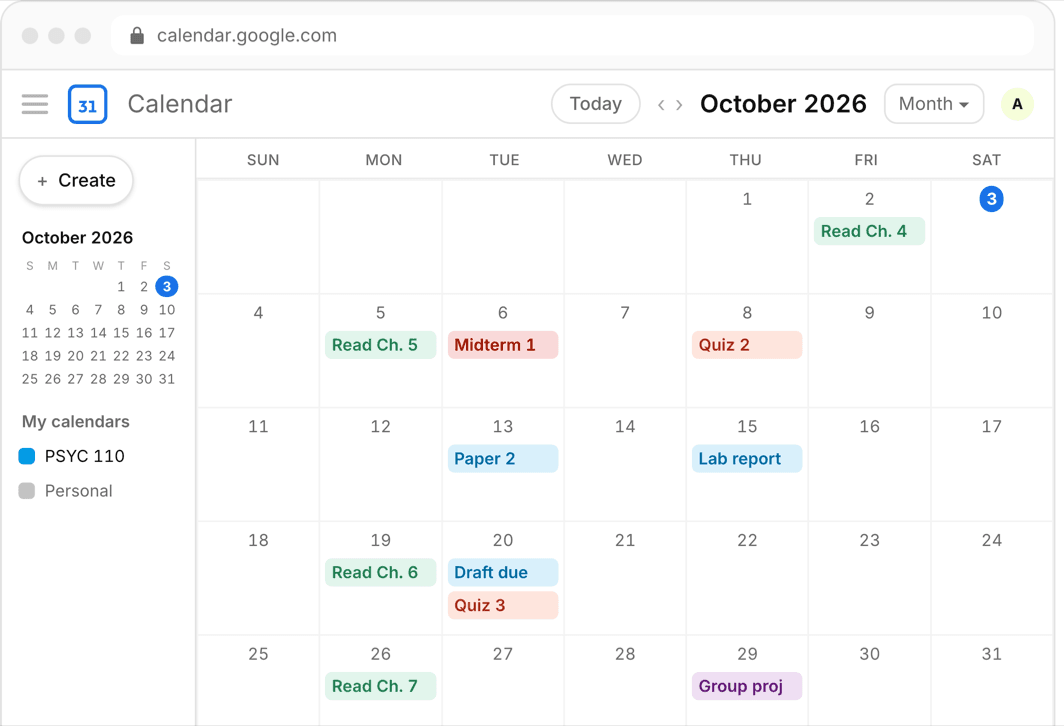
A weekly grid answers where do I have to be. It says nothing about what is due — the essays, problem sets, exams, and readings that live in your syllabi and land on specific dates, not weekly slots. A complete calendar needs both layers.
The deadline layer is exactly what Classmaite automates: you drop in each syllabus PDF and it extracts the assignments, exam dates, grading breakdown, and reading schedule, then pushes them to Google Calendar, Apple Calendar, or an .ics file in about thirty seconds — landing right alongside the weekly grid you just built.
Frequently asked questions
What is the best free class schedule maker?
For the visual grid, a spreadsheet or any free online schedule builder is fine — they all produce the same weekly picture. The tool that matters is the calendar app you already check daily; recreate the grid there as recurring events with reminders.
How do I put my class schedule on my phone?
Create each class as a recurring weekly event in Google or Apple Calendar with an end date on the last day of classes. It then syncs to your phone automatically with notifications — no separate app needed.
Should I schedule study time like a class?
Yes. Recurring, named study blocks tied to specific courses are the single biggest difference between students who use gaps and students who lose them. Vague plans to study later reliably lose to anything more concrete.