Semester Calendar Template: What It Needs and How to Build One
Quick answer
A good semester calendar template is a single view of roughly sixteen weeks containing every graded deadline with its weight, all exam dates, school breaks, and registration or drop deadlines. You can build one in under an hour with a spreadsheet or a dedicated calendar in Google Calendar — the hard part is extracting the data from each syllabus.
Drop your syllabus here
Every assignment, exam, and reading on your calendar in about 30 seconds. Free, no account.
PDF, Word, or a photo of a paper one. No syllabus handy? See a sample
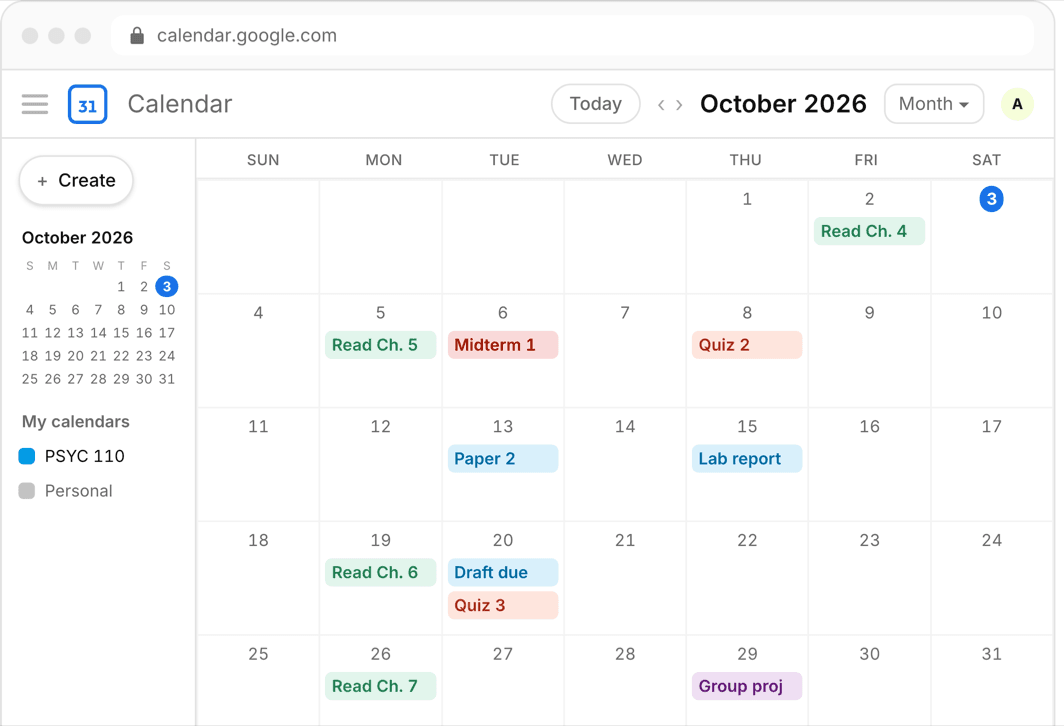
Search for a semester calendar template and you get thousands of pretty grids that all share the same flaw: they are empty. The template was never the hard part. The hard part is the two hours of extraction it takes to fill one — and knowing what belongs on it in the first place.
This guide covers what a semester calendar actually needs to contain, the fastest ways to build one you will keep using, and the option where the filling-in happens automatically.
Or skip all of it
Upload the syllabus. Get the calendar.
Every assignment and exam on Google, Apple, or Outlook in about 30 seconds. One syllabus free, no account, no card.
What a complete semester calendar contains
- Every graded deadline from every course — assignments, papers, projects, quizzes — each labeled with its grade weight
- Every exam: midterms, finals, and the finals-week schedule once the registrar publishes it
- Reading deadlines, because they feed the quizzes that quietly erode grades
- Academic dates: add/drop deadline, withdrawal deadline, registration windows
- Breaks and holidays — partly for travel booking, partly because the week after a break is reliably deadline-dense
- Personal immovables: work schedule changes, travel, major commitments
The weight labels are what make it useful
The difference between a deadline list and a decision-making tool is the grade weight next to each item. Fifteen deadlines in one week reads as panic; the same week showing one 25% paper, one 15% exam, and thirteen items worth 2% each reads as a plan.
Pull each weight from the syllabus grading breakdown and attach it to the event title or notes. When two deadlines collide — and they will — the weights make the triage decision for you.
Build it in a spreadsheet
The spreadsheet version is a flat list, not a grid: columns for date, course, item, type, and weight, one row per deadline, sorted by date. It takes maybe an hour to fill from four or five syllabi and gives you sorting superpowers — by date for what is next, by weight for what matters.
Bonus: a sheet with Subject and Start Date (MM/DD/YYYY) columns can be imported straight into Google Calendar or Outlook as a CSV, so the spreadsheet can become calendar events instead of remaining a document you have to remember to open.
Or build it directly in a calendar app
The alternative: create a dedicated Semester calendar in Google or Apple Calendar and enter every deadline as an all-day event with the weight in the title. You lose sortability but gain the two things paper and spreadsheets cannot do — notifications, and presence on your phone.
A printable wall-calendar version is a legitimate supplement; a month at a glance above a desk has ambient value. Just never let print be the only copy, because it cannot remind you of anything.
The auto-generated alternative
Everything above shares one cost: the manual extraction pass through each syllabus, 15–30 minutes per course, with a typo risk on every date you transcribe. This is exactly what Classmaite automates: you drop in the syllabus PDF and it extracts the assignments, exam dates, grading breakdown, and reading schedule, then pushes them to Google Calendar, Apple Calendar, or an .ics file in about thirty seconds.
The result is the filled-in template — every deadline, weighted and dated, on the calendar you already check — which was the point of the template hunt all along.
Frequently asked questions
What should a semester calendar include?
Every graded deadline labeled with its grade weight, all exams, reading deadlines, registration and drop deadlines, breaks, and your own fixed commitments — roughly sixteen weeks in a single view.
Is a paper semester calendar enough?
As a supplement, yes — a wall calendar gives useful month-at-a-glance awareness. As your only system, no: it cannot send reminders and it is not with you on campus. Keep the master copy digital.
How long does it take to build a semester calendar by hand?
Plan on 15–30 minutes per course to extract deadlines and weights from each syllabus, so one to two hours for a full load — or about thirty seconds per syllabus with an automated parser like Classmaite.