How to Calculate Your Grade (and What You Need on the Final)
Quick answer
To calculate your grade, multiply your average score in each category by that category’s weight from the syllabus, then add the results. To find what you need on the final, subtract your earned weighted points from your target grade and divide by the final’s weight.
Drop your syllabus, then enter your scores
We build the calendar first, then tell you what you need on everything left. Free, no account.
PDF, Word, or a photo of a paper one. No syllabus handy? See a sample
Most college classes don’t average your scores — they weight them. A 95 on homework and a 70 on the midterm doesn’t make an 82.5 unless the two categories happen to count equally, and they almost never do.
The math is genuinely simple once you have the weights in front of you. Here’s the full walkthrough, including the question everyone actually wants answered: what do I need on the final?
Or skip all of it
Upload the syllabus. Get the calendar.
Every assignment and exam on Google, Apple, or Outlook in about 30 seconds. One syllabus free, no account, no card.
Step 1: Get the weights from the syllabus
Every syllabus has a grading breakdown — something like “Homework 20%, Midterms 30%, Final 35%, Participation 15%.” Those percentages are the whole game. Write them down along with your current average in each category.
Step 2: Multiply each category average by its weight
Convert each weight to a decimal and multiply. Say your syllabus reads: Homework 20%, Midterms 30%, Final 35%, Participation 15%. So far you have a 92 homework average, an 84 midterm average, and 100 in participation. The final hasn’t happened yet.
Your earned weighted points: 92 × 0.20 = 18.4, plus 84 × 0.30 = 25.2, plus 100 × 0.15 = 15. That totals 58.6 weighted points out of the 65 points available so far (20 + 30 + 15).
Step 3: Your current grade is earned points ÷ points possible
Divide what you’ve earned by what’s been available: 58.6 ÷ 65 = 0.9015, so your current grade is about 90.2%. That’s the number your professor sees when they say “you currently have an A−.” Don’t just average 92, 84, and 100 — the unweighted average (92) would overstate your standing because your weakest category, midterms, carries the most weight so far.
Step 4: “What do I need on the final?”
The formula: required final score = (target grade − earned weighted points) ÷ final’s weight.
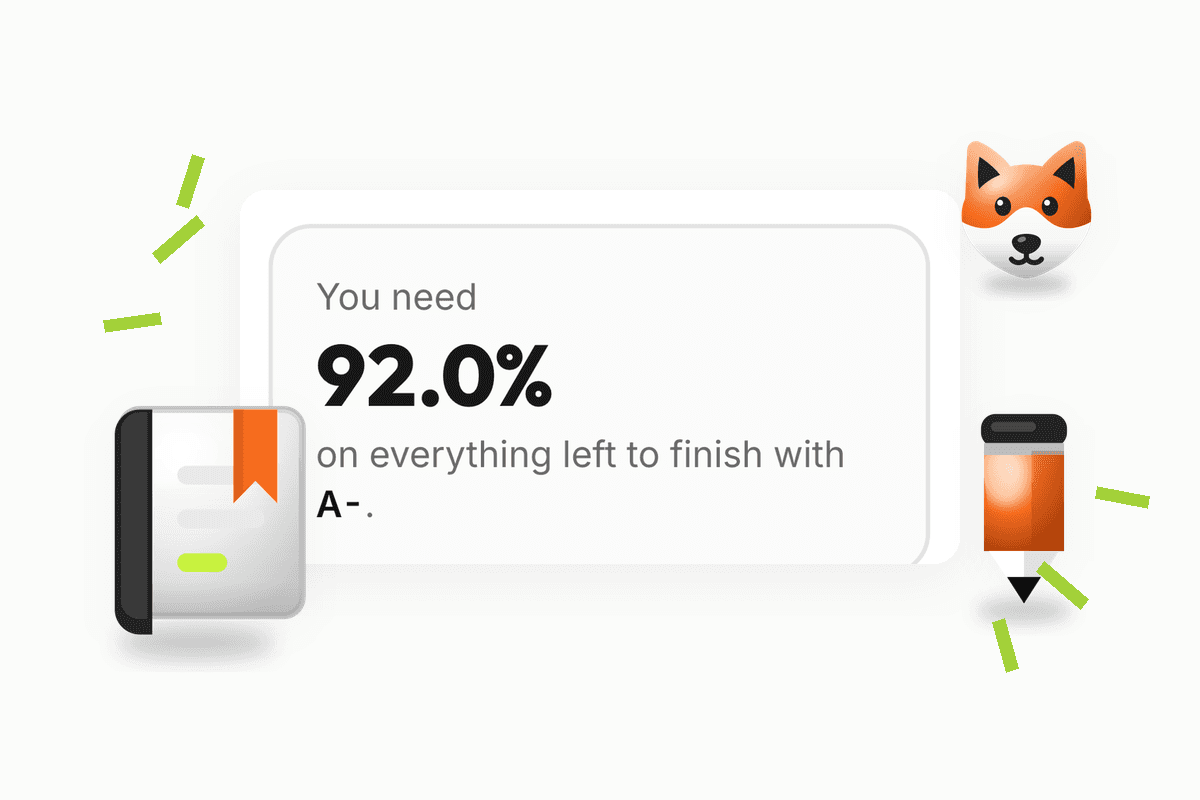
Using the numbers above, suppose you want a 90 in the class. You’ve banked 58.6 weighted points, and the final is worth 35% (0.35). Required score = (90 − 58.6) ÷ 0.35 = 31.4 ÷ 0.35 = 89.7. You need roughly a 90 on the final to finish with an A−. Check it: 58.6 + (89.7 × 0.35) = 58.6 + 31.4 = 90. For a B (80): (80 − 58.6) ÷ 0.35 = 61.1 — so anything above a 61 locks in at least a B.
Run this formula for two or three targets and you know exactly what’s realistic — and how to divide your finals-week hours across classes.
Watch for the fine print
- Dropped scores: “lowest quiz dropped” changes your category average — recompute without the dropped score.
- Points-based classes: some professors use raw points instead of weights. Then it really is total earned ÷ total possible.
- Grading scale cutoffs: an 89.5 may or may not round to an A. The syllabus usually says; if not, don’t count on rounding.
- Category minimums: a few classes require passing the final to pass the course, regardless of your average.
Skip step 1 entirely
The only tedious part of this math is digging the weights out of a 12-page syllabus PDF. Classmaite does that step for you — upload the syllabus and it extracts the full grading breakdown along with every assignment and exam date, so you always know what each category is worth when it’s time to run the numbers.
Frequently asked questions
How do I calculate my grade if the final replaces my lowest midterm?
Compute the grade both ways — with the low midterm included, and with the final’s score substituted for it — and take whichever the syllabus says applies. Replacement policies vary a lot, so read the exact wording.
What if a category hasn’t started yet?
Leave it out of both the numerator and denominator. Your current grade is earned weighted points divided by the weight of categories with grades in them — that’s why a class can show 90% even before a single big exam.
Is a 79.5 a B or a C+?
Depends entirely on your professor’s rounding policy, which is usually in the syllabus. Many round to the nearest whole number; some don’t round at all. If it’s unstated and you’re on a boundary, ask before finals — not after.