Midterm Season Survival Guide: When All Your Exams Collide
Quick answer
When multiple midterms collide, triage instead of panicking: list every exam and deadline with its grade weight and your current standing in the course, allocate study hours where weight × need is highest, and block those hours backward from each exam date on a calendar. Deprioritize low-weight busywork for the two peak weeks — a 25% midterm always outranks a 2% quiz.
Drop your syllabus here
Every assignment, exam, and reading on your calendar in about 30 seconds. Free, no account.
PDF, Word, or a photo of a paper one. No syllabus handy? See a sample
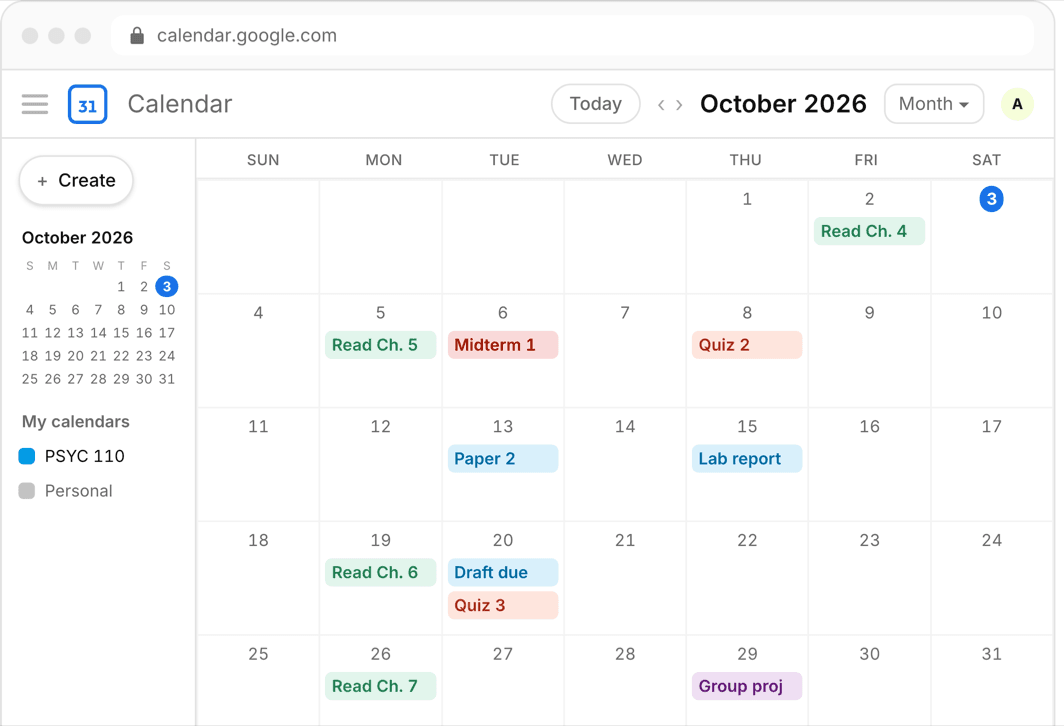
Unlike finals, midterms are not coordinated by anyone. Each professor schedules theirs somewhere in weeks six through ten without consulting the others, and the math of five courses doing this independently makes collisions nearly guaranteed: at some point you will face three exams and a paper inside five days. That week was visible in the syllabi since January — but visible or not, here you are.
Survival is a resource-allocation problem, not an effort problem. You do not have enough hours to prepare perfectly for everything, which means the skill that matters is deciding where hours go. This guide is that skill: triage, calendar blocking, execution, and the aftermath.
Or skip all of it
Upload the syllabus. Get the calendar.
Every assignment and exam on Google, Apple, or Outlook in about 30 seconds. One syllabus free, no account, no card.
Step 1: Triage — list, weight, and rank everything
Before studying anything, spend 30 minutes building the triage table. List every exam and deadline in the collision window. For each, write down two numbers: its weight (percentage of course grade, from the syllabus) and your need (how shaky you currently are in that course).
Priority is weight times need. A 30% midterm in a course you are barely passing is the top of the list. A 15% exam in a course where you have a 96 average and strong fundamentals is lower than its weight suggests. A 3% quiz is bottom regardless of anything. Rank the list before opening a single textbook — hours follow the ranking, not anxiety, and anxiety is a terrible allocator: it routes hours to whichever course feels scariest, which is often not the one that moves your GPA.
Step 2: Block the calendar backward from each exam
With the ranking set, work backward from each exam date and place actual study blocks on a calendar. Not “study bio this week” — “Tuesday 2–4pm: bio, chapters 5–7 practice problems.”
- Start each exam’s prep 7–10 days out with short sessions; spaced repetition beats a cram day for retention, and starting early is what makes spacing possible
- Give top-ranked exams first claim on your best hours (whenever you are sharpest); bottom-ranked items get the leftovers
- Interleave subjects across a day rather than marathoning one — three 90-minute blocks on different courses beats five straight hours on one
- Schedule sleep like it is graded, because it effectively is: memory consolidation happens overnight, and an all-nighter before an exam reliably costs more points than it earns
- Put a hard stop on each block; open-ended sessions expand to fill the evening while covering the same material
- Leave one slack block per week for whatever runs over — something will
Step 3: Cut ruthlessly during peak weeks
Midterm season is two or three weeks; you can suspend normal life for it. The errors students make are cutting nothing (drowning) or cutting sleep (self-sabotage). Cut in this order instead:
- First: optional social commitments, club meetings, and anything reschedulable — say “after midterms” freely
- Second: low-weight assignments, strategically — if a 2% discussion post costs three hours you need for a 25% exam, take the small loss on purpose; check drop-lowest policies for free skips
- Third: work shifts if you can — asking two weeks ahead succeeds far more often than asking two days ahead
- Never: sleep, meals, or the 30 minutes of daily movement that keeps your brain functional
- Ask early where policies flex: some professors will shift a paper deadline for a student who asks a week out with a plan; almost none will the night before
Step 4: Execute — and recover on purpose
During the weeks themselves, protect the plan from your own second-guessing. Follow the blocks as written and re-rank only at day boundaries, not mid-session; “should I actually be studying chem right now?” is a question that burns the hour it interrupts. Use past exams and professor-provided reviews as your primary study material wherever they exist — they are the closest sample of the real test. After each exam, do not conduct a hallway post-mortem; the next block starts on schedule.
When the last exam ends, two small acts close the season properly. First, take a real day off — recovery is part of the system, not a reward. Second, spend 20 minutes on a review: Which collisions did you see coming? What would starting three days earlier have changed? Midterm season runs on the same calendar mechanics every term, and the students who get calmer each semester are the ones who treat each season as data for the next.
See the collision coming next time
Everything in this guide works better with lead time, and the lead time was always available: every one of those colliding exam dates was printed in the syllabi during week one. The survival guide you actually want is the one you get to run three weeks early, when “start bio prep” can land on a calm Tuesday instead of a desperate Sunday.
That is the case for mapping the semester up front: upload each syllabus to Classmaite at myclassmaite.com/try — PDF, Word doc, or screenshot — and in about 30 seconds per course every exam, paper, and deadline lands on one calendar, synced to Google Calendar, Apple Calendar, or Outlook with reminders weighted by grade impact, so the heavy exams start surfacing while there is still time to plan. The collision weeks light up in week one. First syllabus is free, no account. Midterm season stops being a surprise and becomes a scheduled event you prepared for.
Frequently asked questions
When is midterm season in college?
Typically weeks six through ten of a fifteen-week semester — roughly early October in fall and early March in spring. But midterms are uncoordinated: each professor picks their own date, some courses have two midterms, and the season is really whenever your particular courses happen to stack. Your syllabi, combined on one calendar, are the only accurate forecast.
How do I study for three midterms in one week?
Start 7–10 days out and interleave: split each day into two or three 90-minute blocks on different subjects rather than devoting whole days to one course. Allocate more blocks to exams worth more or where you are weakest. Prioritize practice problems and past exams over rereading, and keep sleeping — recall drops sharply when you cut sleep to add hours.
Should I skip small assignments to study for a midterm?
Sometimes, and deliberately. If a 2% assignment costs hours you need for a 25% exam, the trade favors the exam — especially in courses that drop the lowest quiz or homework score, which makes the skip free. Do the math per course rather than adopting a blanket rule, and never skip anything in a course where you are near a grade boundary.