How to Plan Your Semester: The Complete System
Quick answer
To plan your semester: (1) build a semester map by putting every deadline from every syllabus into one calendar, (2) weight each deadline by its percentage of your grade, (3) backward-plan large projects and exams into weekly milestones, and (4) run a short weekly review to adjust. The map is built once; the weekly review keeps it alive.
Drop your syllabus here
Every assignment, exam, and reading on your calendar in about 30 seconds. Free, no account.
PDF, Word, or a photo of a paper one. No syllabus handy? See a sample
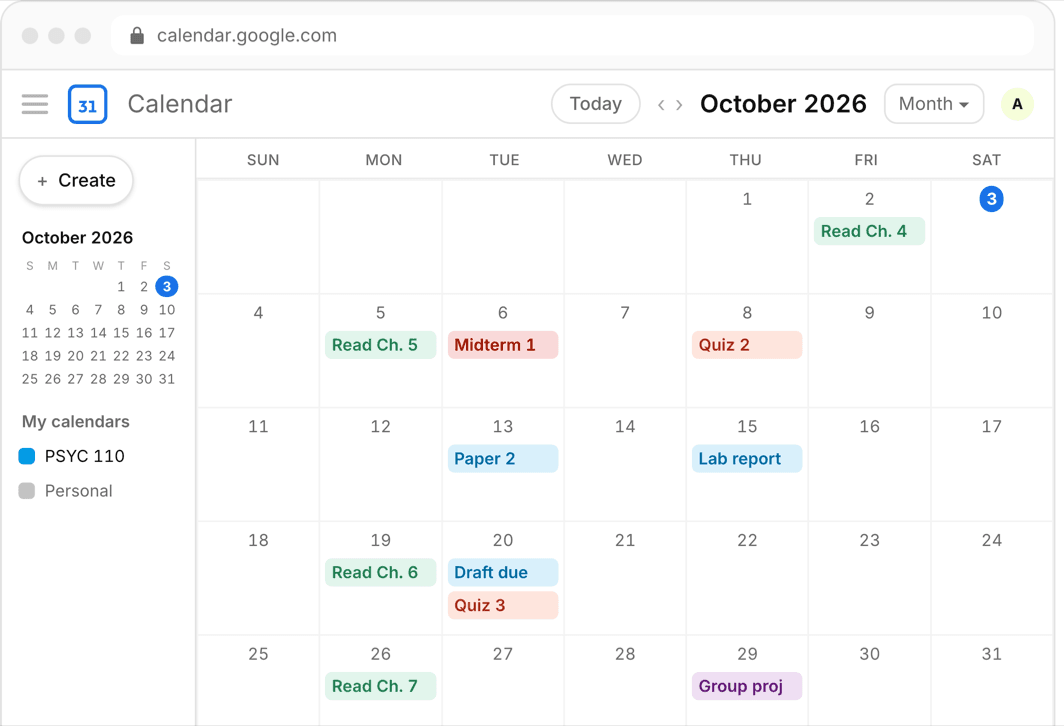
Most students plan a semester the way most people plan a road trip with no map: they know the destination (good grades in December) and just start driving. Then week eight arrives with two midterms, a paper, and a lab report in the same five days, and it feels like bad luck. It was never luck — those dates were published in week one.
This guide is the full system: a semester map you build once, a weighting pass so effort follows grade impact, backward planning for anything big, and a weekly rhythm that keeps the plan matching reality. None of it requires discipline heroics. It requires about two hours up front and twenty minutes a week.
Or skip all of it
Upload the syllabus. Get the calendar.
Every assignment and exam on Google, Apple, or Outlook in about 30 seconds. One syllabus free, no account, no card.
Step 1: Build the semester map
The semester map is one calendar containing every dated commitment from every course: exams, papers, projects, quizzes, presentations, reading deadlines. Not five syllabi you re-read when anxious — one view.
Build it in week one from the syllabi, and add school-level dates too: add/drop deadline, withdrawal deadline, breaks, and the final exam schedule. When it is done, zoom out and look at the whole semester on one screen. The crunch weeks become visible immediately — and a crunch you can see eight weeks out is just a scheduling problem, not a crisis.
Step 2: Weight everything by grade impact
A calendar treats all events equally. Your grade does not. The second pass is to attach weights: next to each deadline, note what percentage of the course grade it carries, straight from the syllabus grading breakdown.
This changes decisions all semester. When a 3%-weight discussion post and a 25%-weight midterm compete for the same evening, the answer is obvious — but only if the weights are visible. Students without weights default to whatever is due soonest, which systematically overinvests in small assignments and underinvests in exams.
- Write the weight next to every deadline: “Midterm 1 — 25%”, “Weekly quiz — 2%”
- Flag every item worth 15% or more of a course grade as a major deadline
- Compute what each week is “worth” by summing the weights due — that is your true crunch-week detector
- Check drop-lowest policies: a quiz category that drops two lowest scores changes which quizzes you can afford to punt
Step 3: Backward-plan the big stuff
Anything worth 15% or more should not exist in your plan as a single due date. Work backward from the deadline and place intermediate milestones on the map.
A 20-page paper due November 14 becomes: topic chosen by October 17, sources gathered by October 24, outline by October 31, full draft by November 7, revision the final week. Each milestone is small enough to actually start — which kills the procrastination that a single monolithic deadline invites.
- Papers: topic → sources → outline → draft → revision, roughly a week apart
- Exams: start reviewing 10–14 days out; schedule 3–5 short sessions rather than one cram day
- Group projects: put the coordination milestones (roles assigned, parts merged) on the map, not just the final date
- Put milestones in the calendar as real entries — a milestone that lives only in your head is a wish
Step 4: Design your weekly rhythm
The map tells you what is coming; the rhythm is how you meet it. Look at your fixed commitments — classes, work, practice — and find your real recurring study windows. Then assign them standing jobs: problem sets Tuesday and Thursday afternoons, reading Sunday and Wednesday evenings, and so on.
A rhythm beats a to-do list because it removes the daily negotiation. You are not deciding whether to study each day; you are deciding what fills a block that already exists. Protect at least one fully free evening per week — schedules with zero slack shatter the first time anything unexpected happens.
Step 5: Run the weekly review
No plan survives fifteen weeks unchanged. Professors move dates, you fall behind, an assignment turns out twice as big as expected. The weekly review — 20 minutes, same time every week, most commonly Sunday — is what keeps the map matching reality.
Look at the next two weeks on the map, check the weights coming due, adjust milestones, and set the week’s three most important outcomes. That is the entire practice. It is the difference between a plan you made once and a system you actually run.
Build the map in minutes, not hours
Step 1 is the bottleneck of this whole system. Manually transcribing every date and grading weight from five syllabi takes a couple of hours, and it is boring enough that many students never finish — which quietly kills steps 2 through 5.
Classmaite compresses that step to about 30 seconds per course: upload each syllabus (PDF, Word doc, or screenshot) at myclassmaite.com/try, and it extracts every assignment, exam, grading weight, and reading deadline. You review and edit the list, then sync to Google Calendar, Apple Calendar, or Outlook — with smart reminders that fire earlier and louder for the deadlines worth more of your grade, which is step 2 handled automatically. First syllabus is free, no account required. The map gets built; the system gets a chance to work.
Frequently asked questions
When should I plan my semester?
During the first week, while syllabi are fresh and the workload is light. Two hours in week one builds the entire map. Planning in week five still works — it is just harder, because you are building the system while already behind.
What if my professor changes the dates mid-semester?
This happens in most courses at least once, which is exactly why the weekly review exists. When a date moves, update the map and re-check the affected weeks for new collisions. A plan you adjust weekly bends; a plan you made once and never touched breaks.
Is planning a whole semester overkill for an easy course load?
The map takes two hours and the review takes twenty minutes a week — that is the entire cost. Even light semesters have one or two crunch weeks, and seeing them eight weeks early costs almost nothing. Skip the backward-planning granularity if you want; keep the map.
Should I use a paper planner or a digital calendar?
Whichever you will actually check daily — that is the only criterion that matters. Digital calendars have two real advantages: reminders fire without you opening anything, and moving forty entries when a professor reshuffles the schedule takes seconds instead of an eraser.