The 20-Minute Sunday Weekly Review for Students
Quick answer
A student weekly review is a 20-minute routine — most often Sunday evening — with four steps: clear loose ends from last week, scan your calendar two weeks ahead for deadlines, pick the three outcomes that matter most, and block time for them in the coming week. Done weekly, it replaces deadline panic with a short planning habit.
Drop your syllabus here
Every assignment, exam, and reading on your calendar in about 30 seconds. Free, no account.
PDF, Word, or a photo of a paper one. No syllabus handy? See a sample
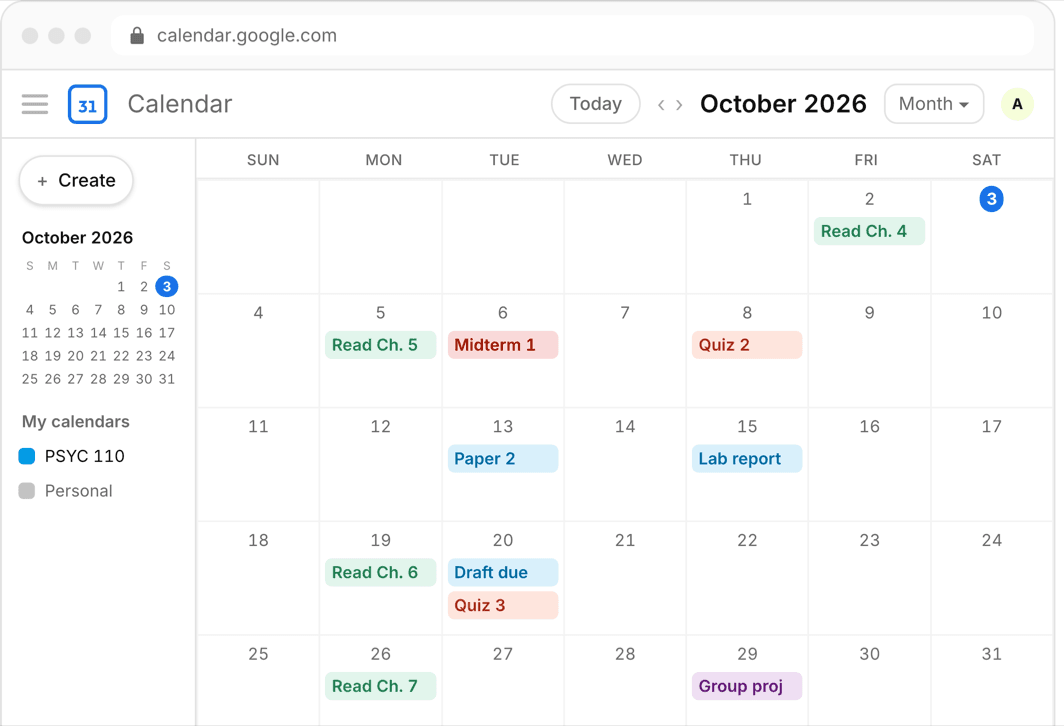
The weekly review is the single highest-leverage habit in student time management, and it takes twenty minutes. It is not journaling, not goal-setting theater, not a productivity system with its own vocabulary. It is a short, structured look backward and forward so the week starts on purpose instead of on impact.
Sunday evening is the classic slot — late enough that the weekend is over, early enough to shape Monday — but any consistent weekly time works. Here is the routine, step by step, with times.
Or skip all of it
Upload the syllabus. Get the calendar.
Every assignment and exam on Google, Apple, or Outlook in about 30 seconds. One syllabus free, no account, no card.
Minutes 0–5: Clear the decks
Start by closing out last week so it stops leaking into this one. This is a sweep, not a deep clean.
- Check every course’s LMS page for new announcements, posted grades, and changed dates
- Scan your school email for anything requiring action — reply now if it takes under two minutes
- Look at last week’s task list: anything unfinished either moves to this week or gets consciously dropped
- Update your calendar with any date changes professors announced
Minutes 5–12: Scan two weeks ahead
Now look forward — and always two weeks, not one. A midterm a week from Friday needs study sessions starting this week; a one-week horizon is how “plenty of time” becomes “tomorrow” overnight.
Go through your semester calendar and list everything due in the next fourteen days, with the grade weight next to each item if you know it. The weight is what turns a list of deadlines into a list of priorities.
- List every deadline in the next 14 days across all courses
- Note the grade weight next to each — a 25% exam and a 2% quiz are not peers
- Flag anything big landing in week two: that work starts now
- Check for collisions — two majors due the same day means one gets finished early
Minutes 12–15: Pick your big three
From the two-week scan, choose the three outcomes that matter most this week. Not three tasks — three outcomes: “problem set 6 submitted,” “first half of midterm review done,” “essay outline finished.”
Three is deliberate. Ten priorities is zero priorities. If everything on the two-week list cannot fit, the weights tell you what wins — and choosing consciously on Sunday beats choosing by panic on Thursday.
Minutes 15–20: Block the time
A priority without a time slot is a hope. Take your big three and place actual work blocks in the coming week’s calendar, around your fixed classes and commitments.
- Give each big-three outcome at least one specific block: “Tue 3–5pm: midterm review, chapters 1–4”
- Schedule the hardest work in your best hours — mornings if you are sharp then, evenings if not
- Leave one evening completely unscheduled as slack; a week with no slack breaks on first contact
- Set reminders on the blocks so they interrupt you, rather than relying on remembering
Make the scan step automatic
The whole review depends on one input: a calendar that actually contains every deadline. If your Sunday scan means re-reading five syllabi and three LMS pages to reconstruct what is due, the review balloons to an hour and the habit dies within a month.
This is where Classmaite slots in: upload each syllabus once at myclassmaite.com/try (PDF, Word doc, or screenshot) and every assignment, exam, and reading deadline lands in Google Calendar, Apple Calendar, or Outlook — with reminders weighted by grade impact. Sunday’s scan step becomes literally opening your calendar and looking at two weeks, which is what keeps the whole routine at twenty minutes. First syllabus is free, no account needed.
Frequently asked questions
Does the weekly review have to be on Sunday?
No — consistency matters, the day does not. Sunday evening is popular because it shapes the whole week and weekends give you slack to actually do it. Friday afternoon is a strong alternative: you plan while the week is fresh and get a genuinely free weekend.
What if I skip a week?
Just run the next one — the routine self-heals because every review scans two weeks forward. Do not do a makeup review or a double session. One skipped week costs a little visibility; quitting because you broke the streak costs the whole system.
Is 20 minutes really enough?
Yes, if your deadlines already live in one calendar — the review is reading and deciding, not gathering. If you spend most of the session hunting through syllabi and LMS pages for what is due, fix the calendar problem first and the review shrinks to 20 minutes on its own.