AI for Group Projects: Meeting Notes, Task Splits, and Merging Drafts Fairly
Quick answer
AI improves group projects at three friction points: transcribing meetings so decisions and action items don’t evaporate (Otter.ai or similar), turning the project into an explicit task list with owners and dates, and smoothing merged drafts into one consistent voice. Agree as a group on how AI will be used first — integrity violations by one member implicate everyone.
Drop your syllabus here
Every assignment, exam, and reading on your calendar in about 30 seconds. Free, no account.
PDF, Word, or a photo of a paper one. No syllabus handy? See a sample
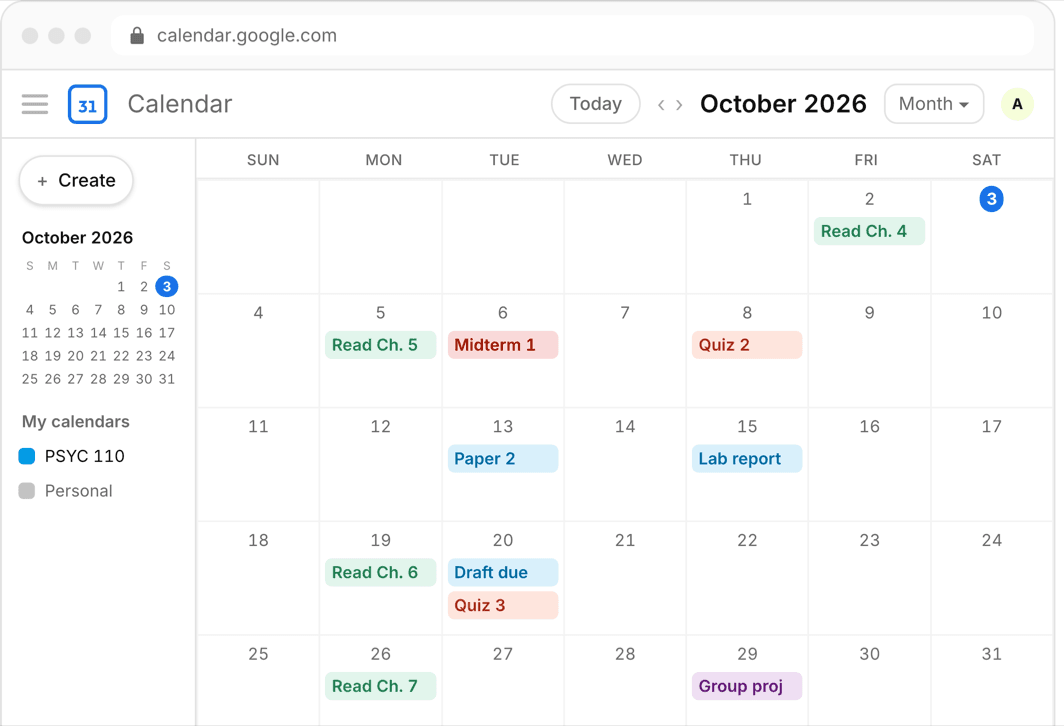
Group projects rarely fail because the work is hard. They fail because nobody wrote down what was decided, the task split lived in one person’s head, and four separately-written sections got stapled together the night before. Every one of those is a coordination failure — and coordination is exactly what AI tools are good at patching.
There’s also a risk unique to group work: AI misuse by one teammate can land the whole group in an integrity case. So this guide covers both halves — the workflows that make group projects less miserable, and the ground rules that keep five people’s grades safe from one person’s shortcut.
Or skip all of it
Upload the syllabus. Get the calendar.
Every assignment and exam on Google, Apple, or Outlook in about 30 seconds. One syllabus free, no account, no card.
First meeting: agree on AI ground rules
Before splitting any work, spend five minutes on two questions: what does this course’s syllabus AI policy allow, and what will this group actually do? Group submissions carry everyone’s name, which means one member quietly generating their section can trigger a case against all of you.
Write the agreement into your shared doc: what AI is used for (notes, planning, feedback), what it’s not used for (generating submitted content, unless the policy allows it), and whether disclosure is required. Boring now, priceless later.
Record and transcribe meetings so decisions survive
The classic failure: a productive meeting, then a week later nobody agrees on what was decided. Fix it by recording — with everyone’s knowledge and consent — and letting a tool like Otter.ai transcribe. Afterward, run the transcript through a chatbot: “Extract every decision made and every action item with its owner.”
Post the resulting summary in the group chat within the hour. Decisions in writing end the “I thought YOU were doing the slides” genre of disaster entirely.
Split tasks with AI as the neutral party
Task splits go wrong in two ways: vague (“Sam does research”) and unfair (one person notices they’re doing 60%). AI helps with both. Paste the assignment brief and ask: “Break this into concrete tasks with rough effort estimates, so four people can divide it evenly.”
A machine-generated breakdown is also socially easier to negotiate over than one written by the group’s self-appointed manager — it’s a neutral starting point nobody has ego invested in. Assign owners and dates to each task, working backward from the due date with buffer before submission.
Merge drafts into one voice — the legitimate way
Four people writing four sections produces a document with four voices, and graders notice. The integrity-safe merge: each member writes their own section, one editor does a human pass for content and flow, and then AI is used to flag inconsistencies — “point out where terminology, tone, or formatting differs between sections” — with humans making the actual edits.
Whether AI can go further and smooth the prose itself depends on your course’s policy; some allow editing assistance on group deliverables, some don’t. This is exactly the clause to have settled in your first-meeting agreement.
Keep the fairness ledger honest
Most group resentment comes from invisible effort. The transcripts and task list you’ve already built double as a contribution record: who owned what, what got delivered, what got dropped. If your course includes peer evaluations, you now have facts instead of vibes.
And if a teammate ghosts, the same record supports the awkward-but-necessary email to the professor — sent early, while there’s still time to rebalance, rather than the night before.
Get every deadline into every calendar
A group project deadline that lives in one member’s planner is a single point of failure. Everyone should carry the same dates — the final due date and the internal milestones you set — in the calendar they actually check.
Classmaite makes the baseline easy: any member can drop the course syllabus in, get every project deadline and deliverable extracted in about 30 seconds, and sync it to Google Calendar, Apple Calendar, or Outlook — or export an .ics file to share so the whole group is working from the same dates.
Frequently asked questions
Do we have to tell teammates we’re recording meetings?
Yes — always get the group’s explicit consent before recording, both as basic courtesy and because recording laws in some states require all parties to agree. In practice nobody minds when the payoff is automatic meeting notes.
If one group member uses AI against the rules, is the whole group responsible?
Often, yes — the submission carries everyone’s name, and many integrity processes treat group work collectively. That’s why an explicit AI agreement and a record of who wrote what matter: they protect the members who played it straight.
Can we use AI to write the parts nobody wants to do?
That’s submitting AI-generated work under your names, which most syllabi prohibit. If a task is genuinely low-value busywork, it’s still safer to split it than to generate it — and if the policy does allow AI drafting with disclosure, disclose it explicitly.