AI for College Language Classes: Conversation Practice, Nuance, and the Limits
Quick answer
AI’s biggest gift to college language students is unlimited, judgment-free conversation practice — text or voice chat in your target language, adjusted to your level, any time. Its limits are real too: it can miss register and cultural nuance, its pronunciation feedback is far weaker than a human ear, and using AI to translate your homework is both against most syllabi and a guaranteed way to fail the oral exam.
Drop your syllabus here
Every assignment, exam, and reading on your calendar in about 30 seconds. Free, no account.
PDF, Word, or a photo of a paper one. No syllabus handy? See a sample
Language classes have a structural shortage: speaking time. In a fifty-minute class with twenty students, you might produce two minutes of the target language out loud. Everyone knows immersion is what works; almost nobody can afford a semester abroad or a private conversation partner. This is the gap AI fills better than any tool before it — a conversation partner with unlimited hours and zero judgment.
It fills that gap imperfectly, and the imperfections matter in a college course where a professor grades your register, your pronunciation, and your feel for the culture. Here’s how to use AI for the volume it’s great at, while staying honest about what it can’t teach — and away from the translation shortcut that language syllabi almost universally prohibit.
Or skip all of it
Upload the syllabus. Get the calendar.
Every assignment and exam on Google, Apple, or Outlook in about 30 seconds. One syllabus free, no account, no card.
Conversation practice: the killer app
ChatGPT and Gemini both support voice conversations, and all the major chatbots handle text chat in dozens of languages. The setup prompt that works: “Have a conversation with me in [language] at [course level]. Stay in the language, keep your vocabulary near my level, and gently correct my errors as we go. Topic: ordering food.”
The judgment-free part is not a small feature. Speaking anxiety — fear of sounding stupid in front of classmates — is one of the biggest brakes on language acquisition, and it disappears completely when the other speaker is a machine. Fifteen minutes a day of AI conversation is more production than most students get in a month of class.
Grammar feedback: strong, with a nuance asterisk
Paste your composition and ask for corrections with explanations — “fix my errors and explain each one” turns every mistake into a mini-lesson, and AI handles standard grammar very well in widely-taught languages.
The asterisk is nuance. Register (formal versus casual, when politeness forms are required), idiom, and cultural appropriateness are where models still stumble — an AI may bless a sentence that’s grammatical but socially wrong, or miss regional usage your professor specifically teaches. When AI feedback contradicts your professor or textbook, the course wins. Your professor grades the exam.
Pronunciation: know the ceiling
Voice-mode AI can model pronunciation for you — hearing words and phrases spoken is genuinely useful for rhythm and listening comprehension. What it can’t reliably do is hear you precisely: fine-grained feedback on your tones, vowel quality, or stress patterns is still much weaker than a human ear.
So use AI voice chat for listening and fluency volume, and route pronunciation correction to humans: your professor, TA, language-lab hours, or campus conversation tables. A semester of practicing a sound wrong is expensive to unwind.
The translation trap
Writing your essay in English and having AI translate it is the language-class cardinal sin, and it’s doubly self-defeating: most language syllabi explicitly prohibit machine translation on submitted work, and professors spot it easily — the output uses grammar and vocabulary you haven’t been taught, which is exactly the you-versus-you signal that triggers integrity questions.
Worse, it skips the entire point. Producing the language — slowly, wrongly, then less wrongly — is the learning. The legitimate version of the same impulse: write it yourself in the target language first, then ask AI to correct and explain. Check your course’s AI policy for where it draws the line on correction tools; language courses are often stricter than average, for good reason.
Consistency beats intensity — make the daily reps automatic
Languages are the most cramming-resistant subject in college. Vocabulary and grammar live in spaced, repeated exposure; a heroic six-hour session before the exam produces almost nothing durable. The AI conversation partner only pays off as a near-daily habit, which makes language classes a scheduling problem wearing a linguistics costume.
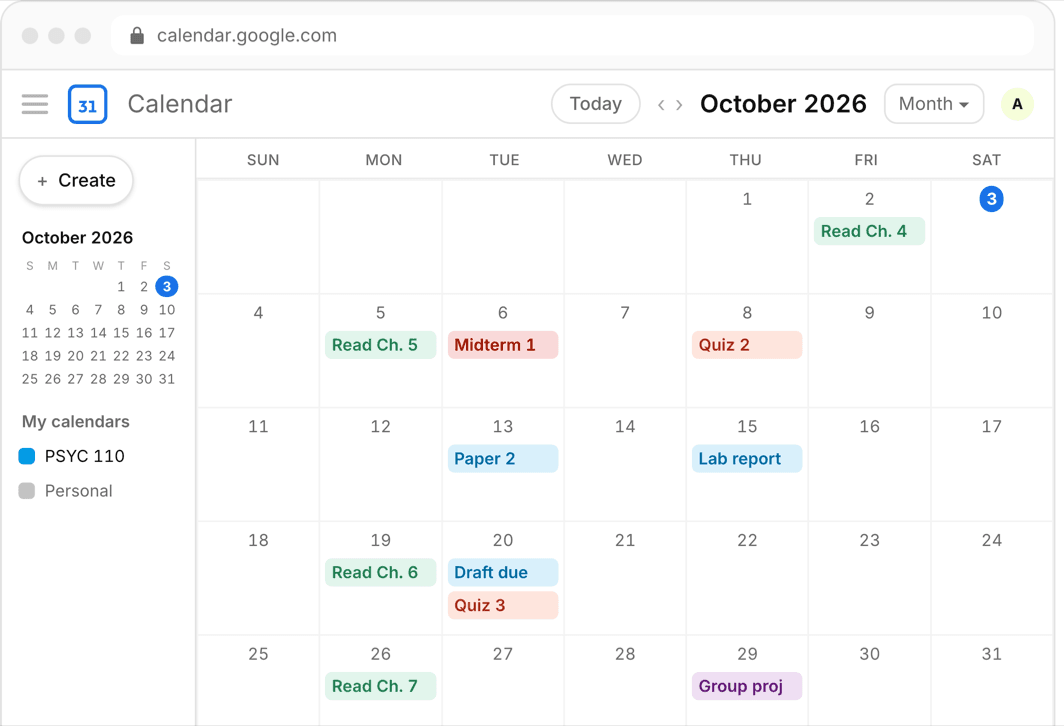
This is where Classmaite fits: drop your syllabus in and every quiz, composition, oral exam, and chapter deadline lands on your calendar in about 30 seconds, with smart reminders weighted by grade impact. When Thursday’s vocab quiz is visible on Monday, the fifteen-minute daily conversation actually happens.
Frequently asked questions
Can AI replace a language partner or tutor?
For volume of practice — conversation reps, corrections, vocabulary drilling — largely yes, and at zero cost. For pronunciation correction, cultural nuance, and the unpredictability of real human speech, no. The strongest setup is AI for daily reps plus regular human conversation through class, conversation tables, or a tutor.
Is using Google Translate or AI translation cheating in a language class?
On submitted work, almost always — most language syllabi explicitly prohibit machine translation, and it defeats the course’s purpose besides. Using AI to correct writing you produced yourself sits in grayer territory that varies by course, so check your syllabus’s AI policy and ask if it’s unclear.
Which AI is best for language conversation practice?
ChatGPT and Gemini both offer voice conversation that works well for spoken practice in major languages; Claude is strong for text chat and grammar explanation. Pick by trying your target language and level in each free tier — quality varies more by language than by model.