AI Tutor vs Human Tutor: An Honest Comparison of When Each Wins
Quick answer
AI tutors win on availability, cost, and patience — instant help at 1am, effectively free, no judgment. Human tutors win on diagnosis, accountability, and course-specific knowledge — they catch the misconception you can’t articulate and know what your professor’s exams look like. For most students the best answer is both: AI for daily questions, a human for recurring struggles in your hardest course.
Drop your syllabus here
Every assignment, exam, and reading on your calendar in about 30 seconds. Free, no account.
PDF, Word, or a photo of a paper one. No syllabus handy? See a sample
The tutoring question used to be simple: can you afford it? At market rates for private tutoring, most students couldn’t, and campus tutoring centers had queues. Now a capable AI tutor is effectively free and always awake, which changes the question from “can I get help” to “which kind of help does my situation actually need?”
The honest answer is that AI and human tutors are good at different failures. AI is a phenomenal answer machine and a mediocre diagnostician; humans are the reverse. Match the tutor to the problem and you’ll spend less and learn more than students who pick a side.
Or skip all of it
Upload the syllabus. Get the calendar.
Every assignment and exam on Google, Apple, or Outlook in about 30 seconds. One syllabus free, no account, no card.
Where AI tutors win
- Availability: help at the moment of confusion — 1am before the problem set is due, not Thursday’s appointment slot
- Cost: free tiers of ChatGPT, Claude, and Gemini handle explain-quiz-reexplain loops that would cost real money per hour with a human
- Infinite patience: you can ask the same question five ways without embarrassment, which matters more than students admit — shame is a real barrier to asking humans
- Adaptivity on demand: “explain it simpler,” “use a sports analogy,” “now quiz me” — instant register changes no human sustains for hours
- Volume: unlimited practice problems and worked explanations, which is most of what routine studying needs
Where human tutors win
- Diagnosis: the best tutor skill is spotting the misconception you can’t articulate — AI answers the question you asked; a good human notices you’re asking the wrong question
- Accountability: a Tuesday appointment gets you studying in a way a chatbot never will; you can’t ghost a person as easily as an app
- Course-specific intel: a tutor who took Professor Chen’s orgo class knows what her exams punish — knowledge no general model has
- Reliability: humans who know a subject don’t confidently invent things; AI still sometimes does, which matters most exactly when you can’t tell
- Motivation and confidence: for students who are struggling emotionally with a course, not just intellectually, a person is the intervention
The cost math, honestly
Private tutoring commonly runs $30–100+/hour depending on subject and market. AI tutoring is free to ~$20/month. That gap means the question is never “AI or human for everything” — it’s “which few hours are worth human rates?”
Don’t forget the free human option: your campus tutoring center and your professor’s office hours cost nothing and carry the course-specific knowledge advantage. Office hours are the most underused tutoring resource in college, and they’re run by the person who writes your exam.
The hybrid that actually works
Default to AI for the daily layer: explanations at the moment of confusion, practice problems, self-quizzing. This is 80% of tutoring need and the part AI does excellently.
Escalate to a human on clear triggers: the same confusion keeps coming back despite AI explanations, your grade is slipping in a course that matters, the material is in your major’s critical path, or you need accountability more than answers. Use the AI sessions to arrive prepared — showing up to a paid hour with specific questions doubles its value.
Whichever you choose, timing decides its value
The most common tutoring mistake isn’t choosing the wrong kind — it’s starting two days before the exam, when neither kind can save you. Help works when it starts at the first sign of trouble, and human tutors in particular book out during midterms.
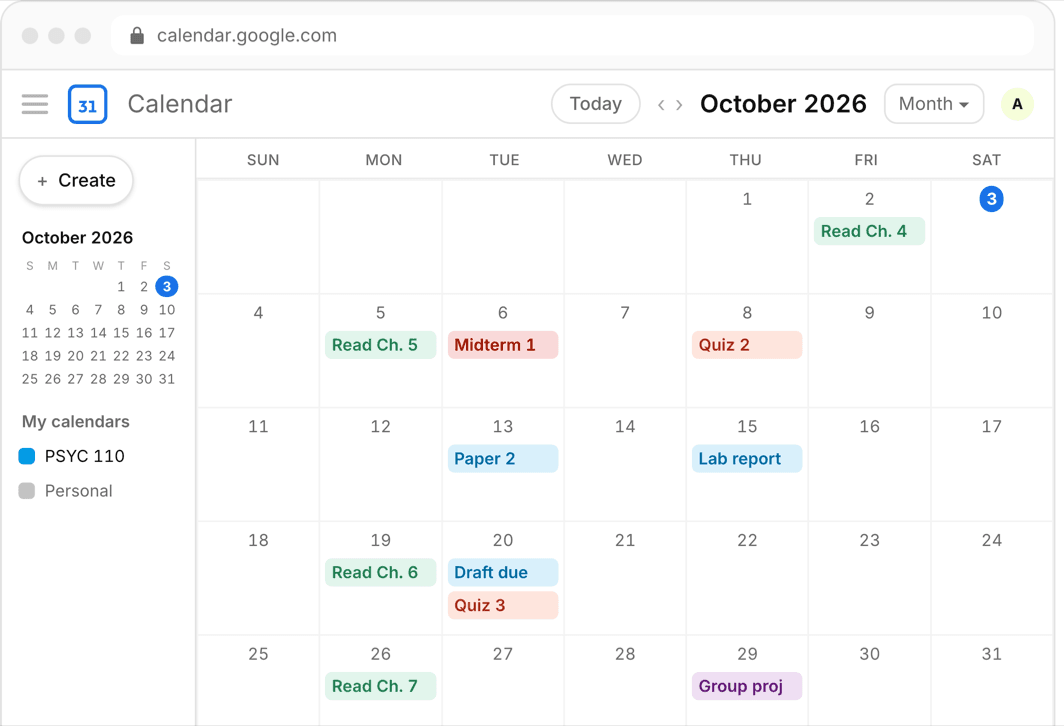
That’s a calendar problem: you need to see the exam coming three weeks out. Classmaite handles it by reading your syllabus and putting every exam and assignment on your calendar in about 30 seconds, with reminders weighted by grade impact — so “book a tutor” or “start the AI practice loop” happens while there’s still time for it to matter.
Frequently asked questions
Can an AI tutor fully replace a human tutor?
For routine explanation and practice, largely yes. For diagnosing why you keep getting stuck, accountability, and course-specific exam knowledge, no. Students who struggle with motivation or have deep misconceptions get disproportionate value from a human; students who just need answers-on-demand often don’t need one.
Is using an AI tutor considered cheating?
Using AI to learn — explanations, practice, quizzing — is permitted in most courses, the same way a human tutor is. The line is the same for both: a tutor of any kind who does your graded work for you is misconduct. Check your syllabus’s AI policy for course-specific rules.
How do I make AI tutoring actually effective?
Make it interactive, not passive: ask for one-question-at-a-time quizzing, explain concepts back and have it find your gaps, and always attempt problems before asking for help. Passive reading of AI explanations is the AI-tutoring equivalent of a tutor who lectures at you for an hour.