AI for English Class: What’s Safe to Use When Writing Is the Whole Point
Quick answer
In writing-focused courses, AI is generally safest for brainstorming, outlining, and getting feedback on drafts you wrote — and most dangerous when it generates prose you submit. Because the writing itself is what’s being graded, always check your syllabus’s AI policy first; many writing courses restrict AI more than other classes do.
Drop your syllabus here
Every assignment, exam, and reading on your calendar in about 30 seconds. Free, no account.
PDF, Word, or a photo of a paper one. No syllabus handy? See a sample
English and composition classes are the trickiest place in college to use AI, for one structural reason: the writing is not a vehicle for the grade, it is the grade. In a biology class, a lab report communicates your science. In a writing class, the prose itself — your argument, your sentences, your voice — is the thing being taught and assessed. That’s why writing professors tend to have the strictest AI policies on campus, and why “everyone uses it” is a terrible risk model here.
None of which means AI is useless to you. There are three uses that improve your writing without replacing it — brainstorming, structural planning, and feedback on your own drafts — and this guide covers how to do each one inside the lines, plus the habits that protect you if your work is ever questioned.
Or skip all of it
Upload the syllabus. Get the calendar.
Every assignment and exam on Google, Apple, or Outlook in about 30 seconds. One syllabus free, no account, no card.
Step zero: read the AI policy for this specific course
Before anything else, find the AI section of your syllabus. Writing courses split sharply: some prohibit AI at every stage including brainstorming, some allow pre-writing but not drafting, some allow anything with disclosure. The policy for your history seminar tells you nothing about your composition class.
If the syllabus is silent, email the professor and ask — a two-line question that takes thirty seconds and converts every gray area into a known rule. Everything below assumes your course allows the use described; where it doesn’t, the syllabus wins.
Brainstorming: AI as a sparring partner, not a source
The integrity-safe brainstorm treats AI output as raw ore, not finished ideas. Describe the assignment and your rough angle, then ask: “What are the strongest objections to this thesis?” or “What angles am I not considering?” Argue with the responses. The thesis you end up with should be one the AI pushed you toward, not one it handed you.
A useful test: if you could show the chat log to your professor without flinching, you’re on the right side. A conversation full of your thinking with AI pushback reads very differently than “write me five thesis statements.”
Outlining: structure help without sentence help
Once you have an argument, AI can pressure-test your structure: “Here’s my thesis and my four main points. Is the order logical? Where will a reader get lost?” This is the kind of help a writing center tutor gives, applied to the skeleton rather than the prose.
The line to hold: the AI comments on your outline; it doesn’t write the paragraphs the outline becomes. The moment generated sentences start migrating into your draft, you’ve changed activities.
Feedback on drafts you wrote
This is AI’s best legal use in a writing class. Paste your finished draft and ask for reader-response feedback: “Where is my argument weakest? Which paragraphs drift from the thesis? Where is my evidence thin?” Then revise in your own words. Grammarly plays a similar role at the sentence level, flagging grammar and clarity issues in prose you wrote.
Avoid the one-click trap: asking AI to “improve” or rewrite your draft replaces your voice with its own, which both defeats the course’s purpose and produces exactly the style shift professors notice. Feedback in, your revision out.
What crosses the line — and the paper trail that protects you
- Submitting AI-generated prose as your own, whole or partial, crosses the line in nearly every writing course
- “Humanizing” or paraphrasing AI text to evade detection is worse, not better — it converts a gray area into deliberate deception
- AI-fabricated quotes and citations are a classic bust: models invent plausible sources, and professors check
- Protect yourself: draft in Google Docs or Word with version history on, keep your notes and outlines, and save your AI chats — a visible writing process is the strongest defense against a false accusation
- If your course requires disclosure, disclose specifically: “Used ChatGPT to brainstorm counterarguments and critique my outline” beats a vague footnote
Give the essay the runway it needs
Every safe use above assumes time: time to brainstorm before drafting, time to draft before feedback, time to revise after. The students who end up pasting AI prose at 2am are almost never the lazy ones — they’re the ones who found out the essay was due tomorrow.
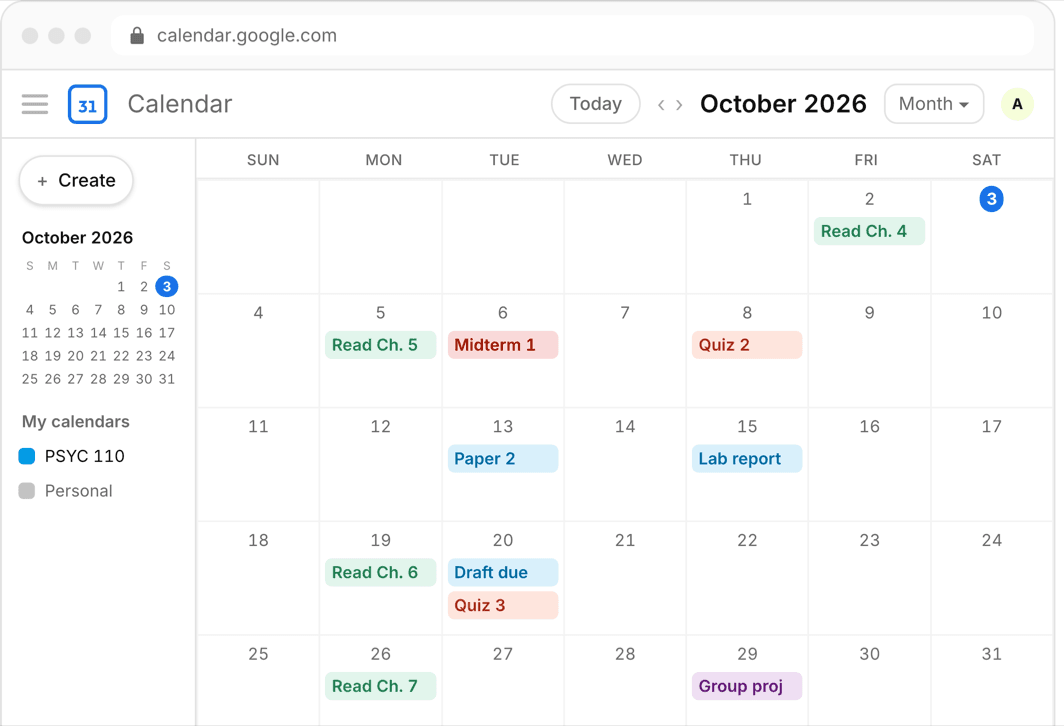
Classmaite exists for exactly that failure: drop in your syllabus and every essay deadline, reading, and draft due date lands in your calendar in about 30 seconds, with reminders weighted by how much each assignment counts. The integrity-safe workflow starts with knowing the deadline early enough to use it.
Frequently asked questions
Can I use Grammarly in a writing class?
Usually, but check — some composition courses restrict even grammar-checking tools, and Grammarly’s generative features (rewriting, drafting) are a different question than its proofreading ones. When in doubt, ask your professor which features are acceptable.
Is it okay to have AI rewrite my paragraphs to sound better?
In most writing courses, no — the sentences are what’s being graded, so AI-rewritten prose misrepresents your work even though the ideas were yours. Ask for feedback on what’s weak instead, then do the rewriting yourself.
What if my professor’s syllabus doesn’t mention AI at all?
Ask directly rather than assuming permission — a short email works. Until you have an answer, the conservative default is to use AI only for studying and understanding, not for producing anything you’ll submit.