How Do Professors Detect AI? An Honest Explainer
Quick answer
Professors detect AI through a mix of signals, not one tool: AI-detection software (which is unreliable in both directions), sudden shifts from your known writing style, work that doesn’t match your in-class performance, fabricated citations, and follow-up conversations where you can’t explain your own submission. Because no method is certain, the only reliable position is following your course’s AI policy and being able to show your process.
Drop your syllabus here
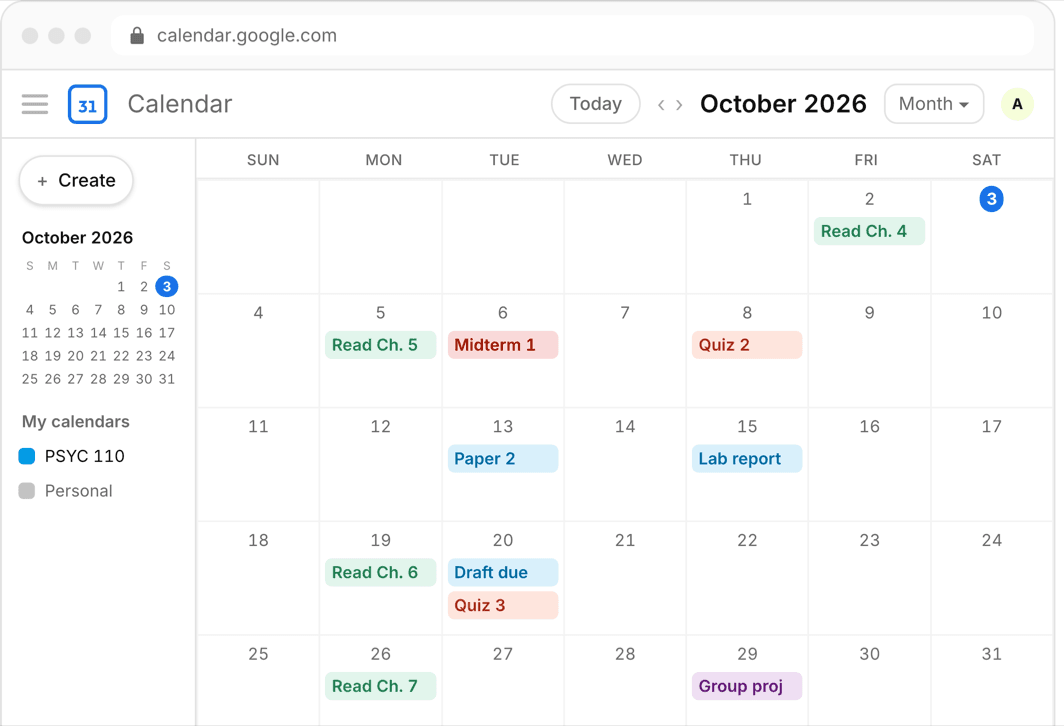
Every assignment, exam, and reading on your calendar in about 30 seconds. Free, no account.
PDF, Word, or a photo of a paper one. No syllabus handy? See a sample
Every student has heard both claims: “professors can always tell” and “detectors don’t work.” The truth is messier and more interesting. No single method reliably detects AI writing — the detectors have real false-positive and false-negative rates — but professors don’t rely on a single method. They rely on converging signals, and the convergence is harder to beat than any one detector.
This guide explains each signal honestly, including the uncomfortable one: detectors sometimes flag human writing, and students get accused wrongly. Understanding how detection actually works leads to one conclusion, and it isn’t a clever evasion strategy — it’s that transparency and a visible process are the only positions that hold up from every direction.
Or skip all of it
Upload the syllabus. Get the calendar.
Every assignment and exam on Google, Apple, or Outlook in about 30 seconds. One syllabus free, no account, no card.
AI detectors: real, used, and unreliable
Detection software estimates how statistically “AI-like” a text is. These tools are widely deployed through plagiarism-checking platforms, and they are wrong in both directions: they miss AI text, and they flag human text — with documented tendencies to false-flag non-native English speakers and writers with very uniform styles.
Most universities know this, which is why detector scores are typically treated as a reason to look closer, not proof. But “not proof” still means a stressful meeting. The takeaway cuts both ways: a clean score doesn’t mean AI use went unnoticed, and a flagged score doesn’t mean you’re doomed — especially if you can show your work.
The stronger signal: you, compared to yourself
Professors read your writing all semester — discussion posts, in-class work, early essays. That backlog is a fingerprint, and sudden departures are conspicuous: vocabulary you’ve never used, a polish level that appeared overnight, prose that doesn’t match the person who wrote last month’s midterm in class.
This is why the timed writing sample many courses collect in week one exists. It isn’t busywork; it’s a baseline. And it’s a signal no paraphrasing tool can beat, because the problem isn’t that the new essay looks like AI — it’s that it doesn’t look like you.
Content tells: the mistakes AI makes
- Fabricated or subtly wrong citations — the classic bust; models invent plausible sources, and professors check them
- Confident errors about lecture-specific content the AI was never in the room for
- Generic argumentation that engages the topic but not the actual course — no reference to readings, discussions, or the professor’s framing
- A distinctive default essay shape and register that graders have now read thousands of times
- Metadata and version history: a 2,000-word document that appeared in one paste tells a story
The conversation you can’t fake
The most reliable check costs nothing: the professor asks you about your own work. Why this argument? What did you mean in the third paragraph? What would you cut? A student who wrote the essay answers easily and imperfectly. A student who generated it gives answers that are vague, wrong, or suspiciously rehearsed.
Oral follow-ups are increasingly formalized — some courses now include short viva-style defenses of submitted work. If your plan for passing a course can’t survive a five-minute conversation about your own submission, it isn’t a plan.
If you’re falsely accused
It happens, and the students who come through it fastest are the ones with a process to show. Version history in Google Docs or Word showing the draft growing over days. Notes, outlines, annotated readings. AI chat logs showing permitted uses like brainstorming rather than generation.
Stay calm, ask what evidence triggered the concern, present your process, and know your university’s procedure — you’re typically entitled to a real process, not a summary judgment from a detector score. Building the paper trail before you need it is the whole trick: draft in tools with history on, and keep your working materials until grades post.
Why transparency is the winning strategy
Run the options honestly. Evasion — paraphrasers, “humanizers,” style-mixing — is an arms race where you don’t control the detector, you can’t beat the you-versus-you comparison, and one oral follow-up collapses the whole thing. And a detected evasion attempt reads as premeditated deception, which is treated far more harshly than a gray-area mistake.
Transparency, by contrast, is boring and bulletproof: know your syllabus’s AI policy, use AI inside it, disclose when required, keep your process visible. Most corner-cutting starts as a time crisis at 1am, so the unglamorous prevention is knowing your deadlines early — that’s what Classmaite is for: syllabus in, every deadline on your calendar with reminders in about 30 seconds, so the essay gets started while doing it honestly is still easy.
Frequently asked questions
Can professors really tell when writing is AI-generated?
Not with certainty from any single signal — detectors are fallible and style judgments are subjective. But converging evidence (a detector flag plus a style shift plus a shaky follow-up conversation plus a fake citation) is a different matter, and that combination is what actually triggers integrity cases.
Do AI detectors give false positives?
Yes — documented ones, including a known tendency to flag non-native English speakers’ writing. That’s exactly why most universities treat detector scores as a prompt for review rather than proof, and why keeping version history and drafts is worthwhile protection for honest students.
If I use AI in ways my syllabus allows, can I still get flagged?
A detector can flag anything, including fully human writing — but permitted use plus documentation is a short conversation, not a case. Follow the policy, disclose if the course requires it, and keep your chat logs and drafts so you can show exactly what the AI did and didn’t touch.