Commuter Student Tips: How to Win College From Off Campus
Quick answer
The core commuter student strategy: compress classes into 2–3 campus days, treat gaps between classes as scheduled study blocks instead of dead time, keep a packed “campus kit” so forgetting something doesn’t cost a round trip, and join one or two recurring clubs — because for commuters, connection has to be scheduled or it doesn’t happen.
Drop your syllabus here
Every assignment, exam, and reading on your calendar in about 30 seconds. Free, no account.
PDF, Word, or a photo of a paper one. No syllabus handy? See a sample
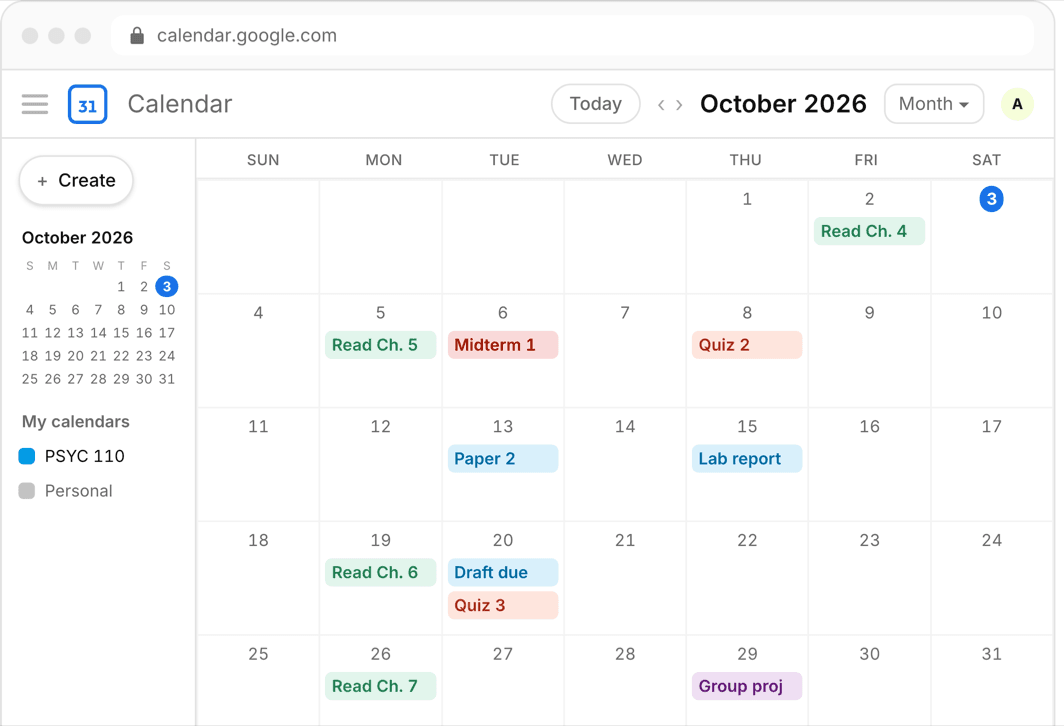
Roughly a quarter of college students commute, but campus life is designed as if everyone lives in the dorms. Events at 9pm, study groups that form spontaneously in residence halls, “just swing by” office hours — all of it quietly assumes you’re a five-minute walk away. You’re fighting a home-field disadvantage nobody acknowledges.
The commuters who thrive don’t out-hustle it; they out-plan it. Their edge comes from treating campus time as a scarce resource and spending it deliberately. Here’s the full strategy.
Or skip all of it
Upload the syllabus. Get the calendar.
Every assignment and exam on Google, Apple, or Outlook in about 30 seconds. One syllabus free, no account, no card.
Schedule design: your biggest lever
Everything downstream gets easier or harder based on how you build your class schedule. The standard commuter play is block scheduling: compress classes into two or three campus days (the classic Tuesday/Thursday stack, or MWF) instead of spreading them across five. Fewer trips means less commute time, less gas or fare money, and full off-days for deep work or a job.
One refinement: don’t schedule back-to-back-to-back with zero gaps. A schedule with one or two 90-minute gaps per campus day gives you built-in study blocks (more on those next) and slack when a class runs over. And check the commute math before finalizing — an 8am class that requires leaving home at 6:30 will lose to your snooze button by October. Register with your commute, not your optimism.
Dead hours are your real study schedule
The gap between classes is the most squandered resource in commuter life. Two hours between lectures, spent scrolling in the union, times three gaps a week, is a part-time job’s worth of lost study time per semester. Dorm students can study at midnight; your equivalent is 11am Tuesday, and it only works if you treat it as an appointment.
- Assign every recurring gap a job in week one: “Tuesday 11–1 = chem problem sets in the library, third floor.” Vague intentions lose to your phone.
- Claim a consistent spot. A regular location makes the habit automatic and gives classmates a place to find you.
- Match task to gap size: 30 minutes = flashcards and email; 60 = a reading; 90+ = real problem sets or drafting.
- Use campus resources that dorm students take for granted — tutoring center, writing center, gym, professor office hours — during gaps. They’re all “free” to someone already on campus.
The logistics kit
- Pack a campus kit the night before: charger and battery pack, headphones, snacks, water, layers (lecture halls are freezing), and anything due. A forgotten item costs a resident a 5-minute walk; it costs you the day.
- Get a locker if your campus offers them (library or student union, often cheap or free) — stop hauling every textbook on every trip.
- Keep a food strategy: a packed lunch plus knowing the cheapest decent on-campus option saves real money over a semester of impulse-buying.
- Build a weather-day protocol before you need it: know each professor’s absence policy, have a notes contact in every class, and email early when the roads are bad — “commuting student, conditions unsafe” is a legitimate message professors respect when it’s rare.
- Have a backup transport plan: the day your car dies or the train stops running should be an inconvenience, not a crisis. Know the bus route, a classmate’s number, or the rideshare cost in advance.
Staying connected without living there
The real commuter risk isn’t academic — it’s becoming a ghost. You come to class, you leave, and by November campus is just a building you visit. Loneliness and lower engagement follow, and so does missing the informal network where study groups, internship tips, and friendships actually form.
The fix is structural, not motivational: connection has to be an appointment. Join one or two clubs that meet on your campus days, ideally in the gap right after your last class — the commute-home decision kills anything that requires a special trip. Say yes to the occasional evening thing each month, deliberately. Get into every course group chat, and be the person who organizes the review session — organizers never have to worry about being included. If your school has a commuter lounge or commuter student org, use it; it’s an instant pool of people who get your logistics.
Guard the home front, and run it all from one calendar
Commuters disproportionately juggle jobs and family obligations, and home is where boundaries erode — the people you live with see “home” and read “available.” Announce your study blocks like shifts (“I’m unavailable 7–9 tonight”), and if home isn’t studyable, make the library-before-driving-home stop part of your routine: for many commuters, staying one extra hour on campus is worth three distracted hours at the kitchen table.
With classes, commute, work shifts, and deadlines all competing, a single trusted calendar is non-negotiable — Classmaite handles the class side by turning each syllabus into calendar events in about 30 seconds, so your campus days, gaps, and due dates all live in one view.
Frequently asked questions
Is it harder to make friends as a commuter student?
Harder by default, not by destiny. Commuters miss the passive social exposure of dorm life, so friendships have to come from recurring structures — clubs that meet on your campus days, study groups you organize, course group chats. Scheduled connection works; spontaneous connection mostly won’t happen.
What is the best class schedule for commuter students?
Most commuters do best compressing classes into 2–3 days (like a Tuesday/Thursday block) with one or two 90-minute gaps per day for studying, rather than spreading short days across the whole week. Fewer trips, full off-days, and built-in study time beat five half-days almost every time.
How do commuter students use time between classes well?
Assign every recurring gap a specific job and location in week one — “Tuesday 11–1, chem problems, library third floor” — and treat it like a class. Matching task size to gap size (flashcards for 30 minutes, problem sets for 90) keeps the time genuinely productive.