How to Find a Study Partner Who Actually Helps
Quick answer
Find a study partner by picking someone from your actual class who shows up consistently, then making a low-pressure, specific ask: “I’m reviewing chapter 4 at the library Thursday at 3 — want to join?” A concrete time and place gets a yes far more often than a vague “we should study sometime.”
Drop your syllabus here
Every assignment, exam, and reading on your calendar in about 30 seconds. Free, no account.
PDF, Word, or a photo of a paper one. No syllabus handy? See a sample
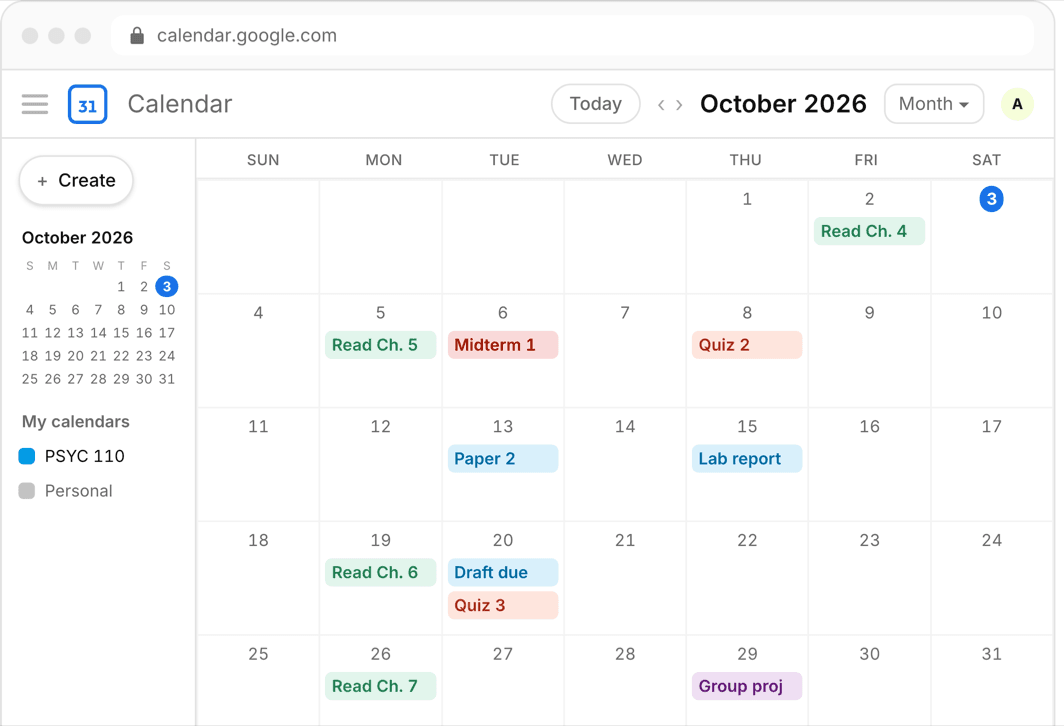
Studying with the right person is a legitimate performance enhancer: you keep appointments you’d break with yourself, you catch gaps when you try to explain things out loud, and you get someone else’s notes on the day you were sick. Studying with the wrong person is two hours of talking with a textbook open as a prop.
The difference comes down to who you pick, how you ask, and whether the sessions have any structure. All three are learnable. Here’s the playbook.
Or skip all of it
Upload the syllabus. Get the calendar.
Every assignment and exam on Google, Apple, or Outlook in about 30 seconds. One syllabus free, no account, no card.
Where to look (in order of effectiveness)
- Your actual class — the best pool by far. You share the same exams, the same professor, the same deadlines. Watch for the people who attend consistently and ask decent questions.
- The course’s online space — a Discord, GroupMe, or discussion board almost always exists. “Anyone want to review before Thursday’s exam?” posted there reliably gets takers.
- Office hours and SI/review sessions — anyone who shows up to optional help is pre-screened for taking the course seriously.
- Your major’s club or lounge — for recurring partners across multiple courses, not just one.
- Labs and discussion sections — smaller rooms where talking to people is structurally easier than in a 300-person lecture.
The first ask (it’s easier than you think)
The move is to make the ask specific and low-commitment. Vague asks (“we should study together sometime”) die because nobody owns the follow-up. Concrete asks are nearly frictionless: “I’m going over the problem set at the library Thursday at 3 — want to join?” The other person can say yes to a single event with zero ongoing obligation, which is exactly why they will.
Natural openers if you haven’t spoken before: comparing notes after class (“Did you catch what she said the essay should focus on?”), a shared struggle (“That problem set was brutal — how far did you get?”), or the direct-but-casual version: “Hey, you seem on top of this class — I’m putting together a review session before the midterm, interested?” Being organized is attractive; nobody is offended by an invitation to be prepared.
Vetting: good partner, bad partner
You don’t need the smartest person in the room — you need someone reliable and roughly matched in effort. Slightly ahead of you is ideal (you learn from them; explaining to you sharpens them). Massively mismatched effort in either direction breeds resentment.
- Green flags: attends class, does the reading at least sometimes, replies to messages, shows up when they say they will.
- Red flags: wants your notes but never shares theirs, treats sessions as social hour, cancels repeatedly, or only appears the night before exams.
- Test with one session before committing to a weekly thing. One meeting tells you almost everything.
Keeping sessions productive
- Set an agenda in one sentence at the start: “Let’s get through problems 1–8, then quiz each other on terms.” Aimless sessions drift immediately.
- Use the teach-back method — take turns explaining concepts to each other without notes. It’s the single highest-value study-pair activity; gaps reveal themselves instantly.
- Time-box socializing: 10 minutes of catching up at the start, then work. Trying to ban it entirely fails; containing it works.
- Do first passes alone, together. Struggle with problems solo for a few minutes before comparing — copying someone’s solution teaches you nothing on exam day.
- End by scheduling the next session. “Same time next week?” takes five seconds and is the difference between a study partnership and a one-off.
- Cap groups at 3–4 people. Beyond that, every session becomes a scheduling negotiation followed by a party.
Make it recurring, and aim it at real deadlines
The compounding value of a study partner comes from rhythm: a standing weekly slot that both of you protect. Anchor it to the course’s actual cadence — the weekly problem set, the reading quiz — so the session always has a built-in agenda and a real deadline behind it.
That’s easier when you can both see the deadlines coming: Classmaite turns each syllabus into a shared-reality calendar in about 30 seconds, so “want to review before the exam?” happens two weeks out instead of the night before.
Frequently asked questions
How do I ask someone to be my study partner without it being awkward?
Skip the label entirely and invite them to one specific session: “I’m reviewing chapter 4 at the library Thursday at 3 — want to join?” A concrete, one-time invitation is easy to accept and carries no pressure. If it goes well, “same time next week?” makes it recurring.
Is it better to study alone or with a partner?
Both, for different things. First-pass learning (reading, initial problem attempts) is usually better alone. Retrieval and consolidation — quizzing, explaining concepts aloud, comparing approaches — is where a partner adds real value. The strongest pattern is solo prep, then partnered review.
What if my study partner isn’t pulling their weight?
Name it once, kindly and specifically: “I need our sessions to be more focused — can we stick to the agenda this week?” If nothing changes, quietly stop scheduling and let it fade. You owe a classmate courtesy, not a semester of one-sided tutoring.