How to Succeed in Online Classes (When No One’s Watching)
Quick answer
Succeed in online classes by rebuilding the structure the format removes: schedule fixed weekly times for lectures and coursework as if they were in-person classes, extract every deadline into one calendar during week one, check the course site on a set schedule, and post early in discussions. Online courses reward self-imposed routine over motivation.
Drop your syllabus here
Every assignment, exam, and reading on your calendar in about 30 seconds. Free, no account.
PDF, Word, or a photo of a paper one. No syllabus handy? See a sample
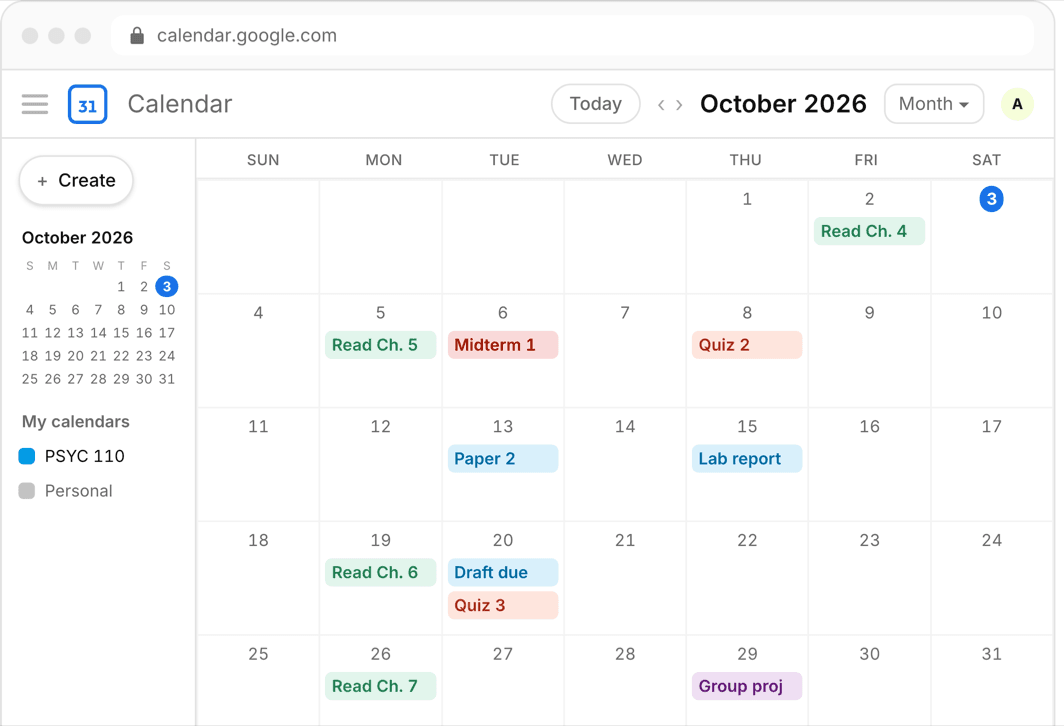
The dirty secret of online classes is that they’re not easier — they’re structurally harder for most people. An in-person class gives you free infrastructure: a room to show up to, a professor watching, classmates whose presence reminds you the course exists. Online, all of that is stripped out, and the course becomes a website that silently accumulates deadlines whether you visit it or not.
Students who struggle online aren’t lazier; they’re running an in-person strategy in a format that punishes it. The fix is rebuilding the missing structure yourself. Here’s exactly what to build.
Or skip all of it
Upload the syllabus. Get the calendar.
Every assignment and exam on Google, Apple, or Outlook in about 30 seconds. One syllabus free, no account, no card.
Give the class a time and a place again
“Work whenever” reliably becomes “work never,” because a task that can be done anytime loses every fight against tasks due right now. The single most effective online-class move is to schedule it like an in-person class: fixed blocks on fixed days — “ECON 210, Tuesday and Thursday 10–11:30” — during which you watch lectures, do the readings, and work assignments. Protect those blocks like you’d never skip a lecture with an attendance policy.
Give it a place, too: a desk, a library corner, a specific coffee shop — anywhere that isn’t your bed. Physical context is a cue your brain uses to switch modes, and “this chair means coursework” is a real effect. Watching lectures at 1.5x from bed with your phone in hand is technically attendance and functionally nothing.
Week one: extract everything
Online courses scatter deadlines across the syllabus, the LMS calendar, module pages, and announcement posts — and unlike a professor, none of them will remind you out loud. In week one, hunt down every assignment, quiz window, discussion deadline, and exam date across all of those places and put them in one calendar you actually check.
While you’re in there, learn the course’s rhythm: When do modules unlock? When are things typically due (Sunday 11:59pm is the classic)? Are quizzes open for a window or a moment? Does the professor post announcements Monday? Knowing the cadence turns the course from a series of surprises into a routine.
The deadline traps unique to online courses
- The Sunday 11:59pm pileup — every online course loves this slot, so three courses can mean three deadlines in the same hour, weekly. Do the work by Friday and Sunday becomes a buffer instead of a cliff.
- Quiz windows that close forever — “available Tuesday–Thursday” often means zero make-ups after Thursday. Treat the window’s open, not its close, as your deadline.
- Timed quizzes with one attempt — confirm the time limit, attempt count, and tech requirements before you click start, not after.
- Multi-part deadlines — “initial post Wednesday, two replies Sunday” is two deadlines, and the Wednesday one is the one everyone misses.
- Timezone mismatches — the LMS clock runs on the school’s timezone, not yours. If you’re remote, verify what 11:59pm actually means for you.
- Silent syllabus changes — announcements can move dates. If you don’t have notifications on, a moved deadline is invisible. Turn on LMS email/push notifications on day one.
Discussion posts: the reality nobody explains
Discussion boards feel like busywork, but they’re usually 15–25% of your grade and one of the few visibility channels you have. The strategy: post early in the window — early posts get engagement, replies, and better-rested grading, while Sunday-night posts vanish into a flood. Follow the rubric mechanically (word count, citations, number of replies — points live there), and say one actual thing: reference a specific detail from the reading and take a small position. “Great point, I agree” replies earn the minimum; “I read this differently because of X on page 40” reads like thought.
Budget it honestly: a post plus two substantive replies is 45–60 minutes of real work per course per week. Schedule it inside your fixed blocks instead of discovering it at 11:40pm Sunday.
Stay visible, stay connected
Online, your professor’s entire impression of you is your submissions, your posts, and your emails — nobody sees you taking diligent notes. Manufacture presence: attend virtual office hours once early in the term (often you’ll be the only one there, which is a private tutoring session), ask an occasional good question by email, and turn your camera on in live sessions when you can. That thin thread of relationship is what makes a professor flexible when your wifi dies during a quiz — which you should report immediately, with a screenshot, the moment it happens.
Do the same laterally: join or start the course group chat, and find one classmate who’ll trade “did you catch what module 6 wants?” messages. Online courses are isolating by default, and isolated students quietly drift into failing.
The system that holds it together
Every tip above reduces to one principle: in-person courses supply structure, online courses make you supply it. Fixed times, one calendar, notification hygiene, early posts, manufactured visibility — that’s the entire formula, and none of it requires more motivation, just more setup.
The one-calendar step is the fastest to automate: Classmaite reads each syllabus and drops every deadline onto your calendar in about 30 seconds, with reminders weighted toward the assignments that actually move your grade.
Frequently asked questions
Why are online classes harder than in-person classes?
They remove the built-in structure — scheduled meeting times, a physical room, a professor who reminds you of deadlines, and classmates who make the course feel real. The material is the same; the accountability isn’t. Students who schedule fixed work blocks recreate that structure and close most of the gap.
How many hours a week does an online class take?
Plan for the same as in-person: roughly 8–10 hours per week for a 3-credit course, covering lectures, readings, assignments, and discussion posts. The flexible format changes when you do the work, not how much of it there is — underestimating this is the most common online-course mistake.
How do I not procrastinate in online classes?
Stop relying on willpower and start relying on appointments: fixed weekly time blocks for each course, deadlines pulled into one calendar with reminders, and a self-imposed Friday deadline for work that’s due Sunday. Procrastination thrives on “I’ll do it whenever”; a schedule removes the whenever.
Do discussion posts actually matter in online classes?
Yes — they’re commonly 15–25% of the final grade and often the professor’s main impression of you. Post early in the window, hit every rubric requirement explicitly, and make one specific point per post. It’s a predictable, rubric-driven grade that organized students bank every week.