How to Email a Professor (Without Sounding Weird)
Quick answer
Email a professor with a specific subject line (course code + topic), a greeting using their title (“Dear Professor Lee”), 2–4 sentences stating who you are and exactly what you need, and a sign-off with your full name and course section. Keep it under 100 words and never open with “Hey.”
Drop your syllabus here
Every assignment, exam, and reading on your calendar in about 30 seconds. Free, no account.
PDF, Word, or a photo of a paper one. No syllabus handy? See a sample
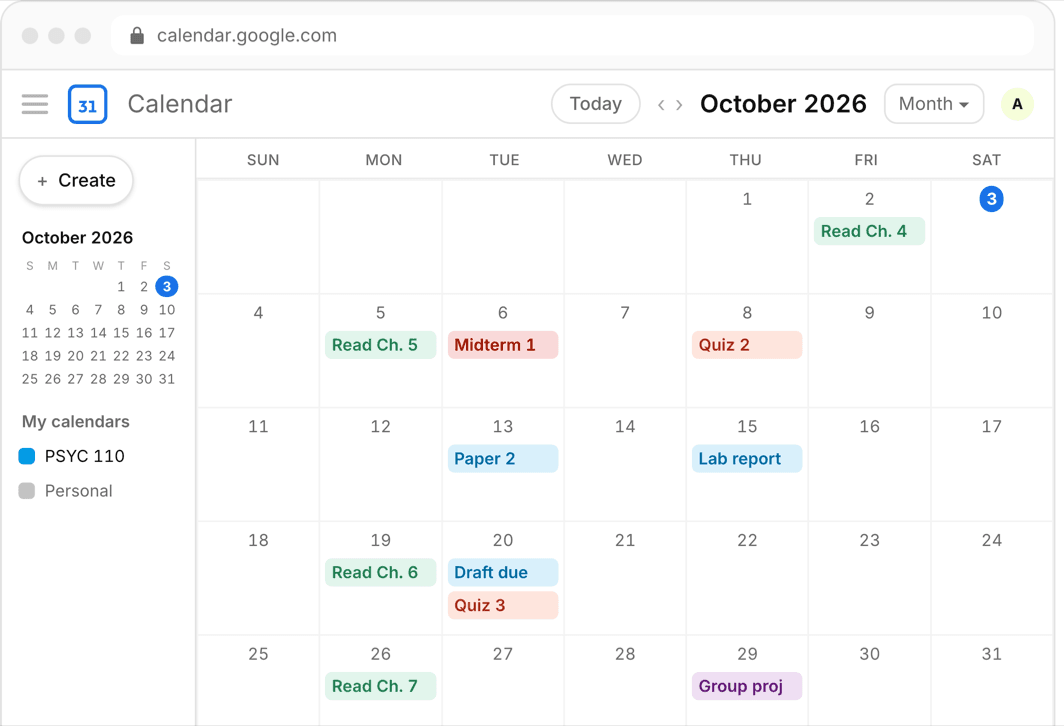
Emailing a professor feels high-stakes because it kind of is. Professors get dozens of student emails a day, and they form opinions fast. A sloppy email won’t tank your grade, but a clear one gets answered faster, makes office hours easier, and quietly builds the kind of reputation that turns into recommendation letters later.
The good news: a great professor email is a formula, not an art form. Get the subject line, greeting, body, and sign-off right and you’re ahead of 80% of your classmates. Here’s the full structure, a template you can copy, and the mistakes to avoid.
Or skip all of it
Upload the syllabus. Get the calendar.
Every assignment and exam on Google, Apple, or Outlook in about 30 seconds. One syllabus free, no account, no card.
Subject lines that actually get opened
Your professor is scanning an inbox full of “Question” and “(no subject).” The fix is specificity: put the course code first, then the actual topic. That lets them triage your email in two seconds and answer it in the gap between meetings.
- Good: “BIO 201: Question about Friday’s lab report format”
- Good: “ENG 102 (Sec 04): Requesting extension on Essay 2 — documentation attached”
- Bad: “question”, “hey”, “HELP”, or no subject at all
- Bad: anything vague enough that it could be from any student in any class
Greeting and tone: formal until told otherwise
Default to “Dear Professor [Last Name]” or “Hello Professor [Last Name].” If they have a doctorate and you’re not sure of their preference, “Professor” is always safe — it’s never wrong, while “Mr.” or “Ms.” can be. Never open with “Hey” or use their first name unless they’ve explicitly signed emails that way and invited it.
Tone-wise, aim for polite and direct. You don’t need to grovel (“I’m so sorry to bother you…”) and you shouldn’t be casual (“can u resend the slides lol”). Write like a competent adult asking a reasonable question, because that’s what you are.
The 4-part body structure
- Line 1 — Identify yourself: name, course, and section. Professors teach hundreds of students; never assume they know who you are.
- Line 2 — State the reason: one sentence on why you’re writing. Get to the point immediately.
- Line 3 — Show your work: what you already checked (syllabus, course page, notes). This is the line that separates serious students from lazy ones.
- Line 4 — Make the ask: the specific thing you need, with any relevant deadline. End with a simple thank-you.
A template you can copy
Here’s the whole thing assembled. Swap in your details and you’re done in two minutes:
Subject: HIST 110 (Sec 02): Question about the midterm study guide — “Dear Professor Alvarez, I’m Jordan Reyes in your HIST 110, Section 02 class (MWF 10am). I’m working through the midterm study guide and want to confirm whether the exam covers Chapter 8, since it’s listed on the syllabus but wasn’t discussed in lecture. I’ve checked the course page and my notes and couldn’t find a definitive answer. Thank you for your time. Best, Jordan Reyes”
Notice what it does: identifies the student, asks one specific question, proves they did their homework first, and takes 20 seconds to read. That’s the entire game.
Mistakes that make professors sigh
- Asking something answered in the syllabus — the #1 credibility killer. Check it first, always.
- Emailing at 11:47pm asking about an assignment due at midnight and expecting a reply.
- Writing a wall of text. If your email needs five paragraphs, you need office hours instead.
- Demanding rather than requesting: “I need you to regrade this” vs. “Could I meet to go over my grade on this?”
- No name, no course, no section — forcing them to play detective.
- Following up within 24 hours. Give it 2–3 business days before a polite nudge.
Before you hit send
Read it once out loud. Check the professor’s name is spelled right (seriously — check it twice), confirm you attached anything you said you attached, and make sure your ask is answerable in one or two sentences. If it isn’t, ask to meet instead.
Half of professor emails exist because students lose track of what’s due when — a tool like Classmaite can pull every deadline out of your syllabus and put it on your calendar in about 30 seconds, so you’re emailing about ideas, not due dates.
Frequently asked questions
How long should an email to a professor be?
Under 100 words for most requests. Identify yourself, state the question, show what you already checked, and make one specific ask. If it takes longer than that, the topic probably deserves office hours instead of an email.
How long should I wait for a professor to reply?
Give it 2–3 business days before following up. Professors rarely answer nights and weekends. A polite follow-up (“Just floating this back to the top of your inbox”) is fine after that window — never sooner than 24 hours.
Should I call my professor “Dr.” or “Professor”?
“Professor” is the universally safe choice. “Dr.” is correct only if they hold a doctorate. Never use “Mr.,” “Mrs.,” or first names unless they have explicitly invited it — some professors read those as disrespectful.
Is it OK to email a professor asking for an extension?
Yes, if you ask before the deadline, explain briefly and honestly, and propose a specific new date. “Could I submit Essay 2 by Friday at 5pm?” gets a far better response than a vague plea after the due date has passed.