Syllabus Terms Decoded: What All That Language Actually Means
Quick answer
The key syllabus terms: weighted grading means categories (exams, homework, participation) count for fixed percentages of your grade rather than raw points; a curve adjusts grades relative to the class; a rubric is the scoring checklist for an assignment; and the academic integrity clause defines what counts as cheating in that specific course.
Drop your syllabus here
Every assignment, exam, and reading on your calendar in about 30 seconds. Free, no account.
PDF, Word, or a photo of a paper one. No syllabus handy? See a sample
A syllabus is written in a dialect. “Assessment will be criterion-referenced with normed adjustments at the instructor’s discretion” is a real sentence style professors use, and it’s hiding information that directly determines your grade. Most students skim past it in week one and get surprised in week twelve.
This glossary decodes the terms that actually matter — the grading mechanics, the policies with teeth, and the clauses that can end your semester if you misread them.
Or skip all of it
Upload the syllabus. Get the calendar.
Every assignment and exam on Google, Apple, or Outlook in about 30 seconds. One syllabus free, no account, no card.
Grading mechanics
- Weighted grading — your grade is built from category percentages (e.g., exams 50%, homework 30%, participation 20%), not total points. A 10-point homework in a 30% category can matter more than a 50-point quiz in a 10% one. Always compute where the real leverage is.
- Points-based grading — the simpler alternative: everything is worth points, your grade is points earned over points possible.
- Curve — grades adjusted relative to class performance. Can mean the average is shifted up to a target (good for you) or grades are ranked and distributed (you’re competing with classmates). If the syllabus says “curved,” ask which kind.
- Rubric — the published checklist showing exactly how an assignment is scored, category by category. Reading the rubric before you start is the closest thing to seeing the answer key.
- Drop policy — “lowest quiz dropped” means your worst score is excluded. Know how many drops you have before you burn one on a skipped week.
- Extra credit — bonus points, if offered. The syllabus usually states whether it exists; professors rarely invent it later for students who ask in December.
Participation and attendance — the sneaky categories
“Participation: 15%” is the vaguest line on any syllabus, and it’s worth a letter grade and a half. Find out what it actually means in this course: speaking in discussion, posting online, clicker questions, attendance in disguise? The syllabus often specifies; if it doesn’t, ask in week one — it’s a completely normal question.
Attendance policies have more teeth than students expect. Watch for: a fixed number of allowed absences before grade penalties, “excused vs. unexcused” definitions (and what documentation counts), and drop-for-non-attendance clauses — at many schools, missing the first class sessions can get you administratively dropped from the course entirely.
Deadline and late-work language
- Late policy — the penalty schedule for late work (e.g., “10% per day, not accepted after 3 days”). This varies wildly between professors; never assume one course’s policy applies to another.
- Grace period — a short no-penalty window after the deadline, if offered. Some professors give 24 hours silently; the syllabus is where they say so.
- Make-up policy — the rules for missed exams. Usually requires advance notice and documentation. “No make-ups without prior arrangement” means exactly that.
- Tentative schedule — the course calendar “subject to change.” The dates are real enough to plan around, but announcements in class or online override the printed version.
The academic integrity clause
This is the section students skip and most regret skipping. It defines what counts as cheating in this course — and definitions genuinely differ. In one course, working on homework with a friend is encouraged “collaboration”; in another, submitting similar answers is a reportable violation. AI tools are the newest fault line: some syllabi permit them with citation, some ban them outright, and some carve out specific uses.
Also decode: self-plagiarism (reusing your own work from another course — usually prohibited without permission), unauthorized aid (anything from old exams in a frat file to a homework-help site), and the reporting process — most schools require professors to report suspected violations to an honor board rather than handle them privately. The two minutes it takes to read this clause per course is the cheapest insurance in college.
Boilerplate worth skimming, and what to do with all of it
The back half of a syllabus is institutional boilerplate — accommodations (how to use disability services, which requires registering with that office, not just telling the professor), Title IX reporting notes, counseling resources, and technology policies. Skim it once so you know what exists; the accommodations section in particular is worth a careful read if it might apply to you.
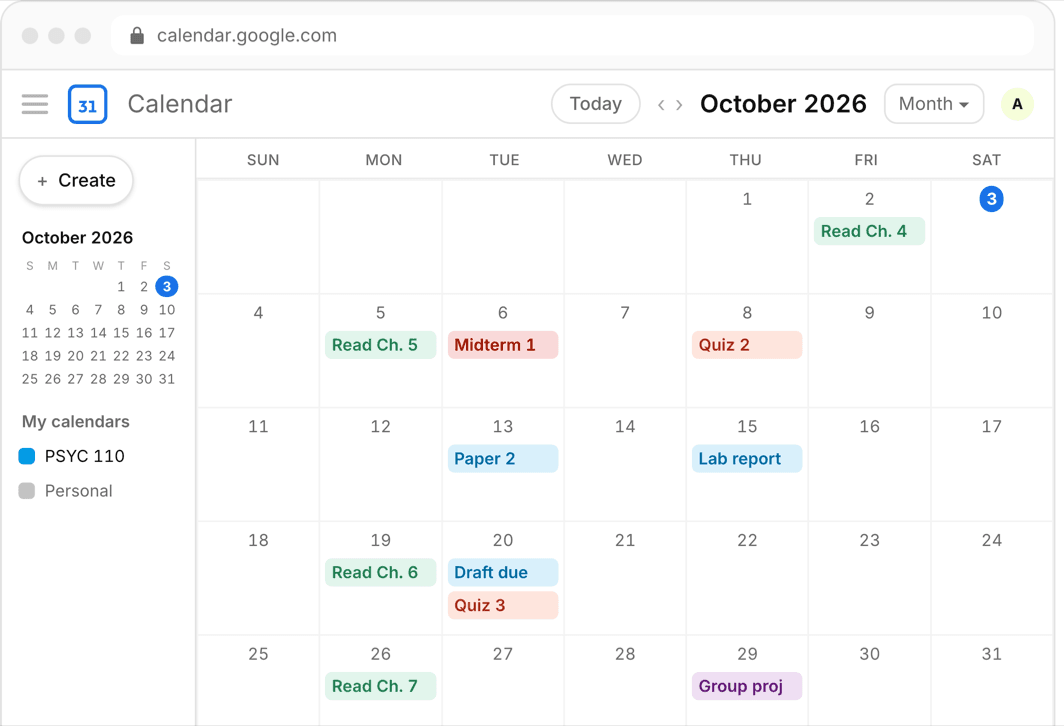
Then extract the part you’ll need weekly: every date. Deadlines live scattered across schedule tables, assignment descriptions, and policy paragraphs — Classmaite pulls all of them out of a syllabus and onto your calendar in about 30 seconds, so the document’s fine print becomes an actual plan.
Frequently asked questions
What does weighted grading mean on a syllabus?
It means your final grade is calculated from category percentages rather than total points. If exams are worth 50% and homework 30%, your exam average is multiplied by 0.5 and homework average by 0.3. A small assignment in a heavy category can outweigh a big one in a light category.
Is a curve good or bad for my grade?
Usually good, occasionally neutral. Most curves shift grades upward when exams run hard. The rarer competitive curve — fitting grades to a distribution — can cap how many As exist. Ask your professor which model they use; the syllabus often doesn’t specify.
What counts as participation in a college class?
It depends entirely on the professor: speaking in discussion, online posts, in-class polls, attendance, or group work. Because it’s often 10–20% of your grade, it’s worth asking in week one exactly how it’s measured rather than discovering the answer at midterm.
Do professors have to follow the syllabus?
Broadly yes — it functions as the course contract, and major unannounced changes (like shifting grade weights mid-term) can be appealed. But schedules marked “tentative” can and do shift, and announced changes in class or by email generally override the printed version.