College Terms Glossary: The 25 Words Freshmen Actually Need
Quick answer
The college terms freshmen most need to know: registrar (records and registration office), bursar (billing office), FAFSA (federal aid application), credit hour (unit of course load), add/drop (window to change your schedule penalty-free), withdraw (leaving a course after that window, earning a “W”), and dean’s list (semester honor for high GPA).
Drop your syllabus here
Every assignment, exam, and reading on your calendar in about 30 seconds. Free, no account.
PDF, Word, or a photo of a paper one. No syllabus handy? See a sample
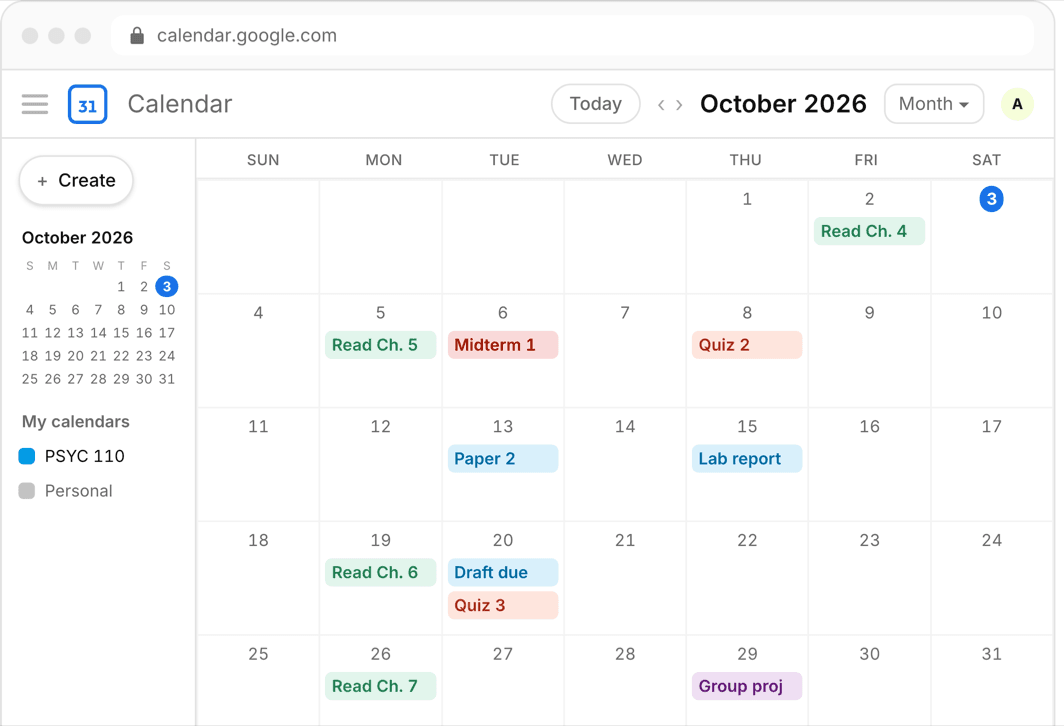
College comes with a vocabulary nobody teaches you. Orientation assumes you know it, emails from the “bursar” assume you know it, and asking feels embarrassing by October. It’s not — every freshman is quietly googling these words.
Here are the 25 terms that actually show up in your first year, grouped by where you’ll encounter them, defined in one or two plain sentences each.
Or skip all of it
Upload the syllabus. Get the calendar.
Every assignment and exam on Google, Apple, or Outlook in about 30 seconds. One syllabus free, no account, no card.
Offices and people
- Registrar — the office that owns official student records: registration, transcripts, enrollment verification, and grade posting. When paperwork needs to be official, it goes through here.
- Bursar — the billing office. Tuition bills, payment plans, refunds, and the dreaded “bursar hold” that blocks registration until you pay.
- Academic advisor — the staff or faculty member who helps you plan courses and stay on track to graduate. Meet yours every semester, not just when required.
- Dean — a senior administrator who leads a college or school within the university (Dean of Engineering) or a student-life function (Dean of Students).
- Provost — the university’s chief academic officer. You’ll see the name on emails; you’ll probably never need to interact with them.
- TA (teaching assistant) — a graduate student who runs discussion sections, labs, and grading for a course. Often your fastest route to help.
- RA (resident assistant) — the trained student on your dorm floor who handles community, conflicts, and crises.
Money and aid
- FAFSA — the Free Application for Federal Student Aid, the form that determines your federal grants, loans, and work-study. File it every year, as early as possible.
- Grant — aid you don’t repay, usually need-based (like the federal Pell Grant).
- Scholarship — aid you don’t repay, usually merit- or category-based. Stacking small ones adds up.
- Work-study — a federal program funding part-time campus jobs for students with financial need.
- Subsidized vs. unsubsidized loans — subsidized federal loans don’t accrue interest while you’re enrolled; unsubsidized ones start accruing immediately.
- Financial aid package — the combined offer of grants, scholarships, loans, and work-study your school assembles for you each year.
Courses and registration
- Credit hour — the unit measuring course load, roughly one weekly class hour. Most courses are 3 credits; full-time is usually 12+, and graduating in four years typically means averaging 15.
- Prerequisite — a course or requirement you must complete before enrolling in a more advanced course.
- GE / gen eds (general education) — the required breadth courses outside your major: writing, math, sciences, humanities.
- Elective — a course you choose freely, counting toward total credits but not a specific requirement.
- Add/drop period — the first week or two of a term when you can change your schedule with no penalty, no transcript record, and full refund.
- Withdraw (W) — leaving a course after add/drop. You get a “W” on your transcript (GPA-neutral but visible) and usually little or no tuition back.
- Syllabus — the contract for each course: grading breakdown, policies, and every deadline. Read it like it’s legally binding, because functionally it is.
- Office hours — scheduled times when professors and TAs are available to help you. Free tutoring from the person who writes your exams.
Records and standing
- GPA (grade point average) — your grades converted to a 0.0–4.0 scale and averaged, weighted by credit hours.
- Transcript — the official record of every course you’ve taken and the grade you earned.
- Dean’s list — a semester honor for a high GPA (commonly 3.5+). Nice on a résumé for early internships.
- Academic probation — the warning status when your GPA falls below the minimum (usually 2.0). It comes with conditions, not expulsion — but take it seriously.
- Cohort — the group of students who start a program together and move through it on the same timeline. Common in nursing, education, and business programs.
- Matriculation — formally enrolling as a degree-seeking student. Your “matriculation date” is when your degree clock starts.
The terms that cost you if you miss them
If you only internalize three: add/drop (a hard deadline that decides whether leaving a class is free or costly), FAFSA (an annual deadline that decides your aid), and syllabus (the document holding every other deadline you’ll face). College doesn’t send reminders for any of them.
The syllabus part, at least, is automatable — Classmaite reads yours and puts every assignment and exam on your calendar in about 30 seconds, first one free.
Frequently asked questions
What is the difference between the registrar and the bursar?
The registrar handles academic records — registration, transcripts, grades, enrollment verification. The bursar handles money — tuition billing, payments, and refunds. Rule of thumb: records questions go to the registrar, billing questions go to the bursar.
What does a “W” on a transcript mean?
A “W” means you withdrew from a course after the add/drop period. It doesn’t affect your GPA, but it stays on your transcript. One or two are harmless; a pattern of them can raise questions for grad schools and some employers.
How many credit hours is full-time?
At most U.S. colleges, 12 credit hours per semester is the minimum for full-time status, which matters for financial aid, housing, and insurance. But graduating in four years usually requires averaging about 15 credits per semester.