Digital vs Paper Planner in College: An Honest Comparison
Quick answer
Digital planners win on reminders, recurring events, cross-device sync, and capacity — decisive advantages for deadline tracking. Paper wins on memory encoding, focus, and the planning ritual itself. The most durable setup for college is hybrid: deadlines and schedule live in a digital calendar with alerts, while weekly planning happens on paper.
Drop your syllabus here
Every assignment, exam, and reading on your calendar in about 30 seconds. Free, no account.
PDF, Word, or a photo of a paper one. No syllabus handy? See a sample
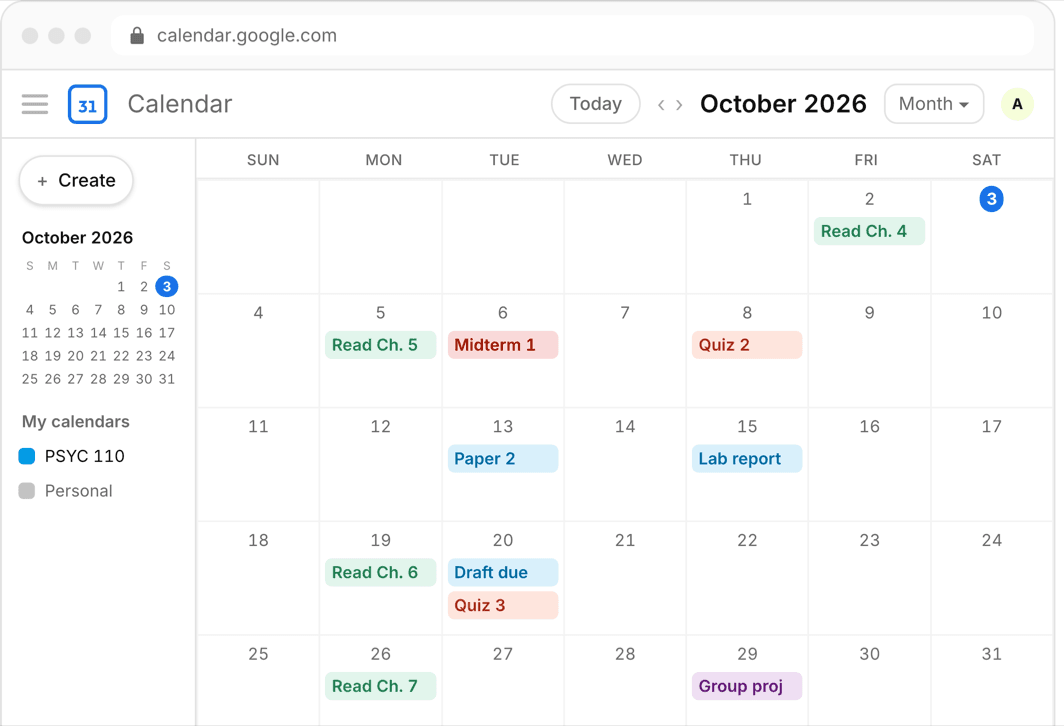
The digital-versus-paper planner debate produces more strong opinions per useful fact than almost any productivity topic. Both sides are right about different things: the paper crowd is right about attention and memory, the digital crowd is right about everything a semester actually throws at you.
Here is the honest version of the comparison, organized around what college specifically demands — and the hybrid setup most long-term planners quietly converge on.
Or skip all of it
Upload the syllabus. Get the calendar.
Every assignment and exam on Google, Apple, or Outlook in about 30 seconds. One syllabus free, no account, no card.
Where paper genuinely wins
Writing by hand encodes memory better than typing — the research on note-taking supports this, and it plausibly extends to writing down deadlines. A paper planner also cannot ping you with a group chat mid-planning session; opening one is a single-purpose act in a way opening your phone never is.
The ritual matters too. A Sunday planning session with a physical week spread produces a kind of engagement with your schedule that dragging events in an app does not. People who love paper planners plan more, and planning more beats any tool choice.
Where digital wins, and why it is decisive for deadlines
- Reminders: a calendar alert fires whether or not you opened the planner — paper only works if you look at it, and the weeks you stop looking are exactly the overwhelmed weeks
- Recurring events: a semester of MWF classes is one entry digitally, forty-five by hand
- Sync and backup: your phone is always with you, and a lost phone does not lose the calendar — a lost planner in November is a genuine disaster
- Capacity: five courses of assignments, readings, and exams plus work shifts overwhelms a paper month grid; a digital calendar absorbs it and lets you filter by course
- Imports: LMS feeds and .ics files can load deadlines automatically; paper has no equivalent of an import
The failure modes of each
Paper fails silently: you stop opening it during a busy stretch, and it quietly stops being true. It also cannot interrupt you, which is precisely what a deadline system must do. Digital fails by distraction — you open the calendar and surface twenty minutes later from something else — and by frictionless over-scheduling that fills a calendar with fantasy blocks.
Notice the asymmetry: paper failure loses deadlines, digital failure loses focus. In college, lost deadlines are the more expensive failure.
The hybrid most students land on
The setup that survives contact with a real semester: hard commitments — every deadline, exam, class meeting, and shift — live in a digital calendar with layered reminders, because that layer must be interrupt-capable and complete. Weekly planning — reviewing the week, choosing priorities, sketching study blocks — happens on paper, because that layer benefits from the focus and encoding paper provides.
The digital layer is the system of record; paper is the thinking surface. If you only build one, build the digital layer — a missed deadline costs more than a mediocre planning session.
Whichever you choose, the loading problem is the same
Both systems start the semester empty, and filling either means the same extraction: every assignment, exam, and reading deadline pulled out of four or five syllabi, 15–30 minutes per course by hand. For the digital layer, this is exactly what Classmaite automates: you drop in the syllabus PDF and it extracts the assignments, exam dates, grading breakdown, and reading schedule, then pushes them to Google Calendar, Apple Calendar, or an .ics file in about thirty seconds.
Paper planner loyalists can then copy the week ahead into the spread by hand — which, given the memory-encoding benefits, is arguably the best of both.
Frequently asked questions
Is a paper planner or digital planner better for college?
Digital is better for deadline tracking because of reminders, sync, and recurring events. Paper is better for focused weekly planning and memory. The most reliable setup uses a digital calendar as the system of record and paper for planning sessions.
Do paper planners actually improve memory?
Handwriting generally encodes information better than typing, so writing deadlines down likely helps you remember them. But memory is a backup, not a system — the deadline should still live somewhere that can send an alert.
What is a hybrid planning system?
Deadlines, classes, and exams live in a digital calendar with notifications, while weekly review and prioritization happen on paper. Digital handles remembering; paper handles thinking.