How to Turn a Syllabus Into a Notion Assignment Tracker
Quick answer
To track a syllabus in Notion, create one database with a row per assignment and properties for course, type, due date, grade weight, and status, then view it as a calendar or grouped board. The data entry itself is manual — expect 15–30 minutes per syllabus — and Notion reminders are weaker than a real calendar, so most students pair it with one.
Drop your syllabus here
Every assignment, exam, and reading on your calendar in about 30 seconds. Free, no account.
PDF, Word, or a photo of a paper one. No syllabus handy? See a sample
Notion is where a lot of students already keep notes, and a well-built assignment database is genuinely one of the best academic uses of it: every deadline, weight, and status in one sortable table with a calendar view.
It is also easy to spend syllabus week building a beautiful dashboard instead of doing the reading. This guide covers the minimal setup that works, the template-versus-build decision, and an honest take on when Notion is the wrong tool for the job.
Or skip all of it
Upload the syllabus. Get the calendar.
Every assignment and exam on Google, Apple, or Outlook in about 30 seconds. One syllabus free, no account, no card.
Build one database, not one per course
The mistake most students make is a separate tracker per course. Build a single Assignments database instead, with a property for the course — one place to answer the only question that matters on a Tuesday night: what is due next, across everything.
- Name — the assignment title, prefixed however you like
- Course — a select property with one option per class
- Due date — a date property, which powers the calendar view
- Type — select: exam, paper, problem set, quiz, reading
- Weight — a number property for the percent of your grade
- Status — select: not started, in progress, done
Add the two views that earn their keep
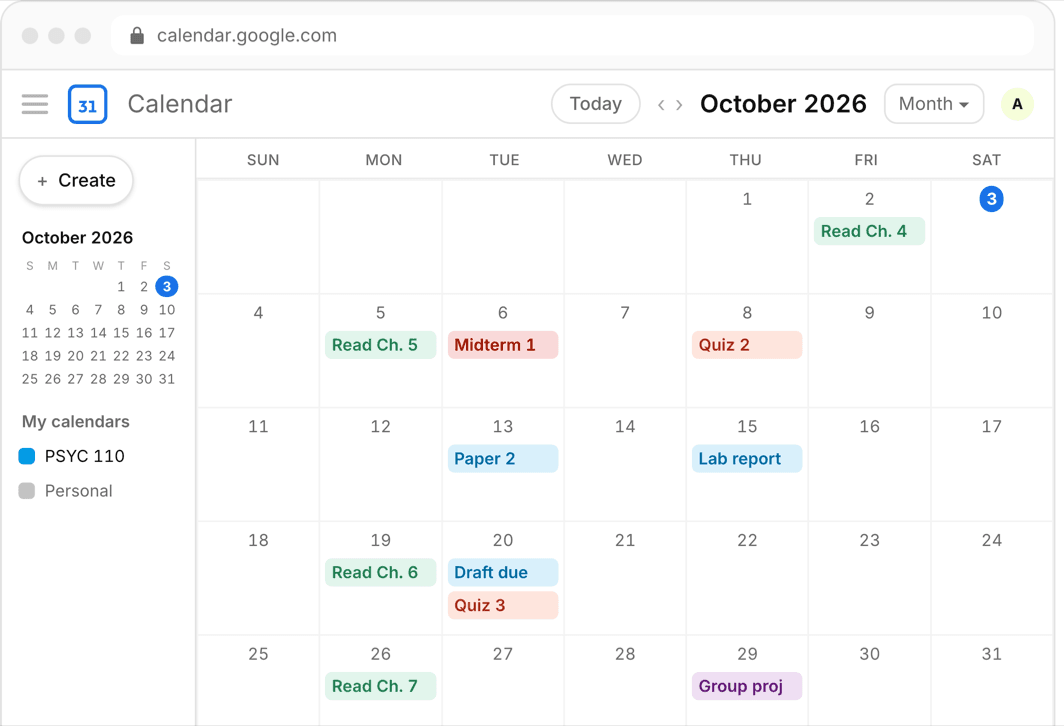
With properties in place, add a calendar view keyed on the due date to see the semester spatially, and a board or table view grouped by course or status for working sessions. Sort the table by due date and you have a permanent what-is-next list.
The Weight property is the sleeper feature: sort by it descending and you get a priority list no to-do app gives you — the 30% paper floats above the 2% quiz regardless of which is due sooner.
The unavoidable step: getting the data in
Notion cannot read your syllabus. Every row — every assignment, exam, and reading with its date and weight — gets typed in by hand from the PDF. Budget 15–30 minutes per course, and be precise on dates: a wrong due date in a system you trust is worse than no system.
Do the entry in one pass during syllabus week for all courses. Half-populated trackers are the ones that get abandoned by week four.
Template or build your own?
Free student templates are everywhere and most are fine. A template saves the hour of setup; the cost is complexity you did not choose — many ship with mood trackers, GPA calculators, and habit sections you will never open, and every unused section adds friction.
A reasonable rule: if the database above sounds like something you can build in twenty minutes, build it — you will understand and trust it. If not, grab a minimal template and delete everything that is not assignments.
When Notion is overkill
Be honest about what you need. Notion reminders are page-level notifications, not the layered, insistent alerts a calendar app fires on your phone — and deadlines you have to remember to look up are deadlines you will eventually miss. If you were not already living in Notion, an assignment tracker alone rarely keeps people there.
The setup that works long-term for most students: deadlines and reminders live in a real calendar, and Notion — if you use it — is the workspace layer on top. This is exactly what Classmaite automates for the calendar half: you drop in the syllabus PDF and it extracts the assignments, exam dates, grading breakdown, and reading schedule, then pushes them to Google Calendar, Apple Calendar, or an .ics file in about thirty seconds.
Frequently asked questions
Can Notion import a syllabus automatically?
No. Notion has no built-in syllabus parsing — you either type each assignment into the database by hand or generate the structured data with an outside tool and bring it in.
Is Notion better than Google Calendar for assignments?
They solve different problems. Notion is better for tracking status, notes, and grade weights; Google Calendar is far better at reminders and at being checked daily. Many students keep deadlines in the calendar and use Notion for the work itself.
What properties should a Notion assignment database have?
At minimum: name, course, due date, type, grade weight, and status. Due date powers the calendar view and weight lets you sort by grade impact — the two views that make the database worth maintaining.